Post: What Is AI HR Automation? The Definitive Guide for Modern Recruiting
AI HR automation is the integration of artificial intelligence and rule-based workflow automation into human resources and recruiting operations. It runs on two distinct layers: deterministic automation that executes repeatable tasks without human input, and AI that handles judgment-intensive work like candidate ranking, spend anomaly detection, and worker classification risk analysis.
Definition: What AI HR Automation Actually Means
AI HR automation uses software-driven logic and machine learning to eliminate manual effort from human resources workflows — from candidate sourcing and interview scheduling through onboarding, compliance tracking, and workforce analytics.
The term gets used loosely to mean “any technology that helps HR work faster.” That imprecision creates expensive implementation mistakes. A precise definition separates two components:
- Workflow automation — deterministic, rule-based execution. If a candidate completes an application, trigger a screening email. If a contractor’s compliance document expires in 14 days, send a renewal reminder. No learning required. No ambiguity tolerated.
- AI in HR — probabilistic, pattern-based analysis. Rank 400 resumes by predicted success likelihood. Flag a contractor engagement as a potential misclassification risk. Identify spend anomalies in the contingent labor budget. Learning required. Ambiguity is the point.
Both are necessary. Neither replaces the other. The sequence matters: automation creates the clean, consistent data environment that AI requires to produce reliable outputs. Organizations that deploy AI before establishing automation foundations routinely find their models are trained on inconsistent records, duplicate entries, and incomplete fields — producing recommendations that HR professionals quickly learn to distrust.
How AI HR Automation Works
AI HR automation operates through a stack of connected systems, each handling a distinct layer of HR operations. Understanding the architecture prevents the most common implementation mistake: buying an AI tool and discovering it has nothing reliable to learn from.
Layer 1 — The Systems of Record
The foundation is your applicant tracking system (ATS) and HRIS or HCM platform. These store candidate records, employee data, contractor profiles, and compliance documentation. Every automation and AI output depends on data quality at this layer. Garbage in, garbage out is not a cliché — it is the primary reason HR AI pilots fail.
Layer 2 — The Automation Layer
A workflow automation platform sits between your systems of record and every downstream trigger. It watches for defined events — a new application submitted, a hire status changed, a contract expiration date reached — and executes the corresponding action: send a document, update a field, create a task, notify a manager, route a form for signature. No human in the loop. No manual copy-paste. This layer reclaims the productive hours knowledge workers lose annually to manual data entry, routing, and re-keying work between disconnected systems.
Layer 3 — The AI Layer
With clean, consistently structured data flowing through Layer 2, AI modules do their actual job: pattern recognition and prediction. Candidate ranking models learn which profile characteristics correlate with successful hires in your specific roles. Classification risk engines analyze contractor engagement data against IRS and DOL criteria to surface misclassification exposure before it becomes a legal event. Spend analytics models detect budget anomalies in contingent labor programs that no human reviewing a spreadsheet would catch at scale.
Layer 4 — The HR Professional
AI HR automation does not remove HR professionals from the process. It removes the processing. Automation reclaims time lost to status updates, document chasing, and manual data entry. AI surfaces the decisions that require human judgment. HR professionals then apply that judgment without the noise.
Expert Take
The firms that fail at HR automation almost always sequence it backwards — they buy AI first and discover there is no clean data underneath it. The automation layer is not optional infrastructure; it is the prerequisite. Every dollar spent on AI without a functioning automation layer is a dollar spent on a tool that has nothing reliable to learn from.
Why AI HR Automation Matters Now
Three forces are converging to make AI HR automation a competitive necessity rather than an operational nice-to-have.
Contingent Workforce Growth Is Outpacing Manual Process Capacity
The contingent workforce — contractors, freelancers, gig workers, and temporary staff — represents a growing share of total workforce headcount across industries. Each contingent engagement requires intake, classification, documentation, onboarding, compliance tracking, and offboarding. Done manually, this is a volume problem that scales linearly with headcount. Done with automation, marginal cost per additional contractor approaches zero. See our guide to HR tech tools for workforce management for the specific platforms that support this architecture.
Misclassification Risk Has Never Been Higher
Regulatory scrutiny of worker classification has intensified at federal and state levels. The cost of misclassification — back taxes, penalties, benefits liability, and litigation — is severe. The deeper problem is documentation: most organizations cannot reconstruct what classification process they followed for a specific worker engagement from two years ago, because the process lived in emails and spreadsheets. Automation solves this by creating a timestamped, auditable record of every classification decision and its supporting rationale.
HR Administrative Burden Is a Retention and Capacity Problem
HR burnout and strategic capacity constraints rank among the top concerns of CHROs. The root cause is not workload per se — it is the ratio of administrative processing to strategic work. When a skilled HR Director spends 12 hours per week on interview scheduling coordination, that is 12 hours unavailable for workforce planning, talent strategy, and leadership development. Automation eliminates that ratio problem. It does not reduce headcount; it reallocates it.
Key Components of AI HR Automation
The following components represent the primary building blocks of a functional AI HR automation program, ordered by implementation priority.
1. Automated Candidate Sourcing and Initial Screening
AI-assisted sourcing tools move beyond keyword matching to analyze skills adjacencies, career trajectory patterns, and profile signals that correlate with role success. Automation handles the downstream execution: triggering outreach sequences, scheduling initial screening calls, sending status communications, and logging all activity back to the ATS. This is the entry point for AI in talent acquisition and the area with the fastest initial ROI for high-volume recruiting programs.
2. Interview Scheduling Automation
Interview scheduling is the single most time-intensive administrative task in most recruiting operations, consuming hours of back-and-forth coordination per candidate. Automation eliminates this entirely by connecting calendar availability, candidate preferences, and hiring manager schedules into a self-service scheduling flow. The HR professional’s role reduces to reviewing a confirmed calendar, not managing it.
3. Onboarding and Offboarding Workflow Automation
Onboarding is a multi-step, multi-system process: document collection, IT provisioning, systems access, benefits enrollment, compliance acknowledgments, and training assignments. Automation chains these steps together, triggered by a single status change in the HRIS — routing forms for e-signature, sending reminders for incomplete items, and confirming completion back to HR. Our guide to building a future-proof AI-driven onboarding strategy covers implementation specifics.
4. Compliance Documentation and Audit Trail Automation
Every contractor engagement must be documented: classification rationale, contract terms, scope boundaries, and renewal or termination events. Automation captures and timestamps each of these touchpoints, stores them in a retrievable format, and flags approaching expiration dates or scope anomalies. This is the foundation of defensible compliance — and the component most organizations are missing when they face their first misclassification audit.
5. Payroll and HRIS Data Handoff Automation
Manual data transcription between ATS, HRIS, and payroll systems is a high-risk, low-value task. A single transcription error — a compensation figure entered incorrectly, a start date misrecorded — can cascade into payroll processing errors, compliance violations, and employee relations incidents. Automating these handoffs eliminates the transcription step entirely: data flows from system to system through defined field mappings, with validation rules that catch anomalies before they reach payroll.
6. Workforce Analytics and Anomaly Detection
At the AI layer, workforce analytics tools monitor contractor spend, engagement duration, scope patterns, and classification indicators across the full contingent population. They surface exceptions — contractors whose engagement patterns are drifting toward employee-like characteristics, spend anomalies by department or project, time-to-fill trends that indicate sourcing channel problems — so HR and procurement can act before issues escalate. This is where AI delivers its highest strategic value: not replacing HR judgment, but ensuring that judgment is applied to the right situations.
Related Terms
Understanding AI HR automation requires familiarity with several adjacent concepts that are frequently conflated or misused:
- Robotic Process Automation (RPA) — software bots that mimic human actions in existing systems (clicking, copying, pasting) without system integration. Useful for legacy system workarounds; less scalable than native automation integrations.
- HRIS (Human Resource Information System) — the system of record for employee and contractor data. The anchor point for all HR automation flows.
- ATS (Applicant Tracking System) — the system of record for candidate data, job requisitions, and recruiting workflows. The source system for most recruiting automation.
- Worker Classification — the legal determination of employment status (employee vs. independent contractor) under IRS, DOL, and applicable state criteria. The highest-stakes compliance decision in contingent workforce management.
- Vendor Management System (VMS) — a platform that manages contractor procurement, onboarding, compliance, and spend across an organization’s contingent workforce. Often the target system for automation integrations in enterprise programs.
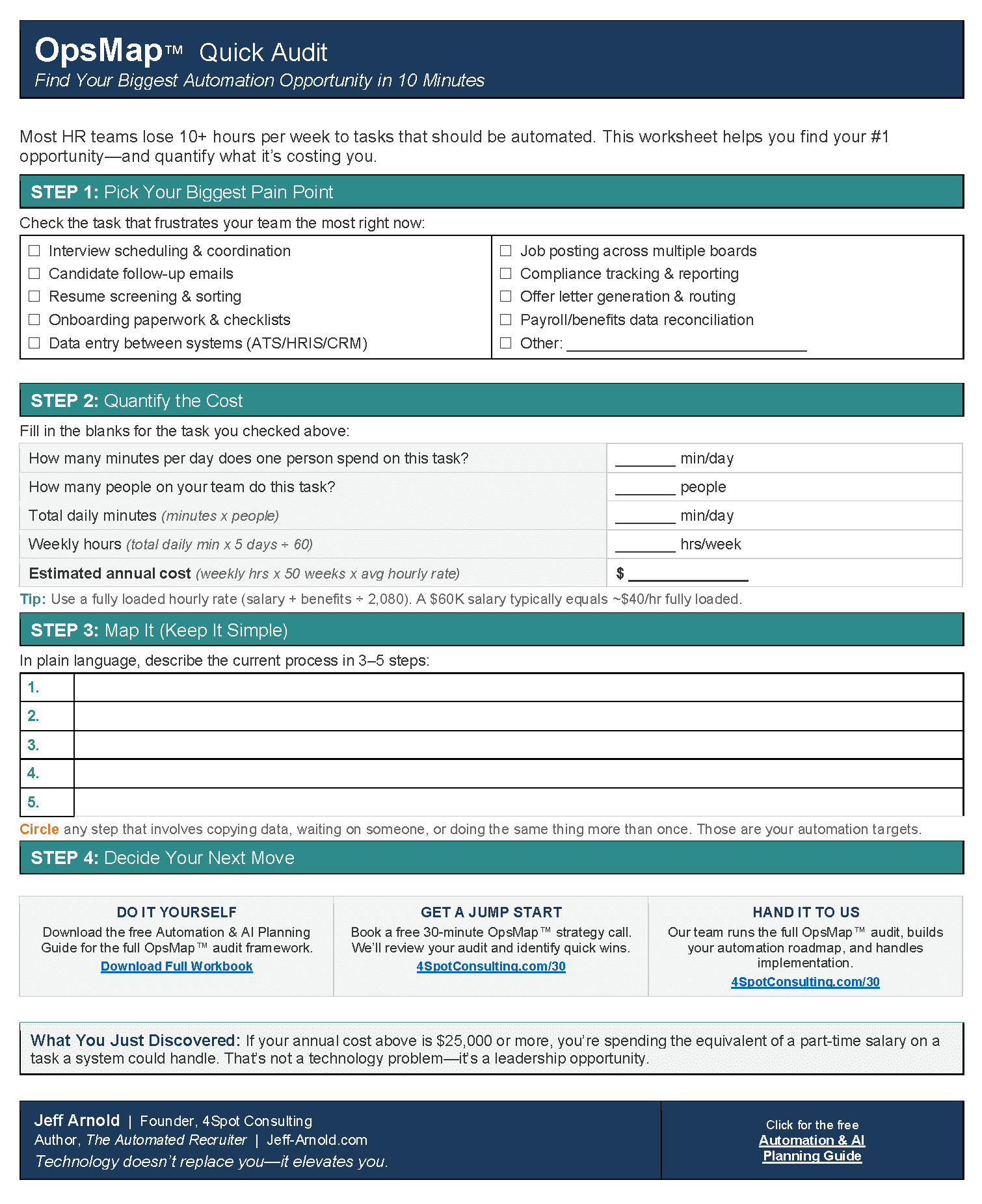
- OpsMap™ — 4Spot Consulting’s structured process mapping methodology for identifying, prioritizing, and sequencing automation opportunities in HR and business operations before any platform is selected or built.
Common Misconceptions About AI HR Automation
Misconception 1: “AI HR automation is only for large enterprises.”
Mid-market firms and growing recruiting agencies see faster ROI than enterprises because their processes are less entrenched and their HR teams are more acutely time-constrained. A 12-recruiter firm processing hundreds of contractor engagements monthly has exactly the volume profile where automation pays back rapidly — and every hour reclaimed is material to a small team.
Misconception 2: “We need to fix our data before we can automate.”
This is the most common stall tactic in HR technology implementation — and it is backwards. Automation improves data quality by enforcing consistent field completion, eliminating manual transcription errors, and creating structured records where none existed. You do not need perfect data to start automating; you need automation to stop making your data worse.
Misconception 3: “AI will make hiring decisions for us.”
AI in HR is a decision-support tool, not a decision-making tool. It surfaces information, ranks options, and flags risks — but hiring decisions, classification determinations, and workforce strategy choices remain human judgments. Organizations that treat AI outputs as recommendations rather than directives achieve better outcomes and face lower bias-related legal exposure.
Misconception 4: “Automation will dehumanize the candidate experience.”
The opposite is true when implemented correctly. Candidates who receive immediate confirmation emails, self-service scheduling links, and timely status updates report better experiences than those left waiting in manual process queues. The human interaction candidates value — substantive recruiter conversations, feedback on fit, authentic engagement — is precisely what automation enables by removing scheduling and administrative overhead from recruiters’ plates.
Misconception 5: “We can automate HR without changing our processes first.”
Automating a broken process produces broken outputs faster. The OpsMap™ methodology exists to prevent this: map current-state workflows, identify failure points and redundancies, redesign the process, then automate the redesigned version. Process discipline precedes technology selection every time.
Measuring AI HR Automation Effectiveness
ROI from AI HR automation is measurable through leading indicators that move before revenue or cost-of-hire metrics shift. The metrics that matter most:
- Administrative hours reclaimed per HR FTE per week — the most direct measure of automation impact on capacity.
- Time-to-fill reduction — automation accelerates scheduling, screening, and document collection; this metric reflects that acceleration.
- Onboarding document completion rate and time-to-complete — a direct indicator of onboarding automation effectiveness.
- Contractor compliance documentation completion rate — the key metric for misclassification risk reduction.
- Payroll error rate — measures the impact of automated ATS-to-HRIS data handoffs.
- Misclassification incidents — the ultimate outcome metric for classification automation programs.
For a full framework of metrics across HR automation programs, see our guide to essential metrics for AI talent acquisition ROI.
Where to Go From Here
AI HR automation is not a single tool purchase or a one-time implementation project. It is an operational discipline — a commitment to systematically removing manual effort from HR processes so that the people doing HR work can apply their judgment where it matters. The sequence is non-negotiable: build the automation foundation, then add AI at the judgment points. Skip that sequence and you will spend budget on AI that has nothing reliable to learn from.
For the full strategy on how automation and AI work together across the talent acquisition lifecycle, see our guide to transforming HR into a strategic powerhouse with AI automation. For the component-level implementation path, our breakdown of AI applications for HR recruiting ROI covers the specific use cases in depth.
The organizations building durable competitive advantage in workforce management are not the ones with the most sophisticated AI. They are the ones who automated the right things first — and then let AI do what AI is actually good at.


RELATED POST