Post: 5 Steps to: Automation First, Then AI
Before layering AI onto your business, you need working automation underneath it. Automation First, Then AI follows five steps: map your processes, fix what’s broken, build reliable automated workflows, add AI where it creates real leverage, then measure before scaling. Skip a step and AI amplifies your existing problems instead of eliminating them.
This sequence is not optional. Companies that bolt AI onto manual, chaotic processes report worse outcomes than those that automate first. The reason is simple: AI is a multiplier. If the process underneath is broken, you get faster broken results at higher cost.
Here are the five steps, in order, with the work each one actually requires.
Step 1: Map Every Process Before You Touch a Tool
Process mapping is the foundation – without it, you automate the wrong things and your AI training data reflects broken workflows from day one.
Start by listing every repeating task your team executes. Not the ones you think they do – the ones they actually do. Pull from your CRM activity logs, your project management tools, and direct conversations with the people doing the work. You need a complete picture of inputs, outputs, handoffs, and decision points before a single automation gets built.
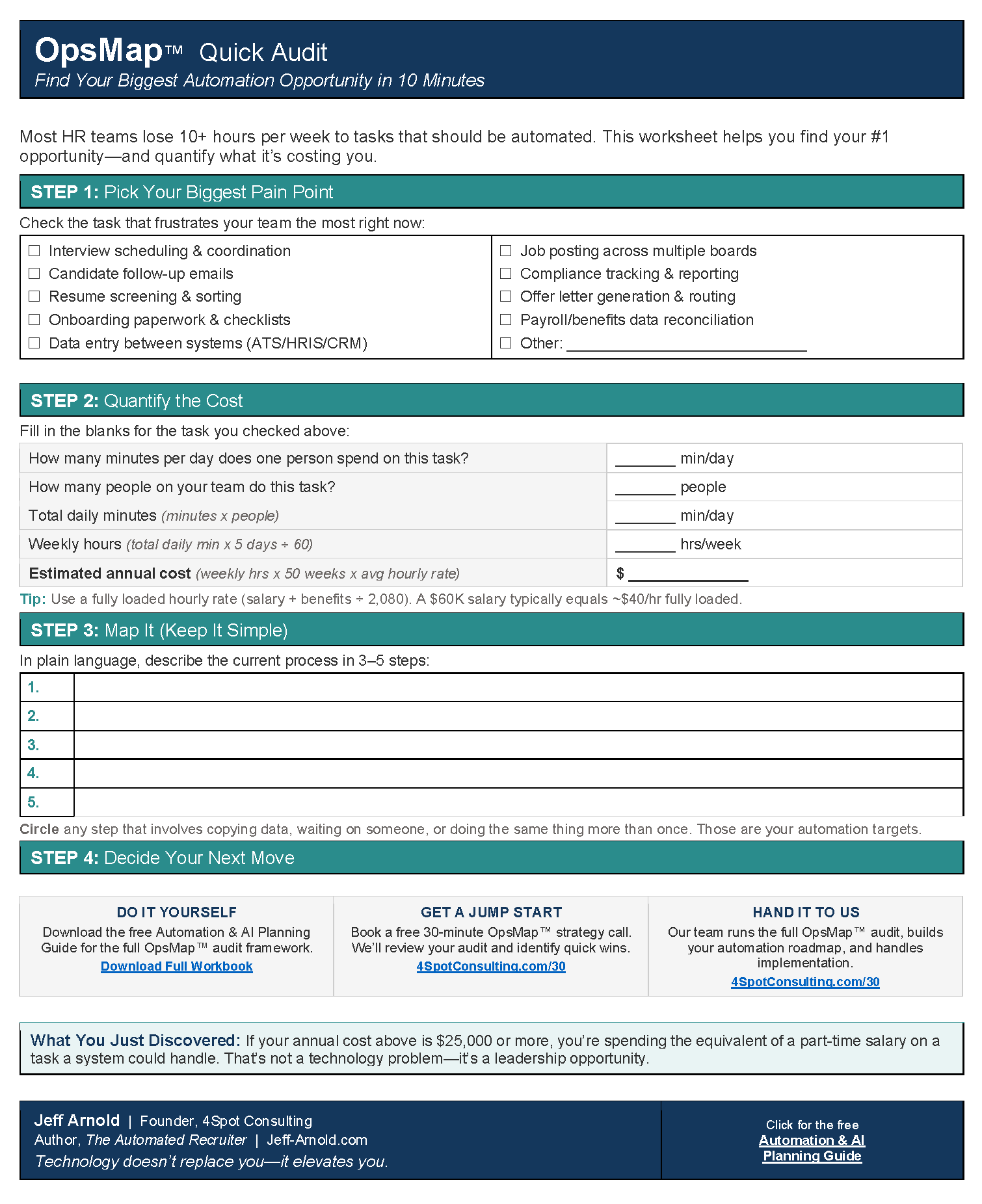
The OpsMap™ framework 4Spot uses in discovery engagements breaks this into three layers: the trigger (what starts the process), the steps (every action taken from start to finish), and the outcome (what the process is supposed to produce). When you map all three layers, bottlenecks become visible and automation opportunities become obvious.
Most companies skip this step. They jump to tools, buy software, and start connecting things – then wonder why the automation keeps breaking. The map is not a nice-to-have. It is the plan.
Expert Take
The biggest mistake we see in early AI projects is that teams spend months selecting an AI tool before they spend a week mapping their processes. You end up with an expensive tool trained on bad data, producing fast-moving garbage. Map first. Every time.
Related: 10 Real Examples of Why Clean Processes Must Come Before Any HR Automation
Step 2: Fix Broken Workflows Before You Automate Them
Automation locks in whatever process exists underneath it – so if the workflow is broken before you build the automation, you now have a broken process running faster and with less human visibility.
After mapping, you will find workflows with missing steps, overlapping responsibilities, and handoffs that only work because one person is manually watching for them. Those need to be fixed before a line of automation logic is written.
The fix work is not glamorous. It is updating SOPs, reassigning ownership, cutting steps that add no value, and confirming that the people doing the work actually agree on what the process is supposed to produce. This is the step most businesses skip because it feels slow. It is also the step that determines whether the automation you build in Step 3 actually holds.
Use the OpsSprint™ model to timebox this work. Set a two-week window, assign a single owner per process, and define a clear done-criteria before you start. Without a fixed endpoint, process cleanup expands indefinitely.
Expert Take
We ran an engagement where a client wanted to automate their candidate follow-up workflow. We mapped it first and found three different people believed they owned the same handoff step. None of them were wrong – the process was genuinely undefined. Automating that without fixing the ownership would have sent duplicate follow-ups to every candidate. Fix the workflow. Then build the automation.
See also: 10 Signs You Need to Fix Processes Before HR Automation
Step 3: Build Automation That Runs Without You
The standard for any automation you build is this: it runs correctly while you are asleep, and when it fails, it tells you why before the error compounds into something larger.
Build on Make.com – not because it is the only option but because it is the right one for businesses without a developer on staff. Its visual scenario builder shows you exactly what is running, error handling is built into the interface, and the operations cost per task is a fraction of competitors like Zapier.
Every automation built at 4Spot under the OpsBuild™ framework includes three non-negotiables: a clear trigger that fires without manual intervention, error routing that alerts the right person when something breaks, and a log that creates a retrievable record of what happened and when. Without those three elements, the automation is a liability, not an asset.
Start with the highest-frequency, lowest-complexity tasks first. Data entry handoffs between systems. Confirmation emails triggered by form submissions. Status updates that currently require a human to go check something and type the result somewhere else. Get those running cleanly before you move to anything more complex.
Expert Take
Teams new to automation always want to start with the most impressive use case. Start with the boring one. A contact sync that runs 200 times a day with zero failures is worth more than a complex AI workflow that impresses in a demo but falls apart in production. Boring automation that works is the foundation AI runs on.
Further reading: 10 Automations Finally Easy to Build: Make + AI, No Developer
Step 4: Layer AI Only Where Automation Already Works
AI belongs in your stack at the point where a stable automated workflow needs a judgment call that rules alone cannot make reliably.
That means AI comes after Step 3 – not alongside it and not before it. Once you have automation running clean and generating consistent data, you can identify the decision points where AI adds real value: classifying inbound leads, scoring candidates against a job profile, drafting a first-pass follow-up email based on prior conversation context, or flagging anomalies in your data that a rule-based filter would miss.
The OpsMesh™ framework treats AI as one layer in a connected stack, not the center of it. Automation handles the deterministic work – the stuff where the right answer is always the same. AI handles the probabilistic work – where context, nuance, or pattern recognition changes the answer. Keep them separated by function and your system stays debuggable when something goes wrong.
When you add AI to a stable automated workflow, the error surface shrinks dramatically because you know exactly what the AI is receiving as input. Every Make.com scenario that feeds data to an AI model should be logging that input. When the AI output is wrong, you need to trace back to the input in seconds, not hours.
Expert Take
The companies getting real ROI from AI right now are not the ones who adopted it fastest. They are the ones who automated the most before they started. The AI layer sits on top of clean, structured data coming out of reliable automation – and it shows in every metric. Automation first is not a philosophy. It is a prerequisite.
Related: 10 Real Examples of Automation First, Then AI | 12 Stats That Explain Automation First, Then AI
Step 5: Measure, Tighten, Then Scale
You scale what works – not what feels impressive or what a vendor demo made look easy.
Before you expand any automation or AI layer to additional teams, processes, or use cases, you need a measurement baseline from the existing implementation. What is the error rate? What is the manual intervention rate – how often does a human have to step in and fix something the automation or AI got wrong? What is the cycle time for the process, end to end, compared to before you built anything?
The OpsCare™ model builds this measurement in from day one. You are not just building automation – you are building a system that produces data about its own performance. That data tells you whether to tighten the existing implementation before scaling or whether you are ready to move to the next process on your OpsMap™.
Scale decisions are data decisions. If the error rate on your current automation is above your acceptable threshold, you fix that before you build the next automation. If your AI layer is producing low-confidence outputs too frequently, you retrain the model or tighten the input data before expanding its scope. Discipline at this step is what separates a stack that compounds over time from one that creates technical debt you can never pay down.
Expert Take
The companies that see the fastest long-term results treat Step 5 as a permanent state, not a final one. Every automation and every AI layer stays in measurement. When something drifts – and it will drift – you catch it early and fix it before it compounds. That is what OpsCare looks like in practice.
See also: 10 Signs You Need Automation First, Then AI
Frequently Asked Questions
What does “Automation First, Then AI” mean in practice?
It means you build reliable, repeatable automated workflows before you add AI to any process. AI requires clean, consistent data to produce reliable outputs. Automation is what creates that clean data stream. The sequence matters because AI layered on a broken or manual process amplifies existing problems instead of solving them.
How long does it take to complete all five steps?
The timeline depends on the scope of what you are mapping and the complexity of the processes you are fixing. A focused engagement on one or two core workflows runs four to eight weeks from process map through initial automation deployment. Adding AI layers on top of stable automation is a separate phase that begins after the automation baseline is established and running clean.
Can small businesses follow this framework?
Small businesses benefit more from this sequence than enterprise teams in many ways. With a smaller team, every broken automation costs proportionally more in manual recovery time. Getting the foundation right before adding AI means you are compounding efficiency, not compounding errors. The tools required – Make.com for automation, common AI APIs for the intelligence layer – are accessible at any scale.
Is Make.com required for this approach?
Make.com is the platform 4Spot builds on because it provides the transparency, error handling, and integration breadth that this approach requires. The principles in this framework apply regardless of your automation platform – but the platform choice affects how cleanly you can execute Steps 3 through 5. Visual scenario building and granular execution logs are non-negotiable features for any platform running this approach.
What is the most common mistake companies make when adding AI before automating?
The most common mistake is using AI to generate outputs from unstructured, manually-entered data. When data entry is inconsistent – different people formatting the same field differently, missing values, duplicate records – the AI produces inconsistent outputs that require manual review to catch. Automation standardizes the data before it reaches the AI layer, which is what makes AI outputs reliable enough to act on without constant spot-checking.
Part of our complete guide: Automation First, Then AI: Why Order Is the Whole Game.