Post: 12 Stats That Explain: Automation First, Then AI
The data is clear: companies that build automation foundations before deploying AI succeed at dramatically higher rates, reclaim more time, and see faster returns. These 12 statistics explain exactly why sequence matters in any AI transformation – and why skipping process automation to chase AI capabilities is one of the most expensive mistakes a business makes.
The “Automation First, Then AI” principle isn’t a philosophical preference. It’s an operational reality backed by research across industries – and the foundation of the OpsMesh™ approach 4Spot Consulting uses with every client. Whether you’re running a recruiting firm, a professional services operation, or an HR department, the numbers tell the same story. See 10 real examples of this sequence in action.
Why AI Projects Fail Without an Automation Foundation
AI projects fail at alarming rates, and the root cause isn’t the technology – it’s the absence of clean, structured processes feeding the models.
Stat 1: 85 Percent of AI Projects Fail to Deliver Expected Business Outcomes
Gartner has tracked AI project performance for years, and the failure rate consistently sits around 85%. The culprit isn’t a weak model – it’s weak inputs. AI trained on inconsistent, manually entered, or incomplete data generates outputs that reflect those same problems at scale. Automating data collection and routing before AI deployment changes this equation fundamentally.
Stat 2: 80 Percent of an AI Project’s Time Goes to Data Preparation, Not Actual AI Work
IBM and enterprise data science practitioners have documented this consistently: the majority of time in any AI initiative goes toward wrangling data into a usable state before the AI work even begins. Organizations that automate data flows and process outputs first eliminate this bottleneck before it stalls momentum and burns budget.
Stat 3: Only 21 Percent of Organizations Have AI-Ready Data Infrastructure
Gartner research found that fewer than one in four enterprises has the data infrastructure AI requires to function reliably. That gap exists because most organizations still rely on manual inputs, inconsistent formatting, and disconnected systems. Process automation closes that gap systematically – automated workflows produce exactly the kind of structured, consistent, timestamped data records AI needs to perform.
Stat 4: Only 32 Percent of Available Enterprise Data Actually Gets Used
Seagate and IDC research found that roughly two-thirds of enterprise data sits dark – never analyzed, never applied. Automation pipelines activate that dormant data by routing it through structured workflows and making it accessible for analysis. By the time AI enters the picture, the data is already organized, labeled, and ready to work.
Expert Take
The businesses we see struggle most with AI made the same move: they treated AI as a starting point rather than a destination. They pointed a model at their existing chaos and wondered why the outputs were wrong. AI isn’t a data-cleaning tool – it’s an intelligence layer. Your automation stack is the cleaning tool. Get the order right and everything downstream works. Get it backwards and you’re spending your AI budget on janitor work.
The Scope of the Manual Work Problem
Before automation, organizations run on human effort for tasks that machines handle faster and more accurately – and the research shows just how universal this problem is.
Stat 5: 94 Percent of Workers Perform Repetitive, Time-Consuming Tasks Every Day
Zapier’s State of Business Automation report found this across every industry studied. Nearly your entire team has identifiable, automatable work buried in their daily routine. Identifying and eliminating that work is the first phase of any real automation program – and it’s the prerequisite for knowing where AI adds leverage after the foundation is in place.
Stat 6: Workers Spend 26 Percent of Their Time on Tasks Automation Replaces
McKinsey Global Institute found that knowledge workers spend more than a quarter of their working time on data collection, report generation, and information routing – work that automation handles in seconds. That 26% reclaimed at scale represents real capacity that gets redirected toward strategic output, and eventually toward the work AI genuinely accelerates. Why clean processes must come before HR automation – 10 real examples.
Stat 7: 60 Percent of Occupations Have at Least 30 Percent Automatable Activities
McKinsey’s analysis of more than 800 occupations found automation potential across every industry sector. HR, operations, finance, and recruiting all carry significant baseline automation opportunity before AI enters the picture. This isn’t a technology-sector phenomenon – it applies to every business running manual processes for work that a well-configured automation layer handles better, cheaper, and without error.
Stat 8: Automation Reduces Process Error Rates by Up to 90 Percent
Shared Services and Outsourcing Network (SSON) research and multiple enterprise automation studies document error rate reductions of 80 to 90 percent when structured automation replaces manual data entry and routing. AI fed by error-prone manual processes inherits those errors and amplifies them at speed. Automation fed by clean processes doesn’t have that problem – which is the clearest argument for getting the sequence right.
What Happens When You Get the Sequence Right
The organizations that commit to process automation before AI deployment don’t just avoid failure – they see compound returns that wouldn’t be reachable if they’d gone straight to AI.
Stat 9: 73 Percent of Businesses Using Automation Report Significant Cost Savings
Deloitte’s global automation survey found that nearly three in four organizations implementing automation report meaningful cost reductions. The critical detail is in the phrasing: organizations that automate. Not organizations that pilot AI without process work underneath it. The returns belong to the ones who execute the foundation, not the ones who skip it in favor of faster-sounding shortcuts.
Stat 10: Companies With Mature Automation Deploy AI 2.5x Faster
McKinsey Digital research found that automation maturity is one of the strongest predictors of AI deployment speed. When data flows cleanly and processes run on triggers instead of human handoffs, AI has structured tracks to run on. The setup time for each new AI use case shrinks because the infrastructure work is already done. See the 10 signs your organization is ready for this sequence.
Stat 11: 103,000 Labor Hours Saved Annually – After the Process Work Came First
4Spot’s work with Global Talent Solutions produced results at that scale, but the sequence was non-negotiable. Phase one was pure process automation: standardizing workflows, eliminating manual handoffs, and cleaning data inputs. The AI layer came after that foundation was in place. That ordering is what made the outcomes hold at scale rather than degrading under real operational load. Read the full case study.
Stat 12: Organizations That Automate First Report 3x Higher AI Use Case Success Rates
MIT Sloan Management Review research on AI adoption found that companies with process maturity before AI deployment succeed at launching new AI use cases at roughly three times the rate of companies that attempt AI without the operational foundation underneath it. The compounding effect is real and measurable – each successful use case is easier to build than the last because the infrastructure already works and the data is already clean. See the compounding effect in one client’s 105,000-hour outcome.
Expert Take
The question we get most often is: “Can’t we do both at the same time?” In a controlled pilot on a single, well-defined workflow, sometimes yes. As a business-wide strategy, simultaneous automation and AI deployment creates two competing demands on your team’s attention and your systems’ readiness. The organizations that succeed at scale almost always ran the automation phase to completion first, then layered AI in with intention. The ones who tried to run both tracks in parallel usually ended up doing neither well. Sequence isn’t just logistics – it’s strategy.
Frequently Asked Questions
What does “automation first” actually mean in practice?
Automation first means mapping your current workflows, eliminating manual steps and data entry points, and building reliable data pipelines before you layer on any AI. The goal is structured, consistent inputs – not asking AI to make sense of disorganized data. Start with the process, then add intelligence on top of something solid.
How long does the automation phase take before a business is ready for AI?
Most organizations complete core process automation for a defined workflow cluster within 90 to 180 days. That timeline isn’t delay – it’s the setup that makes everything downstream work reliably. Attempting AI before that phase is complete produces results that look promising in demos and fall apart under production conditions.
Can AI tools handle messy data on their own?
Modern AI handles pattern recognition well, but messy input produces confident-but-wrong outputs at scale. Inconsistent data, missing fields, and manual data entry all introduce errors that AI amplifies rather than corrects. Clean processes are the prerequisite for reliable AI, not a nice-to-have you can skip and compensate for later with a better model.
Where does 4Spot start when a client is ready to pursue this sequence?
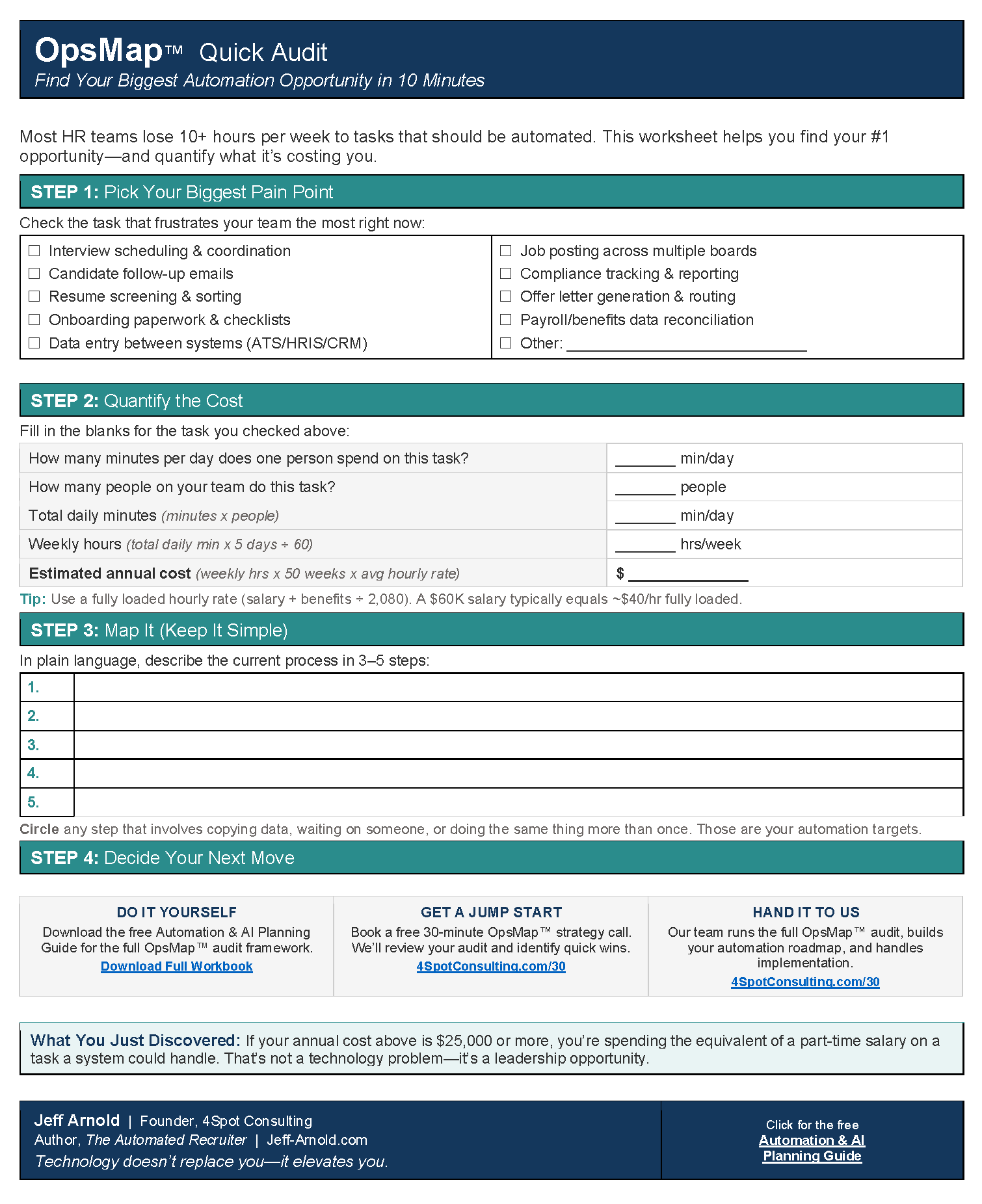
Every engagement begins with an OpsMap™ – a diagnostic process that maps every active workflow and flags exactly where automation opportunities exist before any build begins. That phase identifies what to automate first and the sequence that gets each client to AI-ready fastest, with the proof built in from the start rather than discovered after a failed launch.
The Bottom Line
These 12 statistics point to the same conclusion from 12 different directions: the sequence of automation before AI isn’t a preference, it’s the pattern behind every successful AI implementation at scale. The OpsMesh™ framework exists specifically because that sequence needs a structured path – not just a philosophy. The businesses that get this right build a foundation that compounds over time. The ones that skip it spend their AI budget fixing problems that process automation would have prevented. If you’re planning an AI initiative, the first question isn’t which AI tool to buy – it’s whether your processes are ready to feed it. More on why clean processes must come before automation.
Part of our complete guide: Automation First, Then AI: Why Order Is the Whole Game.