Post: 5 Red Flags in Automation First, Then AI
Automation First, Then AI fails when organizations skip the foundational work that makes AI viable. The five red flags are: dirty data fed into AI models, undocumented manual processes, absent ROI benchmarks, AI layered on broken workflows, and no human review checkpoint. Spot any one of these before you deploy — or pay for it after.
The sequence sounds simple. Build reliable automation. Clean your data. Document your processes. Then add AI on top of a foundation that can actually support it. In practice, most organizations jump straight to the AI layer and wonder why results are inconsistent, expensive, or both. These five red flags tell you when the sequence is already broken — before the damage gets buried under a vendor contract.
Red Flag 1: Your Data Is Dirty and AI Is Eating It Anyway
AI models amplify whatever you feed them — clean inputs produce useful outputs, and dirty inputs produce confidently wrong ones. If your contact records carry duplicate entries, inconsistent field formatting, and gaps in key data points, layering AI on top does not fix the problem. It scales it.
The tell is when AI outputs start surprising the team. Unexpected segmentation results, candidate matches that make no sense, automated sequences firing to the wrong audience — these are data quality problems wearing an AI costume. The fix belongs upstream, in the automation and data hygiene layer, not in prompt engineering or model selection.
Before any AI model touches your operational data, run a structured audit: duplicate rate, field completion rate, date format consistency, and source-of-record clarity. If those numbers are not where they need to be, pause the AI deployment and fix the data pipeline first. That is the Automation First part. It is not optional.
For HR and recruiting operations, this shows up constantly. Candidate records missing status fields, job codes that vary by recruiter, engagement history split across three tools — none of that gets better when you add AI. It gets worse, faster. See 10 Real Examples of Why Clean Processes Must Come Before Any HR Automation for what the cleanup actually looks like in practice.
Expert Take
Data quality is not a pre-project task you check off once. It is an ongoing operational discipline that your automation layer enforces continuously. If your scenarios are not validating and rejecting bad data on ingest, AI treats every garbage record as a legitimate signal — and acts on it with full confidence.
Red Flag 2: Nobody Can Describe the Manual Process Being Replaced
If you cannot describe the exact steps a human takes today, you cannot automate them well — and you definitely cannot hand them to AI. The process documentation gap is one of the most common failure points in any automation project, and it gets worse when AI is involved, because AI needs clear decision rules to operate from.
Ask the team to walk through the process end to end. If the answer is “it depends” more than twice, or if different team members describe it differently, you do not have a process. You have a collection of individual habits. Habits do not automate cleanly.
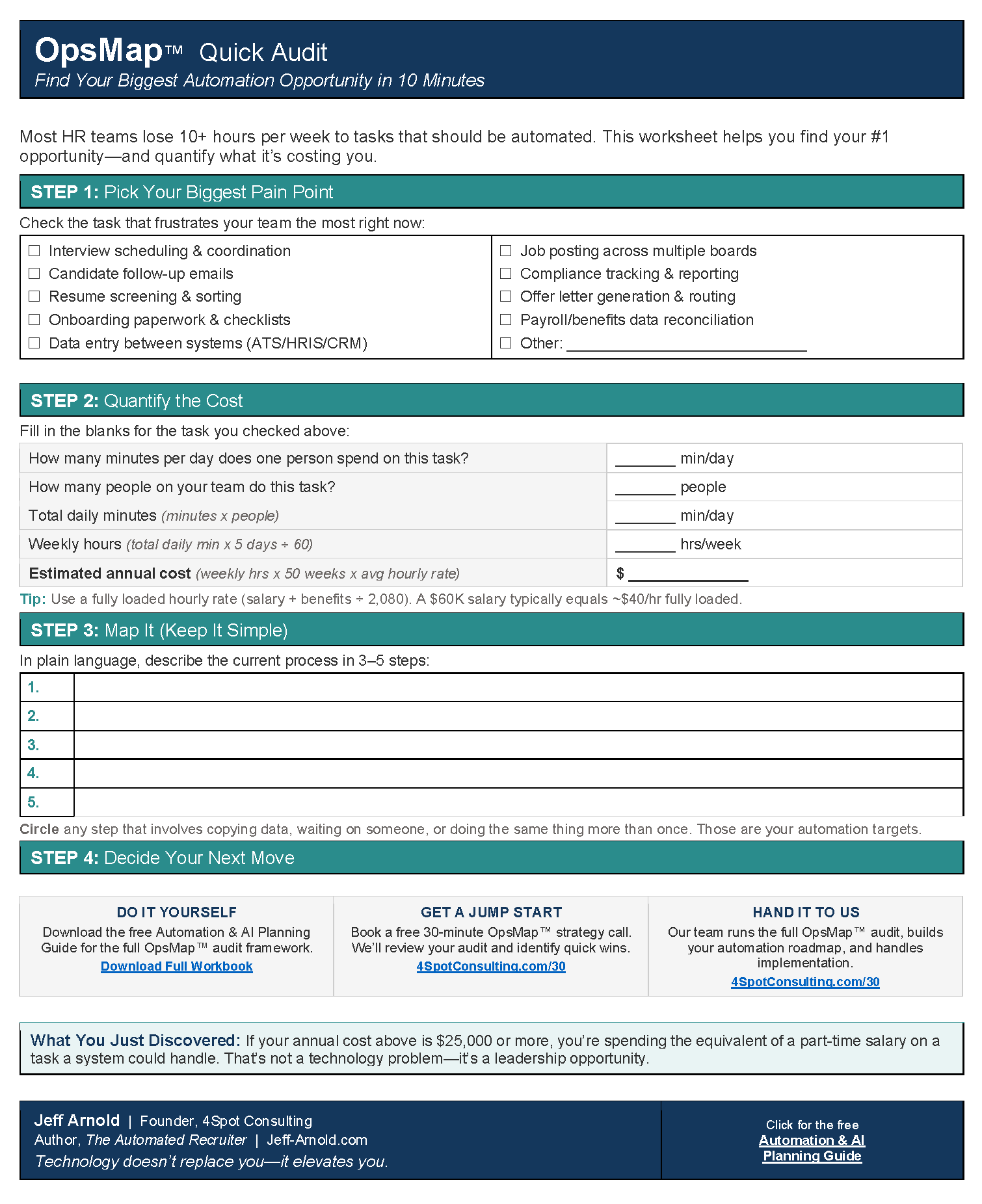
The OpsMesh™ framework addresses this at the OpsMap™ stage: map what actually happens before touching a single tool. That mapping work produces the decision rules, exception paths, and data requirements that make automation reliable and AI defensible. Skipping it is not a time savings. It is a cost that shows up later as rework.
Document the process at the step level — not the category level. “Candidate review” is not a process step. “Recruiter checks five fields in the ATS, compares against the job requisition criteria, and moves the record to the shortlist or sends a rejection template” is a process step. That level of specificity is what automation and AI need to work from.
Red Flag 3: ROI Benchmarks Were Never Set
You cannot measure a win you never defined. If the decision to deploy AI happened without baseline metrics — time per task, error rate, throughput, cost per outcome — there is no way to know whether the AI is working, underperforming, or creating hidden problems that have not surfaced yet.
This red flag is especially common when AI adoption is driven by executive pressure or vendor enthusiasm rather than operational need. The goal becomes “deploy AI” instead of “reduce time-to-fill by X days” or “cut manual data entry by Y hours per week.” Without a specific, measurable target, every result looks like progress.
Set benchmarks before you flip the switch. Pull current numbers — even rough ones — for the process being automated. Cycle time, error count, labor hours, output volume. Then define what success looks like at 90 days. That number becomes the checkpoint that tells you whether to expand, adjust, or stop.
The statistics behind Automation First, Then AI reinforce this consistently: organizations that define ROI targets before deployment outperform those that measure after the fact. The sequence matters as much for measurement as it does for execution.
Expert Take
An AI project without a defined success metric is a science experiment on company time. The benchmark does not need to be perfect before you start. It needs to exist — so that when the 90-day review happens, you have something to measure against instead of a collection of anecdotes and instincts.
Red Flag 4: AI Is Stacked on Top of a Broken Workflow
Broken workflows do not become functional when you automate them — they become consistently, rapidly broken at a scale that is harder to manage than the original manual version. AI makes this worse because failure modes compound and outputs look authoritative even when they are wrong.
The pattern to watch for: a team adopts AI to handle a step that already has a high error rate or high exception volume in the manual version. The assumption is that AI will sort it out. Instead, the AI inherits the ambiguity, makes confident decisions in the gray areas where humans used to apply judgment, and generates outputs the team does not fully trust but cannot easily override.
Fix the workflow first. That means identifying where errors actually originate, closing the process gaps, and getting the manual version running cleanly before handing it to automation or AI. The 10 signs you need Automation First, Then AI covers the diagnostic side — including how to tell whether your workflow is ready or still broken at the foundation.
In practice, the workflow fix often takes longer than the AI deployment itself. That is the right order. A clean workflow with no AI outperforms a broken workflow with AI every time. OpsMesh™ engagements at 4Spot start with the workflow audit for exactly this reason: there is no point building on a cracked foundation.
Red Flag 5: There Is No Human Review Checkpoint
AI outputs require a human gate — especially early in deployment. Removing human review because the AI “seems to be working” is how confident errors propagate through downstream systems before anyone catches them.
The checkpoint does not need to be manual review of every record. It needs to be a structured sampling protocol: review a defined percentage of outputs on a defined cadence, with clear criteria for what passes and what gets flagged. When the error rate drops below a defined threshold and holds there over time, reduce the sampling rate. Do not eliminate it.
The absence of a review checkpoint is a governance failure, not a trust signal. It signals that nobody took ownership of the AI layer’s output quality — which means nobody catches the drift when model performance degrades, data inputs change, or edge cases accumulate. All three of those happen. The question is whether you find out on your own schedule or because a client tells you.
For recruiting and HR operations, this checkpoint is non-negotiable. AI-assisted candidate screening, offer letter generation, and compliance-adjacent workflows carry real consequences for errors. Build the review gate into the OpsSprint™ design before the OpsBuild™ phase starts — not as an afterthought once the system is live. See real-world Automation First, Then AI examples to understand how review gates are structured in production environments.
Expert Take
Human oversight is not a sign that your AI is not ready. It is a sign that you are running a mature operation. The teams that remove the review checkpoint too early are the same ones reporting AI failures six months later. The checkpoint is how you earn the right to reduce it over time — not something you skip to look confident.
Run These as a Pre-Deployment Gate, Not a Post-Mortem
Each of these five red flags maps to a fixable problem — but fixing it after the AI is live costs more than fixing it before. The Automation First, Then AI sequence exists precisely because the preparation work is what makes the AI layer viable. Skip the preparation and you are not moving faster. You are borrowing against future rework.
If you identify more than two of these red flags in a current initiative, stop the AI deployment and go back to the automation layer. Clean the data. Document the process. Set the benchmarks. Repair the workflow. Install the review checkpoint. Then restart the AI phase on a foundation that can support it.
The organizations that get AI right are not the ones with the most sophisticated models. They are the ones that did the automation work first and refused to skip the foundation — and the results show it.
Frequently Asked Questions
What does Automation First, Then AI mean in practice?
It means you build reliable, documented automation before adding AI to any process. The automation layer handles repeatable, rules-based work and produces clean, structured data. The AI layer then operates on that clean foundation — which is what allows it to produce defensible, consistent outputs instead of amplifying the chaos underneath.
Can these red flags be fixed after AI is already deployed?
Yes, but remediation is harder than getting the sequence right upfront. A running AI deployment producing poor outputs requires pausing the system, fixing the underlying issue, reconfiguring the model, and then validating outputs before resuming at scale. The total cost is almost always higher than a pre-deployment fix would have been.
How do we know when the automation layer is ready for AI?
Three conditions need to be true: your data passes a quality audit with defined field completion and consistency thresholds; your processes are documented at the step level with clear decision rules; and your automation runs without significant exception volume or manual intervention. When those three hold, the AI layer has something real to build on.
Is Automation First, Then AI only relevant for large enterprises?
No — the principle applies at any scale. A small HR team running three automated workflows in Make.com and a basic AI screening layer faces the same foundation requirements as a large enterprise. Dirty data, undocumented processes, and missing benchmarks cause the same failure modes regardless of team size. The preparation scales down; the discipline does not.
Part of our complete guide: Automation First, Then AI: Why Order Is the Whole Game.