Post: 8 Reasons to Rethink: Automation First, Then AI
Teams that skip straight to AI without automating first build on sand. Automation forces you to map, clean, and standardize your processes – and that groundwork is exactly what AI needs to deliver real value. Get automation working first, and every AI layer you add afterward multiplies your capacity instead of magnifying existing chaos.
The “AI-first” narrative is loud right now. Vendors are selling intelligence before infrastructure. Leaders are buying tools before fixing workflows. Here are eight concrete reasons why automation belongs in front of AI, and what you actually gain when you sequence it right.
1. AI Accelerates Whatever You Feed It – Including Your Broken Processes
AI doesn’t evaluate your workflow before running it – it executes at scale whatever you point it at. A broken intake process that wastes 20 percent of your team’s time doesn’t get fixed by AI. It gets run faster, at higher volume, producing wrong outputs with more confidence. The chaos multiplies.
Automation catches this first. When you try to automate a broken handoff, the scenario fails immediately – and that failure is your diagnostic. You see the gap, you fix the process, and then you automate the clean version. AI never gives you that feedback loop. It just executes.
This is why teams that rush to AI end up with sophisticated tools producing unreliable results. The tool isn’t the problem. The sequence is.
2. Automation Creates the Clean Data AI Actually Needs
Dirty data going into an AI model produces confidently wrong output, and the model generates no warning flag when something goes sideways. AI is optimized to generate answers, not to catch that your underlying records are inconsistent, incomplete, or out of date.
Automation solves this before AI enters the picture. When you build a well-structured automation, you are forced to define what data flows in, what format it takes, and what happens when a field is missing. That discipline cleans your data as a byproduct. By the time you layer in AI, the model is working from records you can actually trust.
See how this plays out across real deployments in 10 real examples of Automation First, Then AI.
3. Automation Forces the Process Documentation That AI Requires
You cannot automate a process you haven’t documented, and you cannot deploy AI effectively on a process you haven’t structured. Automation is the forcing function for that documentation work – and most teams avoid it until they have no choice.
When a Make.com scenario fails, you debug it step by step. That debugging produces institutional knowledge: who owns which step, what triggers what, where exceptions live. That knowledge doesn’t exist in most organizations before automation forces it into the open. AI needs that map to function. Automation draws it.
You end up with a documented, functioning process architecture that your AI layer can navigate. Without it, you’re asking AI to reason about a system that nobody on your team has ever fully described.
4. Automation Builds Change Management Muscle Before AI Demands More
Every automation win trains your team to trust the system – and that trust is the prerequisite for AI adoption. Change management is the part of every technology implementation that vendors leave out of the demo. It’s the actual work.
Automation gives your team smaller, lower-stakes wins first. A task that used to take 45 minutes now runs overnight without anyone touching it. That experience – real, repeatable, visible – builds the organizational muscle to handle the bigger behavioral shifts that AI requires.
Teams that skip automation and go straight to AI ask their people to trust a black box before they’ve ever trusted a visible workflow. The resistance is predictable. Rollouts stall. Adoption numbers disappoint.
Expert Take
The fastest AI deployments aren’t the ones with the most sophisticated models. They’re the ones where automation was already working. When your data is clean, your processes are documented, and your team has already adapted to workflow changes, AI doesn’t require a transformation project – it becomes a natural extension of infrastructure that already functions. Sequence beats sophistication every time.
5. Automation Exposes Process Debt Before AI Buries It
When you try to automate a broken workflow, it breaks immediately and visibly – and that visibility is a gift. You see exactly where your process carries technical debt: the manual workaround everyone does but nobody wrote down, the step that depends on one person’s memory, the handoff that works 80 percent of the time and fails quietly the other 20.
AI buries that debt. It finds patterns in your broken process, learns to route around the failures, and produces outputs that look plausible until they don’t. By the time you diagnose the problem, you’ve run the broken workflow at scale for months.
Clean processes must come before any automation – the same principle applies at every layer of the stack, and AI is no exception.
6. The ROI Timeline Is Shorter With Automation
Automation delivers measurable results in weeks; AI projects take quarters to prove value, and enterprise AI initiatives extend to years before producing reliable outputs at scale. That timeline difference matters when you’re justifying budget and managing organizational patience.
Automation wins are easy to measure: tasks eliminated, time reclaimed, error rates dropped, handoffs that no longer require a human to touch. Those numbers show up fast and they’re credible. They also fund the next phase – including AI – because leadership has seen real returns and trusts the trajectory.
Going AI-first asks leadership to fund a long, ambiguous runway before seeing results. Going automation-first gives you wins to show at every phase review, which keeps the program alive long enough to actually deploy the AI layer well.
7. Automation Gives You an Audit Trail Before AI Makes Decisions Harder to Explain
Regulated industries need a traceable record of every decision – automation builds that audit trail before AI makes decisions harder to explain. When a Make.com scenario routes a record, every step is logged, timestamped, and traceable to a specific trigger. That traceability is built into how automation works.
AI decisions are harder to explain by design. The model found a pattern. It weighted certain inputs. It produced an output. Reconstructing that decision chain for an auditor or legal team is a non-trivial problem, and most organizations haven’t solved it before they deploy.
Automation-first gives you a layer of documented, defensible decision logic underneath whatever AI does. When something goes wrong – and eventually something will – you have a record. That record is your protection.
8. The OpsMesh Framework Starts With Structured Workflows, Not Intelligence Layers
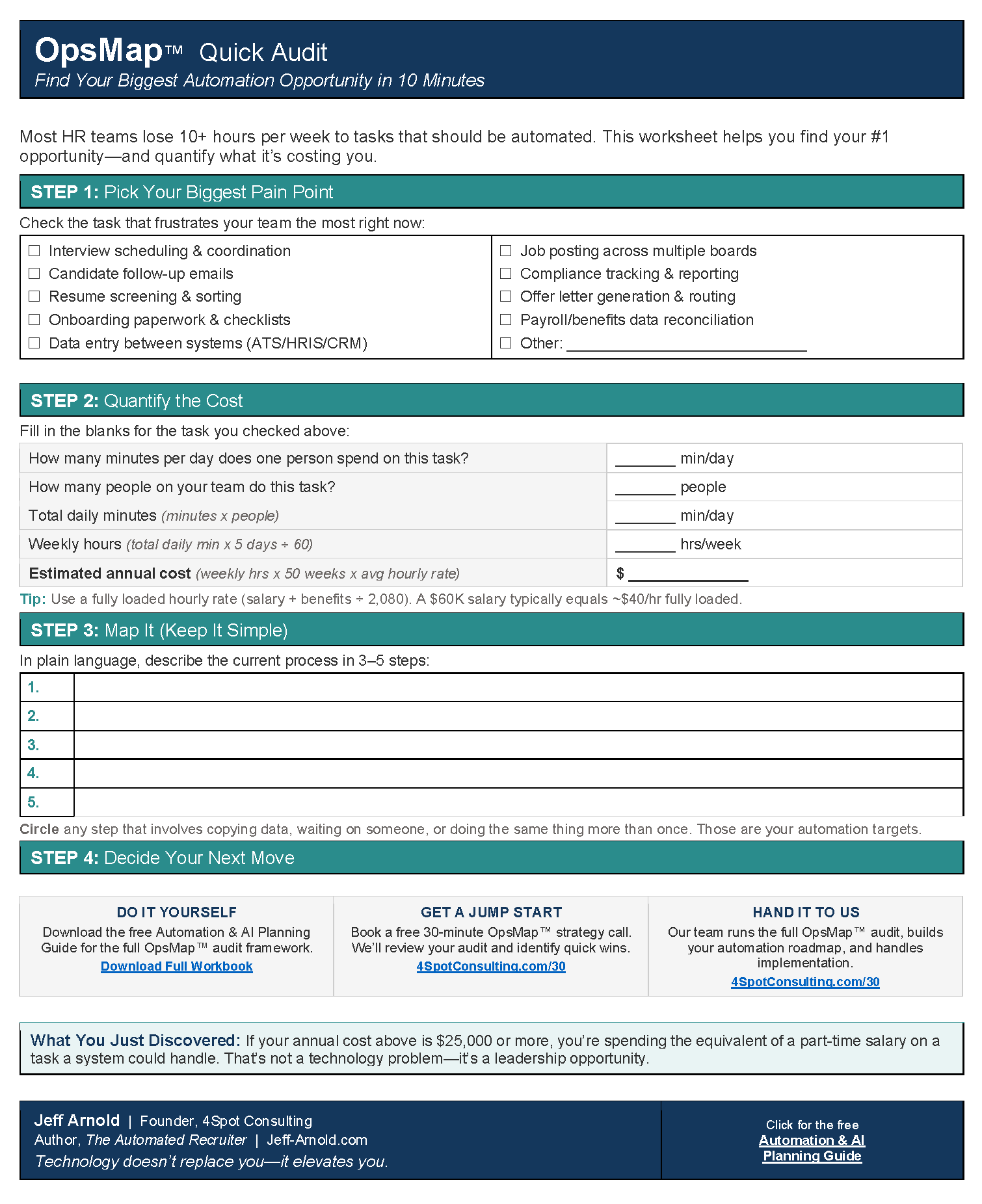
OpsMesh™ works because the automation layer carries the data structure and process logic that AI needs to act intelligently on your business. This isn’t a philosophical position – it’s architectural. Every OpsMesh engagement starts with an OpsMap™ that diagrams your current workflows before a single scenario is built. The automation layer comes second. AI capabilities layer in third, on top of a foundation that already functions without them.
That sequencing is deliberate. It protects clients from paying for AI capabilities that have no reliable foundation to operate on. It also ensures that when AI is deployed, it operates on clean, structured, documented processes – the only condition under which AI delivers what it promises.
The data behind this approach is clear. See the evidence in 12 stats that explain Automation First, Then AI.
Is Your Organization Ready to Sequence This Right?
Most teams that think they’re AI-ready aren’t automation-ready yet – and that gap is where implementations fail. These 10 signs that you need Automation First, Then AI will tell you where you actually stand before you commit budget to either layer.
Frequently Asked Questions
What does “Automation First, Then AI” mean in practice?
It means building reliable, documented, data-clean automated workflows before layering any AI capability on top of them. Automation handles the rules-based, repeatable work. AI handles judgment, synthesis, and pattern recognition – but only once it has clean, structured data to work from. The sequence is the strategy.
Can we run automation and AI projects at the same time?
Parallel tracks create competing priorities and shared technical debt – teams step on each other, data governance decisions get made twice, and neither layer reaches production as fast as a sequenced approach. Run automation first, get it working, then layer in AI on the proven foundation. Sequential delivers both faster.
Doesn’t AI improve even with messy data over time?
AI adapts, but it adapts to whatever patterns your data contains – including the broken ones. A model trained on incomplete or inconsistent records learns to produce outputs that reflect those flaws. Clean the data first through automation, then deploy AI on what you’ve cleaned.
How long does the automation phase take before we’re ready for AI?
Most organizations reach a solid automation foundation in three to six months when they work with an experienced implementation partner. The organizations that rush past this phase spend that time plus more fixing AI problems that were actually automation problems in disguise.
Part of our complete guide: Automation First, Then AI: Why Order Is the Whole Game.