Post: 5 Costly Pitfalls in: Automation First, Then AI
The five costliest pitfalls in an automation-first, then AI approach: automating a broken process, skipping documentation before you build, layering AI on unreliable data, treating automation and AI as a one-time project, and deploying AI before your team knows what to do with the output. Each mistake doesn’t just slow you down – it scales your existing dysfunction.
Every week, businesses launch automation projects with real enthusiasm and real budget – and stall out six months later wondering why nothing changed. The sequencing matters. Automation before AI is the right order. But that sequencing still has landmines, and most teams step on at least two of them before they realize what’s happening.
Here are the five mistakes we see most, and exactly what to do instead.
Pitfall 1: Automating a Broken Process
Speed-running a bad workflow doesn’t fix it – it just makes the bad output arrive faster.
This is the most common mistake in any automation project. A team identifies a repetitive task – candidate intake, data entry, follow-up sequences – and immediately asks how to automate it. The problem: no one asked whether the process itself was right first.
Automation is a force multiplier. It multiplies whatever you hand it. If your candidate intake process has five redundant steps, four missing data points, and two handoffs that nobody owns, your automation will faithfully reproduce all of that – at scale, without complaints, every time a new record comes in.
The fix is straightforward: document the process on paper before you touch a single tool. Walk it end-to-end. Identify every step, every handoff, every decision point. Ask whether each step actually needs to exist. Then automate what’s left.
This is not a slow-down – it’s the thing that makes automation actually work. Teams that skip it spend months troubleshooting automated workflows that produce the wrong outputs, because they automated the wrong process.
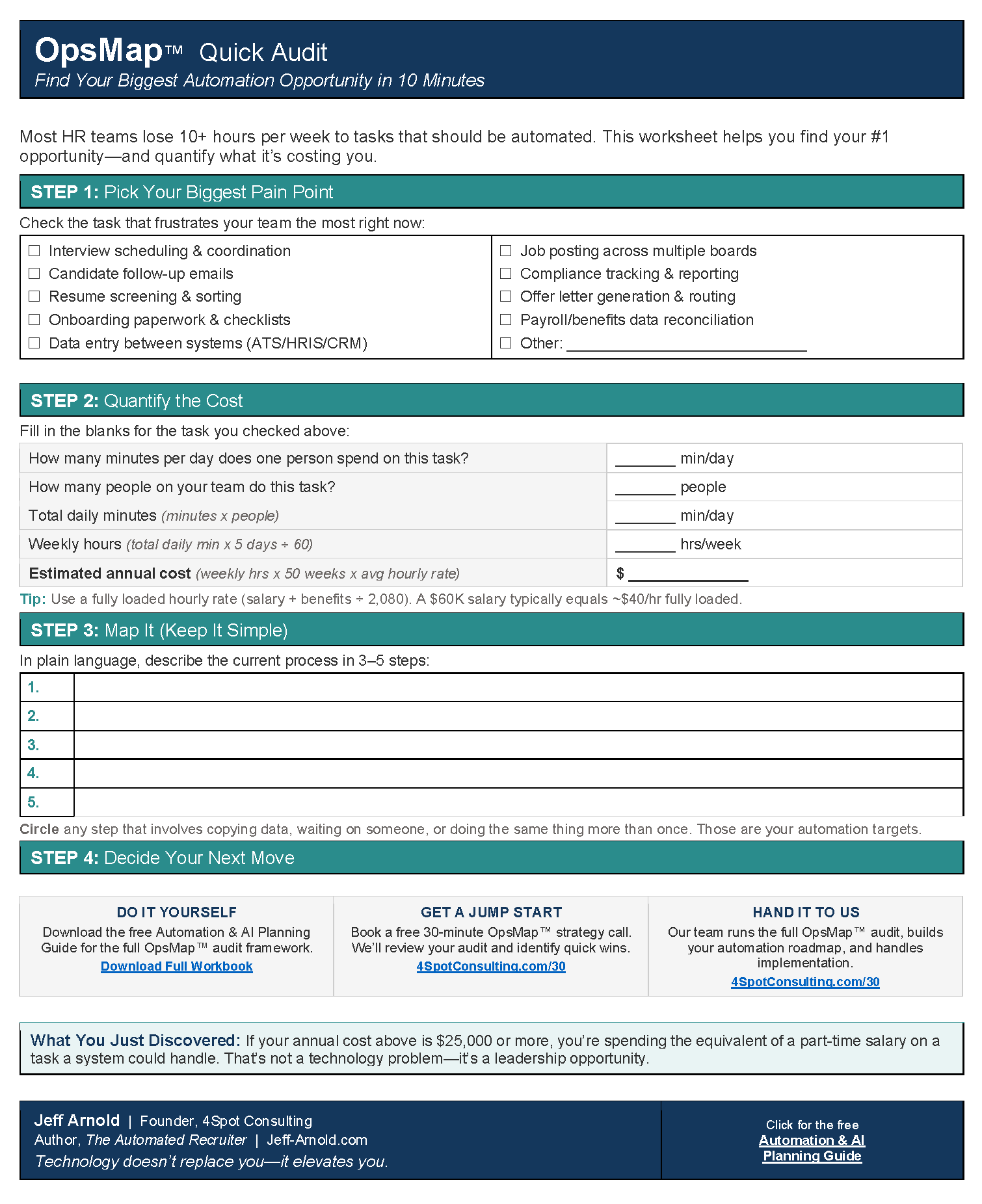
See 10 real examples of why clean processes must come before any HR automation for a breakdown of exactly how this plays out across common HR workflows.
Pitfall 2: Skipping Documentation Before You Build
Undocumented automation is a liability the moment the person who built it leaves.
The second most expensive mistake is not the build itself – it’s building without writing anything down. This shows up constantly in HR and recruiting operations: a workflow runs fine for months, someone on the team departs, and suddenly no one knows how it works, what triggers it, or why it was built that way.
This is especially damaging in the automation-first, then AI sequence, because each layer you add creates more dependencies. Your automation feeds your AI models. If you don’t know how the automation works, you can’t explain the AI outputs when something goes sideways.
Documentation doesn’t need to be elaborate. A one-page process map for each workflow – inputs, outputs, trigger conditions, owner, and what to do when it breaks – is enough. The goal is that anyone on your team can pick it up in two hours and understand it.
The OpsMesh™ methodology we use at 4Spot treats documentation as part of the build, not an afterthought. Every scenario we deploy ships with a plain-language brief alongside it. This is the difference between a system you own and one that owns you.
Pitfall 3: Layering AI on Top of Dirty Data
AI is a pattern-recognition engine – and patterns in garbage data produce garbage outputs at scale.
This pitfall surfaces after teams successfully automate their workflows and feel ready to add AI. The problem is that the automation has been quietly passing along bad data for months – duplicates, missing fields, inconsistent formats, stale records – and nobody noticed because the outputs looked fine on the surface.
When you layer AI on top of that data, the model learns from it. It picks up the inconsistencies, treats outliers as patterns, and starts generating outputs that feel confident but reflect the flaws in your data, not the reality of your business.
Before you introduce any AI layer, audit what your automation is actually producing. Run a data quality check on your key records. Look at field completion rates, duplicate counts, and the consistency of your categorical data. Fix what’s broken first.
The data audit doesn’t need to take weeks. A focused review of your highest-volume data types – candidate records, contact data, transaction history – gives you an accurate read in a few days. The time you spend here is returned many times over in AI outputs you can actually trust.
These 12 stats that explain automation first, then AI make a strong case for why sequencing matters – and the data quality piece sits near the top of every list.
Expert Take
“Garbage in, garbage out” is decades old and still gets ignored constantly. What changes with AI is the scale. Bad data doesn’t just produce one bad output – it trains a model to produce bad outputs systematically, confidently, and at whatever speed your infrastructure allows. The audit you run before adding AI is the cheapest insurance policy in your entire technology stack.
Pitfall 4: Treating Automation and AI as a One-Time Project
Automation deployed and forgotten degrades – your business changes, but the workflow doesn’t.
Most teams approach their first automation build as a project with a start date and an end date. They scope it, build it, launch it, and move on. Six months later, the workflow is running – but it’s running against a process that has changed three times since it was built.
This is one of the most insidious pitfalls because it hides well. The automation is technically still running. No errors are firing. But the output no longer matches what the business needs, because the business moved and the automation didn’t.
Automation and AI require ongoing maintenance – not daily intervention, but regular review. A quarterly check on each workflow is usually enough: does it still map to how we actually work? Are the outputs being used? Are there new steps in the process that aren’t covered?
At 4Spot, the OpsMesh™ framework includes a structured review cadence for every automated system we deploy. We treat automation like infrastructure, not a project. Infrastructure needs maintenance schedules, not completion certificates.
For HR teams specifically, this matters even more. Hiring processes change, compliance requirements shift, and candidate experience expectations evolve. These 10 signs you need an automation-first approach also point toward the organizational maturity required to maintain what you build over time.
Pitfall 5: Deploying AI Before Your Team Knows What to Do With the Output
AI that generates outputs no one acts on is an expensive experiment, not a business tool.
This is the one nobody wants to admit. The automation is working. The AI is running. The outputs are landing – in dashboards, in inboxes, in reports. And nobody is changing their behavior because of any of it.
This happens when teams deploy AI as a capability without connecting it to decisions. The tool generates a ranked candidate list. The recruiter still reviews applications in the order they arrived. The model flags high-risk records. The manager still processes them the same way. The AI is running, but it has no operational surface area.
Before you deploy any AI layer, define exactly what decision it is supposed to inform and who is supposed to make it. Write it down. Then train your team – not on how the AI works, but on what to do when it produces a specific output. Give them a clear protocol: if the model flags X, do Y. That specificity is what turns an AI tool into an operational advantage.
These 10 real examples of automation first, then AI include cases where this exact change – defining the human decision that follows the AI output – turned a stalled implementation into one that produced results.
The Common Thread Across All Five
Every one of these pitfalls shares the same root: treating automation and AI as technology problems when they are process problems first.
The tools are not complicated. Make.com is one of the most accessible automation platforms available. AI layers on top of it are increasingly plug-and-play. The hard part is never the tool – it’s the clarity of your process, the quality of your data, and the operational discipline to maintain what you build.
That’s the full case for automation first, then AI. Fix the process. Document it. Automate it. Clean the data. Then add AI where it actually helps, connected to decisions your team is prepared to act on.
4Spot’s OpsMesh™ framework moves clients through exactly that sequence – OpsMap™ to document and diagnose, OpsSprint™ to build and deploy, OpsBuild™ for complex integrations, and OpsCare™ for the ongoing maintenance that keeps the whole system running. The sequence is not arbitrary. It’s designed to sidestep every one of the pitfalls above.
Frequently Asked Questions
What does “automation first, then AI” actually mean?
It means you build reliable automated workflows before you add any AI layer on top of them. AI performs best when it has consistent, structured data to work with – and automation is what creates that consistency. Jumping straight to AI without the automation foundation almost always produces unreliable outputs.
How do I know if my process is ready to automate?
A process is ready to automate when you can write it down step by step without making assumptions. If you need to ask someone how a handoff works, or if the answer changes depending on who you ask, the process isn’t documented clearly enough to automate reliably yet.
How long does a data audit take before adding AI?
A focused audit of your highest-volume data – candidate records, contact data, transaction history – takes a few days for most HR and recruiting operations. The key is scoping it to the specific data types your AI layer will actually use, not auditing every system you have at once.
What is the OpsMesh framework and how does it apply here?
OpsMesh™ is 4Spot’s end-to-end operational methodology for automation and AI implementation. It includes four service tracks – OpsMap™, OpsSprint™, OpsBuild™, and OpsCare™ – that move clients from process documentation through deployment and ongoing maintenance, in the exact sequence that avoids the five pitfalls described in this post.
Part of our complete guide: Automation First, Then AI: Why Order Is the Whole Game.