Post: How to: Automation First, Then AI
Automation first, then AI means fixing and automating your core business workflows before adding AI on top. Start by mapping every repeating manual process, building rules-based automations to handle them, and only then layering AI for decision-making and personalization. This sequence produces compounding results; reversing it produces expensive confusion.
Every week, a business owner tells me they want AI. What they actually want is to stop wasting hours on tasks a machine has been able to handle since 2015. The distinction matters because AI layered on a broken process does not fix the process — it accelerates the mess. This guide walks you through the right sequence, step by step.
Why the Order Matters
Rules-based automation handles the predictable; AI handles the ambiguous. Deploying AI first on a workflow that has no underlying structure forces the model to compensate for missing rules, missing data, and missing consistency — three problems that compound into unreliable outputs. Automation creates the clean, structured data layer AI needs to perform.
Think of it this way: if your team manually routes every inbound lead because there is no system deciding which bucket it falls into, and you then add an AI to write personalized follow-ups to those leads, you now have a human routing problem with an AI sitting on top of it. The AI works fine. The chaos underneath it still costs hours and errors every day.
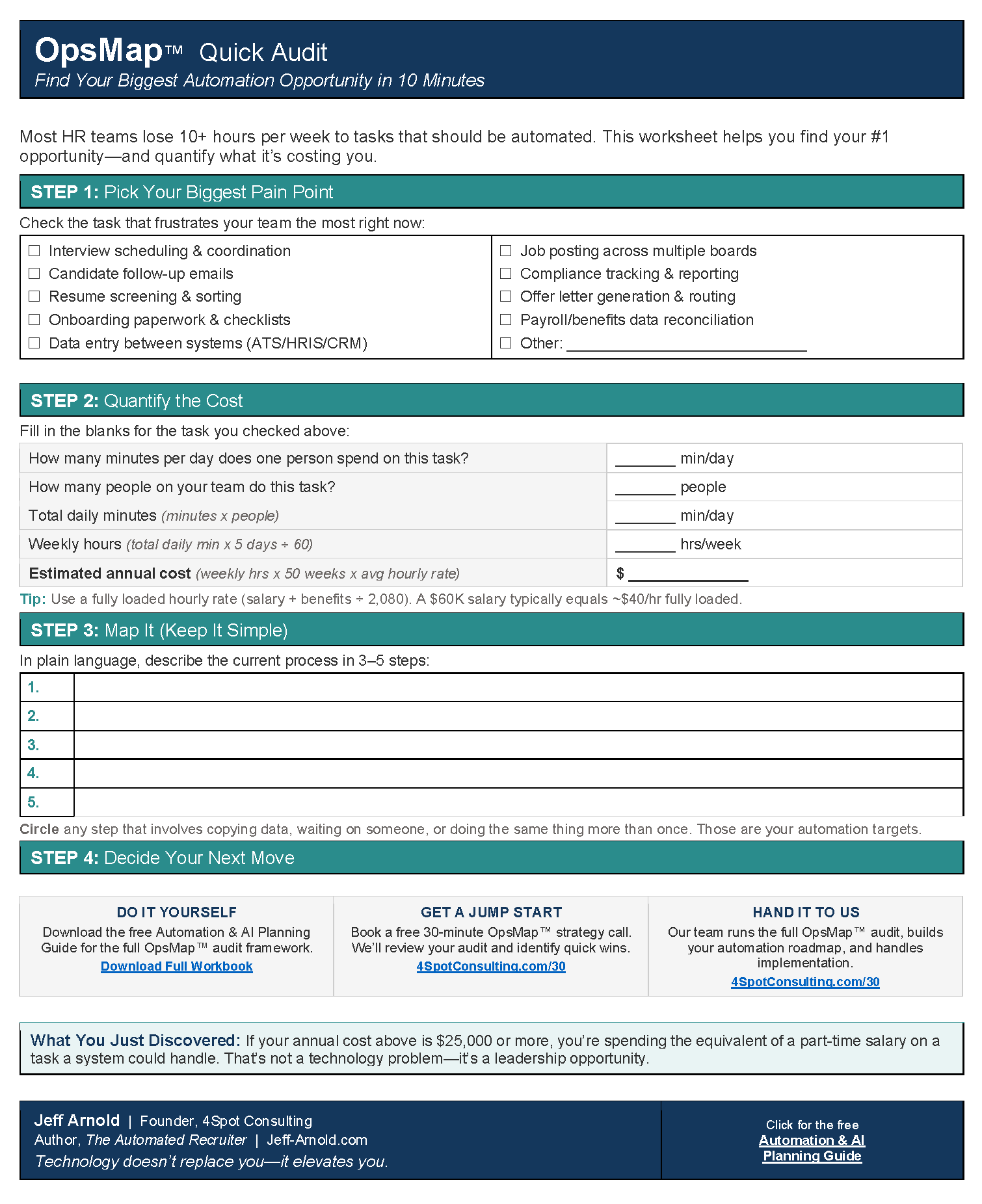
The OpsMesh™ framework at 4Spot is built on this sequence: structure first, intelligence second. Every engagement starts with workflow mapping before any AI conversation happens.
Step 1: Map Every Manual Process You Touch Repeatedly
Write down every task your team performs more than twice a week that follows a consistent pattern. A pattern means: if X happens, you do Y. If a human is making the same decision over and over using the same criteria, that decision belongs in an automation — not on a to-do list.
Common examples across HR and operations:
- New application received → move to stage, send acknowledgment, notify recruiter
- Invoice approved → update CRM, generate payment record, send confirmation
- New hire accepted → trigger document request, set up system access, schedule orientation
- Lead submits website form → tag in CRM, assign to rep, start nurture sequence
Each of these is a rules-based workflow. A human running it manually is a single point of failure. An automation running it is a system. This is where the clean process foundation becomes non-negotiable — garbage in, garbage out applies to automation and AI equally.
Step 2: Automate the Predictable Before You Touch AI
Build automations for every workflow you mapped in Step 1 before introducing any AI. Tools like Make.com handle rules-based workflows without requiring machine learning — they execute conditional logic faster and more reliably than any AI model for tasks where the answer is always the same given the same inputs.
For each workflow you mapped, ask three questions:
- Does the same input always produce the same correct output? → Automate it.
- Does a human need to make a judgment call? → Flag it for AI consideration in Step 3.
- Does it require synthesizing unstructured information? → That is an AI task, not an automation task.
Run your automations live for 30 days before adding AI to anything. You will surface gaps, edge cases, and data inconsistencies during this window. Fixing them now costs nothing. Fixing them after AI is layered in costs a complete rebuild.
The Make.com integration library is the fastest starting point for this phase. The common integrations are already built — your job is connecting them to your specific workflow, not building from scratch.
Step 3: Layer AI Where Human Judgment Currently Lives
After 30 clean days of automation running, you have something valuable: structured, consistent data. Now AI has something real to work with. The places where AI adds the most value are precisely the tasks that fell outside the automation rules in Step 2 — the ones requiring interpretation, synthesis, or personalization.
Where AI earns its place after automation is running:
- Drafting personalized outreach from structured CRM data your automation populated
- Scoring and ranking inbound leads or candidates against criteria your automation tagged
- Summarizing long documents — transcripts, applications, contracts — that trigger actions your automation already handles
- Flagging anomalies in the data your automation collects, so humans review exceptions instead of everything
AI in this position operates on clean inputs with clear outputs feeding back into a system. That is the configuration that produces compounding return. The OpsMesh™ model calls this the intelligence layer — it is always the third layer, never the first.
See 10 real examples of what this looks like in practice across HR, recruiting, and operations roles.
Common Mistakes That Break the Sequence
Most teams reverse the order, skip the mapping phase, or treat automation and AI as interchangeable tools. Each mistake creates a predictable failure mode.
Mistake 1: Starting with an AI tool instead of a workflow audit. The tool does not define the process — the process defines which tool belongs. Buying an AI recruiting platform before knowing exactly what your current recruiting workflow does is buying a solution without a problem definition.
Mistake 2: Automating a broken process. Automation makes a broken process faster, not better. If applicants fall through the cracks manually, automation will lose them at scale. These are the signs your process needs a fix before any automation touches it.
Mistake 3: Treating AI outputs as endpoints. AI in a well-built OpsMesh™ system is an input into a human decision or a rules-based next step — not a final answer. Every AI output has a defined destination in the automation layer below it.
Mistake 4: Skipping the 30-day run. Teams see the automation working and immediately bolt on AI. The 30-day period is not caution theater — it is data collection. Without it, you feed AI incomplete, inconsistent inputs and wonder why the outputs are inconsistent. The most common automation mistakes HR teams make internally follow this pattern almost without exception.
Expert Take
The businesses that get the most from AI treat it like a specialist, not a generalist. A specialist needs a clean brief, structured inputs, and a clear deliverable. Automation builds the brief. Without it, you are asking AI to be your entire operations team — and it will fail at that job the same way a single overloaded employee does. Fix the conveyor belt before you add the robot arm.
Frequently Asked Questions
What is “automation first, then AI” in plain terms?
It is a sequencing principle: fix your repeating manual processes with rules-based automation before using AI for anything that requires judgment or personalization. The automation layer creates the data structure and consistency that AI needs to produce reliable outputs. Reversing the sequence puts expensive AI on top of inconsistent data, which compounds the inconsistency rather than resolving it.
How long should I automate before adding AI?
Thirty days of clean automation runtime is the minimum. The goal is not time for its own sake — it is surfacing edge cases, plugging data gaps, and confirming that the inputs feeding into your future AI layer are accurate and consistent. Some workflows settle faster; complex multi-system ones need longer. Let the error rate guide you, not the calendar.
Which processes are automation candidates versus AI candidates?
A process is an automation candidate when the same input always produces the same correct output. It is an AI candidate when the correct output requires reading context, synthesizing information, or making a judgment that changes based on nuance. Most operational workflows — routing, tagging, notifications, data movement — are automation candidates. Most communication and evaluation tasks become AI candidates once the automation layer feeds them clean, structured data.
Does this apply outside HR and recruiting?
The sequence applies to any operation with repeating manual work. HR and recruiting surface it most clearly because the volume of repetitive tasks is high and the cost of errors is visible, but the principle holds across sales operations, finance, customer service, and any function where people execute predictable workflows by hand every day. The data behind why this sequence works is consistent across industries and business sizes.
What tools do you use for the automation layer?
Make.com is the primary platform 4Spot uses and recommends for rules-based automation. It handles conditional logic, API connections, and cross-platform data movement without requiring developer resources. It is also significantly less expensive than Zapier for equivalent workflow complexity, which matters when you are building a full automation layer before you even touch AI spend.
If you recognize your operation in this guide — repeating the same manual tasks, considering AI tools without a clear automation foundation, or running automations that keep surfacing the same gaps — start with a workflow audit before any new tool purchase. Check the signs you need this sequence now and see where your operation stands.
Part of our complete guide: Automation First, Then AI: Why Order Is the Whole Game.