Post: Step by Step: Automation First, Then AI
The right sequence for business transformation is automation first, then AI. Map your workflows, eliminate the broken steps, build reliable automation, and only then layer AI on top of it. Teams that skip automation and jump straight to AI amplify their chaos instead of solving it. The order is not optional – it is the entire strategy.
Why the Sequence Matters
AI tools are force multipliers. They take whatever process you feed them and do it faster, at scale. If that process is broken, inconsistent, or undocumented, AI makes the damage worse – not better. Automation forces you to document and standardize a workflow before you scale it. That discipline is what makes AI safe to deploy.
Most businesses that struggle with AI implementations did not fail at AI. They failed at the step that comes before it. They handed a large language model a mess and expected it to produce clarity. The OpsMesh™ framework is built on a different sequence: understand the work, automate the repeatable parts, and only then apply AI where judgment adds value.
Expert Take
The businesses that see the highest ROI from AI are not the ones with the most sophisticated models. They are the ones with the cleanest workflows going in. AI’s job is to accelerate a process – not to define it, fix it, or stabilize it. That work happens at the automation layer first.
Step 1: Map What You Actually Do Today
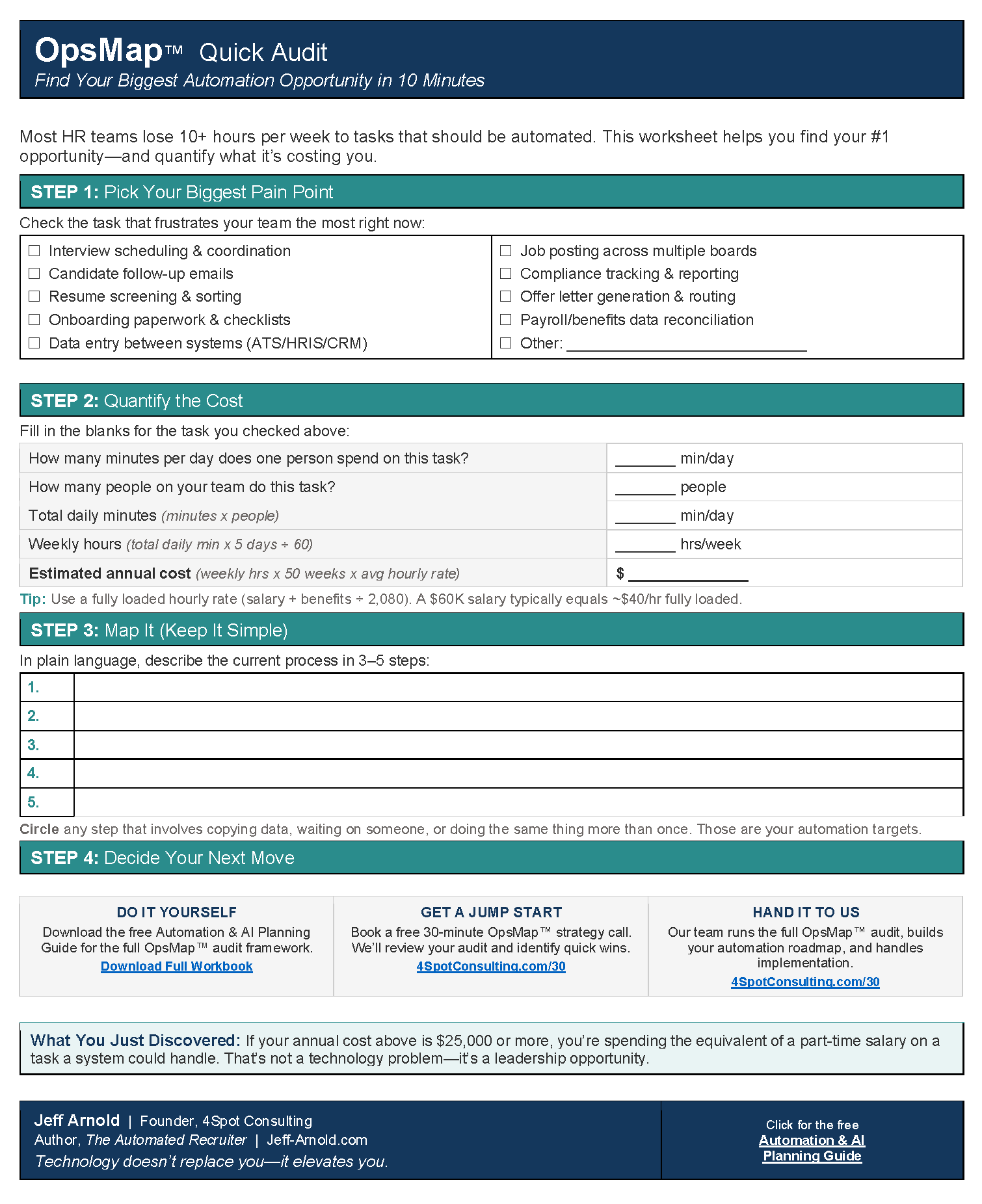
Start with an honest picture of your current operations, not the way you wish they worked. Walk every key process from trigger to output and document each step, every handoff, and every tool involved. You are looking for three things: what runs consistently, what breaks regularly, and what depends entirely on a specific person’s memory.
The OpsMap™ phase does not need to be a long project. A focused two-day workshop with the people who do the actual work produces a usable map. The goal is not perfection – it is visibility. You cannot automate what you cannot see.
For more on what this looks like in practice, see 10 Real Examples of Why Clean Processes Must Come Before Any HR Automation.
Step 2: Fix What Is Broken Before You Automate It
Automation does not fix broken processes – it locks them in place and runs them at scale. Before you build a single scenario or connect a single API, resolve the structural problems in your workflow. This is the step most teams skip because it feels like housekeeping. It is not. It is the foundation the entire build rests on.
In the OpsSprint™ phase, we work through the specific failure points surfaced in the map: unclear ownership, redundant data entry, approval bottlenecks, and steps that only one person knows how to complete. Each broken step is either fixed, eliminated, or formally documented before it becomes part of the automation design.
See 10 Signs You Need to Clean Processes Before HR Automation for common patterns that signal a workflow is not ready for automation.
Step 3: Build the Automation Layer
With a clean, documented workflow in hand, you are ready to build. Start with the highest-volume, most predictable steps – the ones that are already working but eating time. These are the best candidates for automation because there is a clear right answer for every scenario and no need for judgment.
The OpsBuild™ phase uses Make.com as the primary automation platform. Scenarios connect your tools, move data between systems, trigger communications, and handle exceptions without manual intervention. Each scenario is built with error handling, clear naming conventions, and an audit trail so anyone on the team can diagnose a failure without calling the person who built it.
Common automation wins in this phase include lead routing, onboarding sequences, document generation, CRM updates, and internal notifications. 10 Essential Make.com Integrations covers the most impactful connection points for small to mid-size operations.
Expert Take
The automation layer has one job: make the repeatable steps invisible. When a new lead comes in and the CRM updates, the follow-up queues, the owner gets notified, and the data lands in the right place – all without anyone touching it – that is a working automation layer. That is the environment AI needs to be useful.
Step 4: Layer AI Where Judgment Adds Value
Once your automation layer is stable and running, AI becomes something you add to specific decision points – not something you use to replace the entire system. The difference is critical. AI belongs in the steps where a human used to read something, decide something, or summarize something – not in the plumbing that moves data between systems.
Practical AI additions at this stage include email triage and draft generation, lead scoring based on behavioral signals, summarization of long documents or call transcripts, and classification of inbound inquiries. Each of these sits on top of an automation layer that is already functioning. The AI handles the judgment step; the automation handles the routing and execution.
The OpsCare™ phase monitors both layers – automation and AI – for drift. Prompts erode, workflows change, and data models shift over time. Ongoing oversight catches failures before they compound. See 10 Signs You Need Automation First, Then AI to identify where your operation sits in this sequence.
Step 5: Measure Results and Expand
Every automation and AI deployment needs a defined metric before it goes live – not after. That metric does not have to be complex: volume handled per week, error rate, time-to-completion, or manual touchpoints per transaction. Whatever the baseline was before the build, track it after.
Expansion follows evidence. When a scenario proves reliable and the metric moves in the right direction, extend the logic to adjacent workflows. When an AI layer delivers consistent results, apply the same pattern to the next decision point in the process. Growth inside the OpsMesh™ framework is sequential – each phase validates the next before building on it.
For real-world results from this sequence, see 10 Real Examples of Automation First, Then AI and 12 Stats That Explain Why Automation Comes Before AI.
Expert Take
The teams that expand fastest are the ones that resist the urge to add AI before the automation layer is proven. Stable automation gives you the clean data and predictable triggers that AI models need to perform. Without it, you are asking AI to do detective work on messy inputs – and you will not like the outputs.
Frequently Asked Questions
Can we run automation and AI at the same time?
You can run them simultaneously if the automation layer is already stable and the AI is being added to a specific, bounded decision point – not to the entire workflow. The problem happens when teams try to design both layers at the same time from scratch. That produces a system where failures are hard to diagnose because you do not know which layer caused them.
How long does the automation-first phase take?
The timeline depends on how many workflows you are addressing and how clean your current processes are. A focused engagement targeting two or three core workflows runs four to eight weeks. That includes the mapping phase, the process cleanup, the build, and initial validation. AI layers are added after the first stable period of automation performance, not during the build.
What if our team is already using AI tools?
Keep using them, but audit the inputs. AI tools that sit on top of disorganized data or inconsistent workflows produce inconsistent outputs. The automation-first approach does not require you to stop using AI – it requires you to build the infrastructure that makes your AI tools perform reliably instead of occasionally.
Which workflows should we automate first?
Start with the highest-volume, lowest-variance workflows in your operation. These are the steps your team does the same way every time – no judgment required, just execution. High-volume plus low-variance is the cleanest combination for automation. Once those are running reliably, move to workflows that involve more variability, which is where AI starts to earn its place.
How does 4Spot structure this work?
The OpsMesh™ framework sequences the engagement in four phases: OpsMap™ (workflow discovery), OpsSprint™ (process cleanup and design), OpsBuild™ (automation construction and testing), and OpsCare™ (ongoing monitoring and expansion). Each phase gates the next. A client does not move into the build phase until the map and cleanup are complete. That sequence is what makes the final system reliable.
Part of our complete guide: Automation First, Then AI: Why Order Is the Whole Game.