Post: The Complete Guide to: Automation First, Then AI
“Automation First, Then AI” is a sequenced approach to operational transformation: you eliminate manual, rule-based work through structured automation before layering AI on top. Skipping the automation foundation and going straight to AI guarantees compounded chaos – AI amplifies whatever process exists underneath it, clean or broken.
Most businesses get the order wrong. They see AI headlines, buy a tool, and point it at a process that was never properly defined. The result is expensive, inconsistent, and demoralizing – and it sets AI adoption back by years inside the organization. This guide breaks down the correct sequence, why each phase matters, and how to know when you are actually ready to move from one to the next.
What “Automation First, Then AI” Actually Means
The phrase describes a specific build order – not a philosophy, not a preference. Automation handles deterministic work: if X happens, do Y. AI handles probabilistic work: given this context, what is the best response? When you reverse the order, you end up with AI trying to interpret situations inside a process that was never clearly defined, working from data that was never consistently structured.
The distinction matters because the failure modes are completely different. A broken automation fails loudly – a scenario errors out, a webhook fires twice, a record doesn’t create. You see it, you fix it. A broken AI deployment fails quietly – it produces outputs that look reasonable, get used, and compound the original process problem at scale. By the time you notice, you have a data and trust problem that takes months to unwind.
At 4Spot, we built the OpsMesh™ framework around this sequencing because every engagement that reversed the order failed the same way: the AI produced outputs no one trusted, and the team kept doing the work manually anyway – defeating the entire purpose.
Why the Order Matters More Than the Tools
The tools are not the variable. Make.com, Claude, GPT – none of those are the deciding factor in whether your automation and AI initiative succeeds. The variable is the state of your processes when you hand them to technology.
A well-documented, clean, consistently executed process runs well through automation. A vague, inconsistent, exception-heavy process runs badly through automation and catastrophically through AI. Here is the practical test: if two of your team members would handle the same situation differently with no documented rule to resolve it, you have a process problem, not a technology problem. Fix the process first.
That is not a comfortable message when you are three months into an AI initiative. But the teams that hear it early and act on it compress their overall timeline. The teams that ignore it rebuild from scratch six months later.
See 10 real examples of why clean processes must come before any HR automation for a breakdown of what this looks like in practice.
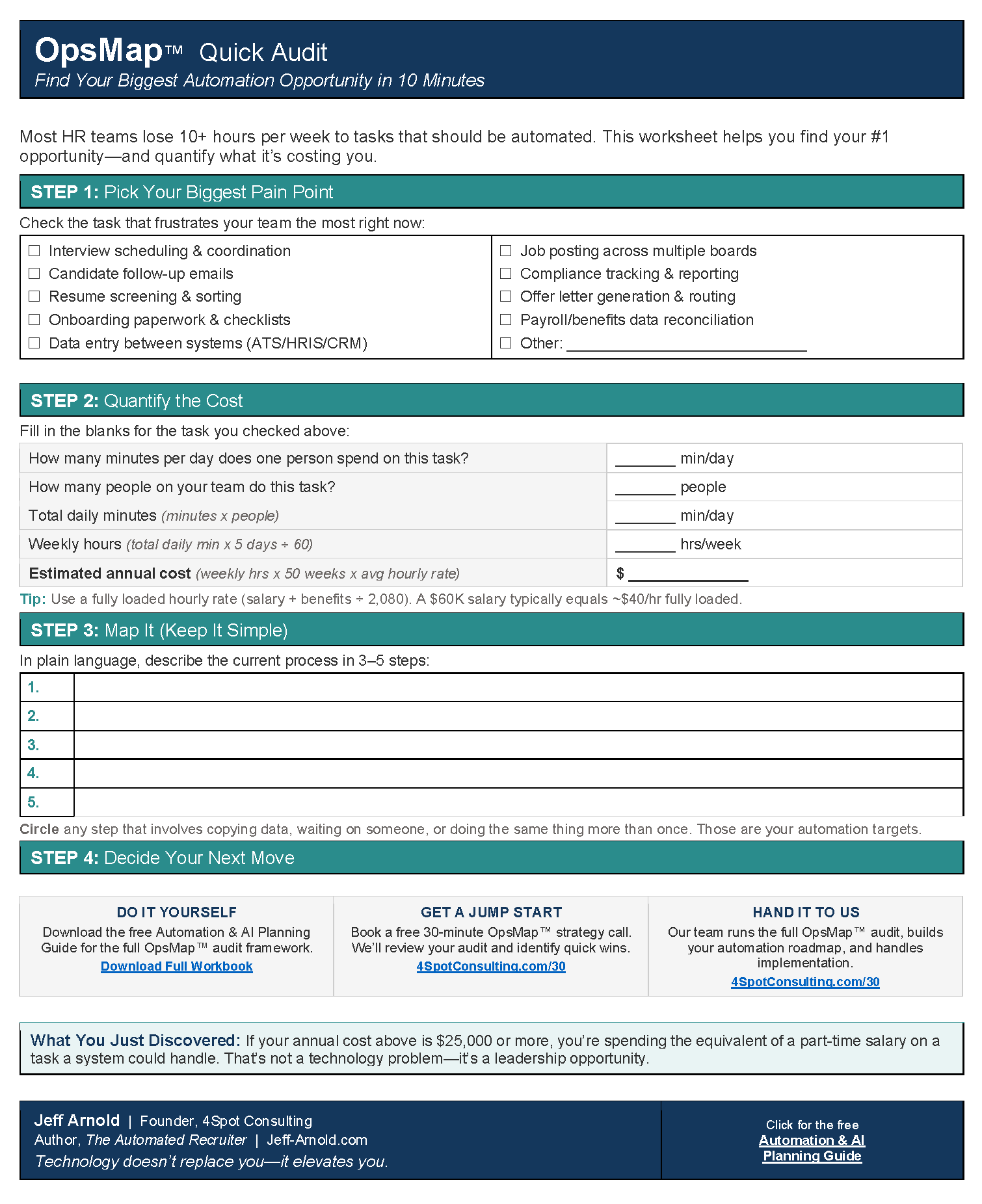
Step 1: Map Every Process You Plan to Automate
Before writing a single Make.com scenario, you need a documented process map for every workflow you intend to touch. This is OpsMap™ work – and not a flowchart on a whiteboard. A real working document that names every trigger, every decision point, every output, and every exception.
The map does three things:
- Forces you to find the exceptions you didn’t know existed
- Creates the spec your automation will actually build against
- Gives you a baseline to measure against after automation runs
Most teams skip this because it feels slow. Teams that skip it spend twice as long debugging automation that was built against a process no one actually understood. The mapping phase is where you discover that what everyone described as “a simple approval workflow” actually has fourteen edge cases, three people who do it differently, and two downstream systems no one mentioned.
Fix all of that before you build anything. The automation will be faster, cleaner, and far easier to maintain.
Step 2: Build the Automation Foundation
Once the process is mapped and clean, you build the automation layer. This is structured, rule-based execution: triggers, conditions, actions, error handling. Make.com is the platform we build on – it handles conditional logic, API calls, error routing, and cross-system data movement without requiring a developer.
This is OpsSprint™ or OpsBuild™ territory, depending on scope. A sprint delivers a defined automation package in a compressed timeframe with a fixed deliverable. A build is a full system architecture project – multi-scenario, multi-system, production-grade. Either way, the work that happens here is concrete: webhooks fire, data moves, tasks create, emails send, records update – all without a human touching it.
The benchmark for “done” at this phase is not “it runs.” The benchmark is “it runs without manual intervention at least 95% of the time, and when it doesn’t, the error is visible and actionable immediately.”
See 10 automations that are finally easy to build in Make.com without a developer for a practical starting point.
Step 3: Add AI Where Judgment Used to Live
After automation is running reliably, you know exactly where your remaining human touchpoints are. Those are the places where someone reads a situation and decides what to do – and those touchpoints are where AI earns its place.
AI drafting a first response to a candidate inquiry is powerful when the intake data is clean, routed correctly, and tagged accurately because the automation underneath it works. That same AI doing the same work when the data is dirty and the routing is inconsistent produces garbage fast. The automation layer is what creates the clean, structured inputs AI needs to produce reliable outputs.
This is also the phase where you define your review protocol. Every AI output that falls below a confidence threshold or touches a high-stakes decision needs a defined human review step. “AI handles it” is not a complete process design.
See 10 real examples of Automation First, Then AI in action for a breakdown of what this looks like across different workflows.
Expert Take
The mistake isn’t choosing the wrong AI tool. It’s treating AI as a process fix instead of a process amplifier. Every AI implementation that fails has the same root cause: the team hoped AI would clean up a workflow they hadn’t cleaned themselves. It doesn’t. AI runs the process faster. If the process is broken, AI breaks it faster – and at a scale that makes the original problem look manageable by comparison.
How to Know If You’re Ready for AI
Four questions determine readiness – and all four have to be yes before you add AI to a workflow:
- Is there a documented process for this workflow that everyone on the team follows consistently?
- Does the automation handling this workflow run without manual intervention at least 95% of the time?
- Is the data feeding this process clean and consistently structured across all input sources?
- Do you have a defined human review step for AI outputs that fall outside acceptable confidence thresholds?
If you answered no to any of these, the answer is not “add AI anyway and see what happens.” The answer is “go back and fix the no.” Adding AI to a workflow that fails any of these four checks accelerates failure – it doesn’t fix it.
Keeping the Foundation Healthy
OpsCare™ is the maintenance layer most teams forget entirely – and the most common reason AI deployments that launched successfully degrade over time. Your automation foundation needs active monitoring: scenario error rates, data quality drift, API changes from connected systems, and process changes that invalidate existing automation logic.
AI output quality is downstream of automation health. When your Make.com scenarios start erroring silently, when data from a connected system changes format, when a process change isn’t reflected in the automation – AI is the first place you see the symptoms, but the automation layer is where the problem lives. OpsCare closes that gap.
The full OpsMesh™ sequence – Map, Sprint, Build, Care – exists because businesses don’t fail at AI because AI is bad. They fail at AI because the operational layer underneath was never designed to support it, and no one was watching it after launch.
See 12 stats that explain the Automation First, Then AI framework for the research backing this sequencing approach.
Frequently Asked Questions
Can we skip automation and go straight to AI?
You can – but the failure rate is extremely high. AI needs clean, structured inputs to produce reliable outputs. When your process is manual and inconsistent, AI output is manual and inconsistent at scale. The automation layer is what creates the consistent inputs AI needs to do its job. Teams that skip straight to AI almost always end up building the automation layer anyway – after a painful and expensive detour.
How long does the automation phase take before we are ready for AI?
The timeline depends on process complexity, not on a calendar. Simple, single-system automations run in days. Multi-system workflows with conditional logic and exception handling take weeks. The benchmark for “ready for AI” is a reliability threshold – your automation runs without manual intervention at least 95% of the time – not a date on the roadmap.
Does this approach apply specifically to HR?
HR is one of the highest-impact verticals for this sequencing because HR operations are high-volume, high-exception, and high-stakes. Candidate routing, onboarding triggers, compliance documentation – all of these have clear rules that belong in automation, and a smaller set of judgment calls that belong in AI. The sequencing matters more in HR, not less, because the cost of AI errors in hiring and compliance is real and visible.
See 10 signs you need to start with Automation First, Then AI to assess where your operation stands today.
What platform do you recommend for the automation layer?
Make.com is the platform we build on at 4Spot. It handles the complexity of real business workflows – conditional logic, API calls, error routing, multi-system data movement – at a price point that makes sense for the businesses we work with. We have built hundreds of production scenarios across dozens of clients, and Make.com handles the edge cases that simpler tools don’t.
See 10 essential Make.com integrations to unlock cheaper, more powerful business automation for a breakdown of the integrations we rely on most.
What if our team is too small to do this in phases?
Size doesn’t change the sequence – it changes the scope. A two-person operation doing one workflow at a time follows the same Map-Automate-AI order as a 200-person HR department running ten workflows simultaneously. The phases scale down to a single process and a single week if that’s what you have. What doesn’t scale is reversing the order.
Part of our complete guide: Automation First, Then AI: Why Order Is the Whole Game.