Post: How to Get Started With: Automation First, Then AI
Start by mapping your most repetitive manual processes – the ones your team does the same way every time. Automate those first using rule-based tools like Make.com. Once those workflows run reliably without human intervention, layer AI on top to handle the judgment calls, exceptions, and patterns that rigid automation cannot touch.
Why the Order Matters
AI applied to a broken or chaotic process does not fix the process – it speeds up the chaos. Rule-based automation forces you to define exactly what a process does before you touch it with any tool. That definition work is the real prize, and it pays off whether you ever add AI or not.
Most teams jump to AI because it sounds more impressive. The result is an AI layer sitting on top of inconsistent data, undefined handoffs, and processes that no one has documented. Automation first creates the clean, structured data that AI needs to work accurately.
Expert Take
The companies that extract the most value from AI investments are not the ones that deployed AI first. They are the ones that ran their processes through a disciplined automation phase, built structured data pipelines, and then introduced AI into a stable environment. The order is not a preference – it is a prerequisite.
Step 1: Map Your Manual Processes Before Touching Any Tool
Write down every task your team performs that follows the same steps every time. These are your automation candidates. Look for work that is triggered by a specific event (a form submission, an email, a date), produces a predictable output, and requires no judgment to complete. If a new employee on their first day could follow the steps from a written checklist, it qualifies.
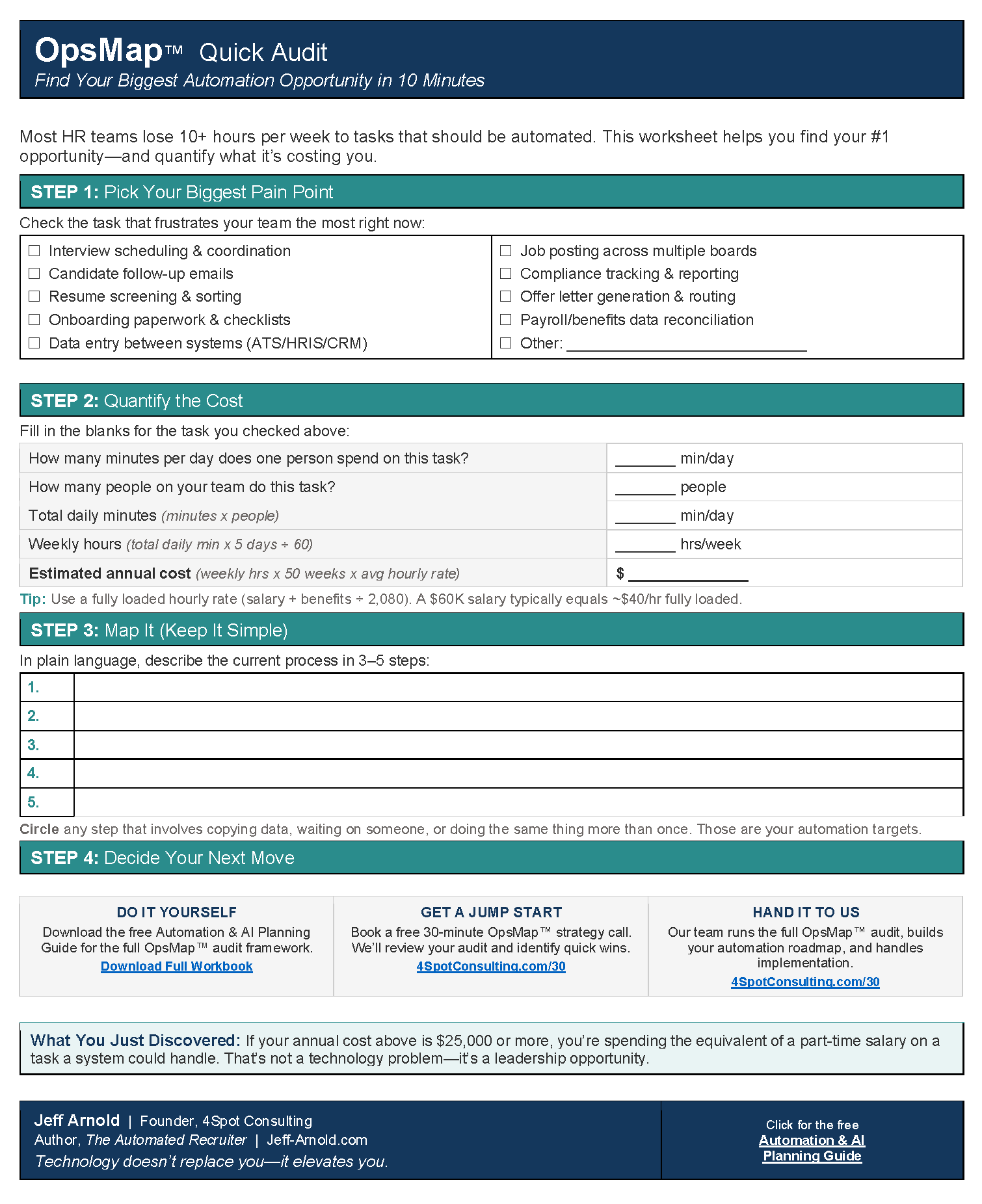
The OpsMap™ process 4Spot uses starts here: a whiteboard session – literal or digital – where you capture inputs, steps, outputs, and who is responsible for each handoff. This is the single most valuable hour you will spend on any automation project.
Do not start with software. Start with a piece of paper. Software decisions come after you understand what the process actually is, not what you think it is.
Step 2: Automate the Repeatable Work First
Take your mapped processes and build automation scenarios that replace the manual steps exactly – no shortcuts, no optimization yet. The goal at this stage is fidelity, not efficiency. You want the automated version to do what the human was doing, reliably, every time.
Make.com is the tool 4Spot recommends for this layer. It handles trigger-based, rule-following work well and forces you to think in explicit if-then logic. That explicitness matters – it surfaces assumptions and edge cases that were invisible when the work lived in someone’s head.
Run the automation in parallel with the manual process for the first two weeks. Confirm it matches the human output before you turn the manual process off. This is not optional. Skipping this step is where most teams create the problems they later blame on AI.
Expert Take
The parallel-run phase is where you find out what the process actually does versus what you thought it did. Every team that skips it discovers a surprise later – usually at the worst possible moment. Two weeks of parallel runs is cheap insurance against months of cleanup.
Step 3: Validate Before You Layer AI
Before any AI touches your operation, the automated workflows must pass three tests. First, they run without errors for at least 30 consecutive business days. Second, every output is auditable – you can trace any result back to the input that created it. Third, the data flowing through the system is clean: consistent formats, no duplicates, no missing required fields.
If you cannot pass all three, you are not ready for AI. That is not a failure – it is the system telling you what to fix. Fix it at the automation layer before adding complexity.
The OpsSprint™ engagement 4Spot runs for clients ready to move from manual to automated includes a formal validation gate at this exact point. Nothing moves forward until the scorecard is clean.
Step 4: Add AI Where Judgment Is Required
AI earns its place in the two spots where rule-based automation breaks down: handling exceptions and extracting patterns. Everything else stays in the automation layer.
Exceptions are the inputs that do not fit the defined flow – the email that arrives with missing data, the applicant whose resume format your parser did not expect, the contract with a non-standard clause. These are the moments where a human was making a judgment call. AI handles them at scale.
Pattern recognition is the second use case. Once your automation has been running long enough to accumulate structured data, AI surfaces the patterns in that data – which lead sources convert best, which process steps correlate with faster cycle times, which client segments show the highest risk of churn. The automation creates the data. The AI reads it.
Expert Take
The clearest sign that a team is ready to add AI is that they have run out of things to automate. When the rule-based work is fully covered and the team is still doing judgment calls manually at scale, that is where AI delivers a return. Not before.
Step 5: Build a Feedback Loop
Every AI decision your system makes needs a mechanism to flag errors and feed corrections back. Without this, AI drift compounds silently – small errors accumulate and the system moves further from accuracy over time without anyone noticing until the damage is significant.
The feedback loop looks like this: every AI output has a confidence score or a human review gate, errors get logged, and the log gets reviewed on a cadence. Monthly is the minimum. Weekly is better when you are still early in the AI layer.
The OpsBuild™ phase of a 4Spot engagement wires this in by design. The feedback mechanism is not an afterthought – it is part of the architecture from day one. If your implementation does not include a feedback loop, it is not complete.
Common Mistakes to Avoid
Skipping the process-mapping step is the most common mistake, and it creates the most expensive problems downstream. The second most common is deploying AI before the automated layer is stable. The third is treating AI as a replacement for process design rather than an enhancement of it.
A few more worth naming:
- Automating a broken process. If the manual version is inconsistent, the automated version will be consistently wrong. Fix the process first.
- Building automation that no one monitors. Automation runs without complaint when it is producing wrong outputs. Build alerting in from the start.
- Letting AI output flow into the business without a review gate. In early deployments, every AI output needs a human checkpoint before it affects a client or a record.
- Treating “automation first” as “no AI ever.” The goal is not to avoid AI – it is to earn the right to use it by building the foundation it needs to work.
For a detailed breakdown of what happens when teams skip the process-clarity step, see 10 Real Examples of Why Clean Processes Must Come Before Any HR Automation.
What This Looks Like in Practice
A recruiting firm that processes hundreds of applications per month starts by automating the intake flow: application received, resume parsed, candidate record created in the CRM, initial status email sent, recruiter notified. That runs clean for 60 days.
Then AI enters at the triage step – screening applications against the role criteria and ranking candidates. The AI works because the data it is reading is clean, consistently structured, and sourced from a validated automation layer. The ranking is auditable because every input and output is logged.
The OpsCare™ support layer monitors the system ongoing, catches drift, and surfaces the next automation opportunity as it emerges. The architecture grows, but it grows on a solid foundation.
This sequence – automation validated, then AI layered on top, then ongoing monitoring – is the pattern behind every durable implementation we have seen work at scale. See 10 Real Examples of Automation First, Then AI for specifics on how this plays out across different business types.
Frequently Asked Questions
How long does the automation-first phase take before I can add AI?
Plan for a minimum of 60 days of stable automated operation before layering AI. The three validation tests – error-free runs, auditable outputs, clean data – rarely pass before then. Some operations need 90 days. The timeline is determined by stability, not by a calendar.
What if my team is already using AI tools?
Keep using them for standalone tasks – drafting, summarization, research – where the output does not flow into a business process. The “automation first” principle applies to workflows, not to individual productivity tools. When you want AI inside a workflow, audit the workflow foundation first.
Do I need a developer to start?
No. Make.com handles the automation layer without code for the vast majority of business workflows. The mapping step requires a facilitator, not a developer. The bottleneck is process clarity, not technical skill.
What is the biggest sign my automation layer is not ready for AI?
Your automation produces inconsistent outputs for identical inputs. When the same trigger returns different results depending on when it fires or what state the system is in, the foundation is not stable. Fix that before adding AI – AI will not resolve the inconsistency, it will amplify it.
Where does OpsMesh fit in?
OpsMesh™ is the connective layer that ties automation, AI, and your existing tools into a single operating system for your business. “Automation first, then AI” is the build sequence. OpsMesh is the end state you are building toward: a network of integrated, monitored workflows where automation handles the rules and AI handles the judgment.
For more on where you stand in this process, see 10 Signs You Need to Adopt Automation First, Then AI and 12 Stats That Explain Automation First, Then AI.
Part of our complete guide: Automation First, Then AI: Why Order Is the Whole Game.