Post: A Practical Guide to: Automation First, Then AI
“Automation first, then AI” is a sequencing discipline: you build clean, repeatable process automation before adding AI on top of it. Map your workflows, eliminate manual steps with a tool like Make.com, and confirm the automation runs without hand-holding. Only then do you add AI. Reverse that order and you amplify broken processes instead of fixing them.
Most businesses chase AI because it sounds more impressive than automation. They buy AI tools before their core workflows are documented, let alone automated. Months later, they have expensive subscriptions and the same manual bottlenecks they started with—now with a chatbot in the corner nobody trusts. The approach that actually works is less glamorous and far more effective.
Why the Sequence Matters More Than the Technology
AI tools need clean inputs and predictable process structures to deliver consistent output. When you skip automation and jump straight to AI, you feed it chaos—inconsistent data, manual handoffs, and process gaps no model can compensate for. The result is AI that underperforms relative to its cost and produces outputs nobody is willing to act on.
Automation solves that by creating structure first. Once a process runs automatically and predictably, AI has something worth enhancing. The OpsMesh™ framework 4Spot uses is built around exactly this sequence—get the machine running reliably, then make it smarter. That order is not a preference; it is the only version that produces compounding returns.
The underlying data makes this concrete. See 12 Stats That Explain Automation First, Then AI for the numbers behind why sequencing drives results.
Step 1: Map Your Process Before You Touch a Tool
Process mapping is the starting point, and skipping it is where most automation projects derail. You need a written record of every step in the workflow—who does it, what triggers it, what information it requires, and where it ends. Without that map, you automate the wrong things in the wrong order.
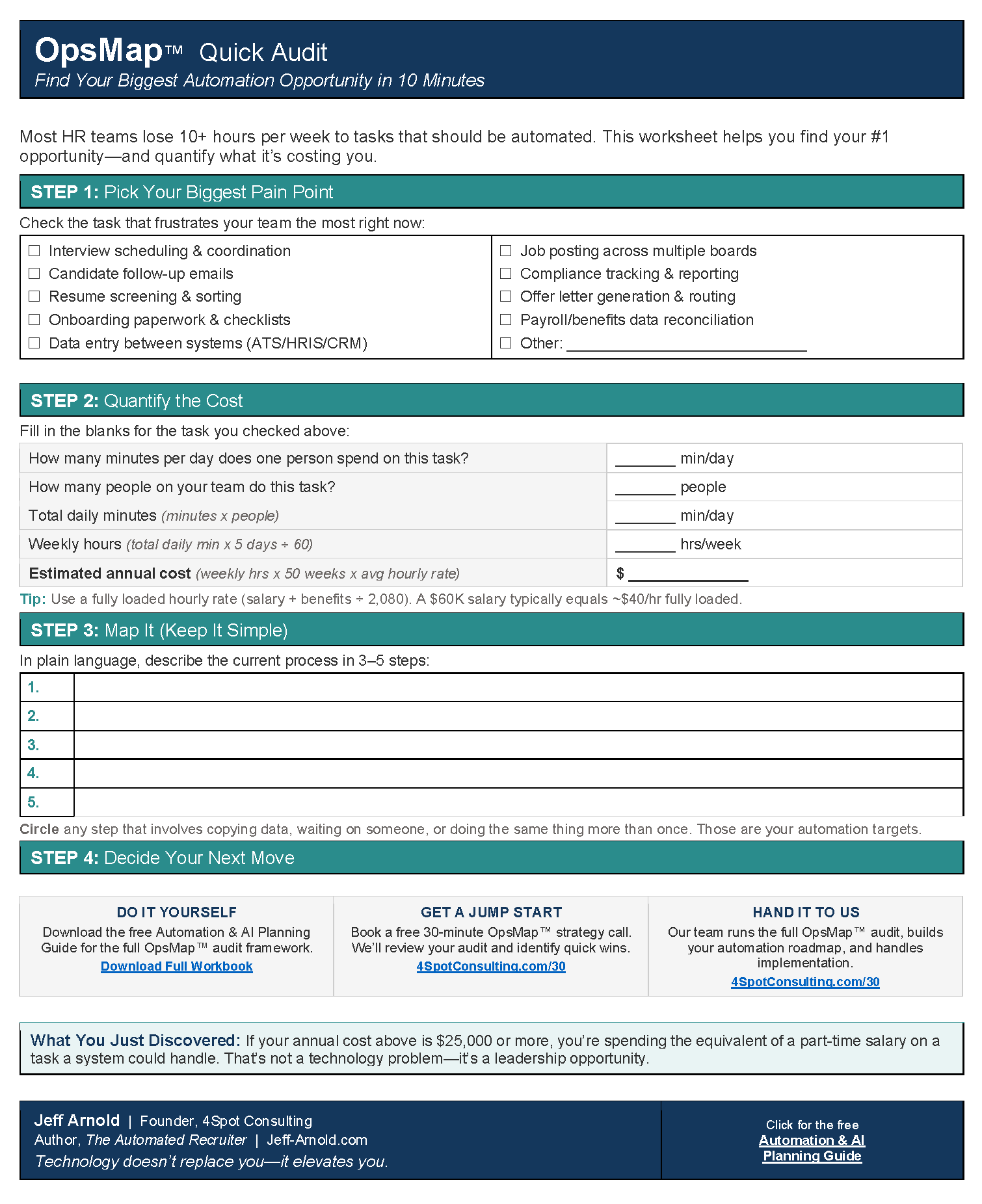
The OpsMap™ assessment 4Spot runs with clients surfaces exactly this. It documents your current workflow reality, not your intended one. Those two are almost never the same. Shadow processes, tribal knowledge, and informal workarounds show up in the map and get resolved before a single scenario gets built. Automating an undocumented process just makes errors happen faster.
- Document every trigger: What starts the process? A form submission, an inbound email, a calendar event, a payment confirmation?
- List every handoff: Where does one person or system pass work to another?
- Identify every manual step: These are your automation candidates.
- Note every exception: What are the edge cases that break the normal flow?
Once you have the map, rank automation candidates by volume and pain. High-frequency, high-pain steps go first. That is how you build momentum without taking on too much at once. For a full picture of what happens when this step gets skipped, see 10 Real Examples of Why Clean Processes Must Come Before Any HR Automation.
Step 2: Build the Automation Skeleton with Make.com
Make.com handles complex, multi-step integrations without requiring a developer, which is why it is the primary build platform at 4Spot. The goal in this phase is to replace every manual step from your process map with an automated trigger, filter, or action. No AI yet—just clean, deterministic automation that runs the same way every time.
Inside the OpsSprint™ engagement model, this is the build phase. Scenarios get constructed, tested against real data, and signed off before going live. Error handling is built in from the start, not bolted on after the first failure. If a scenario breaks, it breaks loudly with a notification—not silently with a lost record.
The core build sequence for any scenario:
- Trigger: Define exactly what kicks off the scenario—a webhook, a schedule, a new CRM record, an inbound email.
- Filter: Set conditions so the automation fires only on the right records.
- Transform: Format data so it matches what the destination system expects.
- Route: Send data to the right place—CRM, email, spreadsheet, Slack, or wherever action happens.
- Confirm: Log the execution with a timestamp so you have a traceable record of what ran and when.
Run the scenario in test mode against real records before activating. Do not move to Step 3 until the automation handles both normal flow and edge cases cleanly. See 10 Essential Make.com Integrations to Unlock Cheaper, More Powerful Business Automation for specific integration patterns worth building first.
Step 3: Layer In AI Where It Creates Real Leverage
Once the automation runs reliably, identify the steps where human judgment was providing value—classifying information, drafting responses, analyzing variable data, making routing decisions—and evaluate whether AI handles those well. Not every manual step benefits from AI. Deterministic decisions belong in logic, not a model.
AI earns its place in a workflow when the task involves variable input that requires interpretation. Classifying a support ticket, generating a draft email response, extracting structured fields from unstructured text, scoring a record against defined criteria—these are the places AI adds consistent value without needing a human to frame every call. The OpsBuild™ process layers these capabilities onto the existing automation skeleton rather than replacing it.
Practical places to add AI on top of working automation:
- Email response drafting: The automation receives an inbound message, passes it to an AI module, gets a draft reply, and routes it to a human for review before sending.
- Record classification: A new lead comes in and AI scores it by service fit, urgency, or source quality before routing it to the right follow-up sequence.
- Data extraction: A PDF or form submission gets passed to an AI module that pulls structured data fields and writes them directly to the CRM.
- Summarization: Meeting transcripts, support tickets, or long emails get condensed automatically so the decision-maker gets the short version, not the full thread.
Keep AI output logged and auditable. The automation skeleton is what makes AI outputs reviewable—you trace exactly what input the model received and what it returned. Without that structure, AI decisions become invisible and unaccountable. For implementation examples across real business processes, see 10 Real Examples of Automation First, Then AI.
Step 4: Monitor, Measure, and Lock In the Gains
Automation does not manage itself. Build monitoring in from day one so you know when a scenario fails, when volume spikes outside expected ranges, or when data quality degrades. The OpsCare™ model covers this—ongoing maintenance and health monitoring for live automation systems, not a one-time build-and-forget handoff.
The metrics that matter once automation is live:
- Scenario execution volume: Is the automation running as expected, or has something upstream stopped triggering it?
- Error rate: What percentage of runs are failing? Anything above a low baseline warrants investigation, not just acknowledgment.
- Processing time: Is the automation adding latency to a customer-facing process? If so, where is the bottleneck?
- Human intervention rate: How often does a person still have to step in? This is the clearest signal that automation coverage is incomplete.
Monthly reviews of these metrics tell you where to build next and where existing automation needs adjustment. The businesses that get compounding returns from automation treat it as an ongoing practice, not a project with a finish line.
Signs You Are Ready to Move from Automation to AI
Three indicators tell you the automation foundation is solid enough to support AI: the scenario runs without manual intervention for at least 30 consecutive days, the error rate stays below a defined threshold, and the team trusts the output enough to act on it without verifying every record. All three need to be true before you add AI to the loop.
Additional signals that point to AI readiness:
- You have a backlog of human decisions that follow a clear pattern but take time to execute one by one.
- Your automation moves data reliably, but the data still requires human interpretation before any action gets taken.
- Response quality or classification accuracy varies because different people apply different criteria to the same inputs.
- Volume has grown to the point where the human review step is the primary bottleneck in the process.
See 10 Signs You Need Automation First, Then AI for a full diagnostic checklist to run against your current state.
Expert Take
The most expensive automation mistake is layering AI onto a process that has not been mapped, cleaned, and automated first. AI amplifies whatever it touches—including the inconsistencies, the exceptions, and the missing data. Businesses that sequence this correctly get faster results, more reliable AI outputs, and a foundation they build on for years. Those that skip straight to AI spend twice as much fixing the problems they created by rushing.
Frequently Asked Questions
What is the difference between automation and AI in a business process?
Automation handles deterministic steps—tasks where the rule is clear and the output is always the same given the same input. AI handles tasks that require interpretation of variable or unstructured information. Both are necessary in a mature system; the sequence is what determines whether either one works.
How long does it take to build the automation foundation before adding AI?
Timeline depends on workflow complexity, but most single-process automation builds take two to eight weeks to map, build, test, and stabilize in production. Do not add AI to a scenario until it has run cleanly for at least 30 days without manual intervention.
Can I use AI tools like ChatGPT before any automation is in place?
Using AI manually for individual tasks is fine at any point—it works as a standalone aid for a person doing a specific job. The question is whether you want AI operating inside your business process at scale. For that, the automation foundation is not optional; it is what makes AI outputs consistent, auditable, and actionable across the whole operation.
What tools does 4Spot use to build the automation layer?
Make.com is the primary automation platform. It integrates with hundreds of business tools—CRMs, email platforms, project management systems, spreadsheets, document tools—without custom code. AI modules connect directly inside Make.com scenarios, which keeps the full workflow in one place and makes every step traceable.
How do I know if my automation is solid enough to add AI?
Three criteria apply: the scenario runs without manual intervention for at least 30 consecutive days, the error rate is consistently low, and the team acts on the output without spot-checking every record. All three need to be true. If any one of them is not, fix the automation before adding AI to the mix.
Part of our complete guide: Automation First, Then AI: Why Order Is the Whole Game.