Post: How to Implement: Automation First, Then AI
Implement automation before AI by auditing your workflows, identifying the highest-volume manual tasks, and building trigger-based automations that run without human intervention. Give those automations 30 days of clean runtime before layering in AI. That sequence ensures AI operates on reliable data – not on the broken process underneath that you never fixed.
Why the Order Matters
The biggest mistake businesses make when deploying AI is skipping automation entirely and expecting AI to fix broken processes on its own.
AI amplifies what is already there. If your lead routing is inconsistent, AI will route inconsistently – faster. If your follow-up sequences have gaps, AI will skip those gaps at scale. The sequence is not a technicality; it is the difference between compounding a problem and solving it.
For the numbers behind why this plays out the way it does, see 12 Stats That Explain Automation First, Then AI.
Step 1: Audit Your Workflows
Every implementation starts with a full map of what your team actually does today versus what your processes were designed to do – and those two things are almost never the same.
Walk through each department’s highest-volume tasks. Flag every place a human is copying data between systems, sending the same message repeatedly, making the same low-stakes routing decision, or chasing someone for an update that a system should trigger automatically.
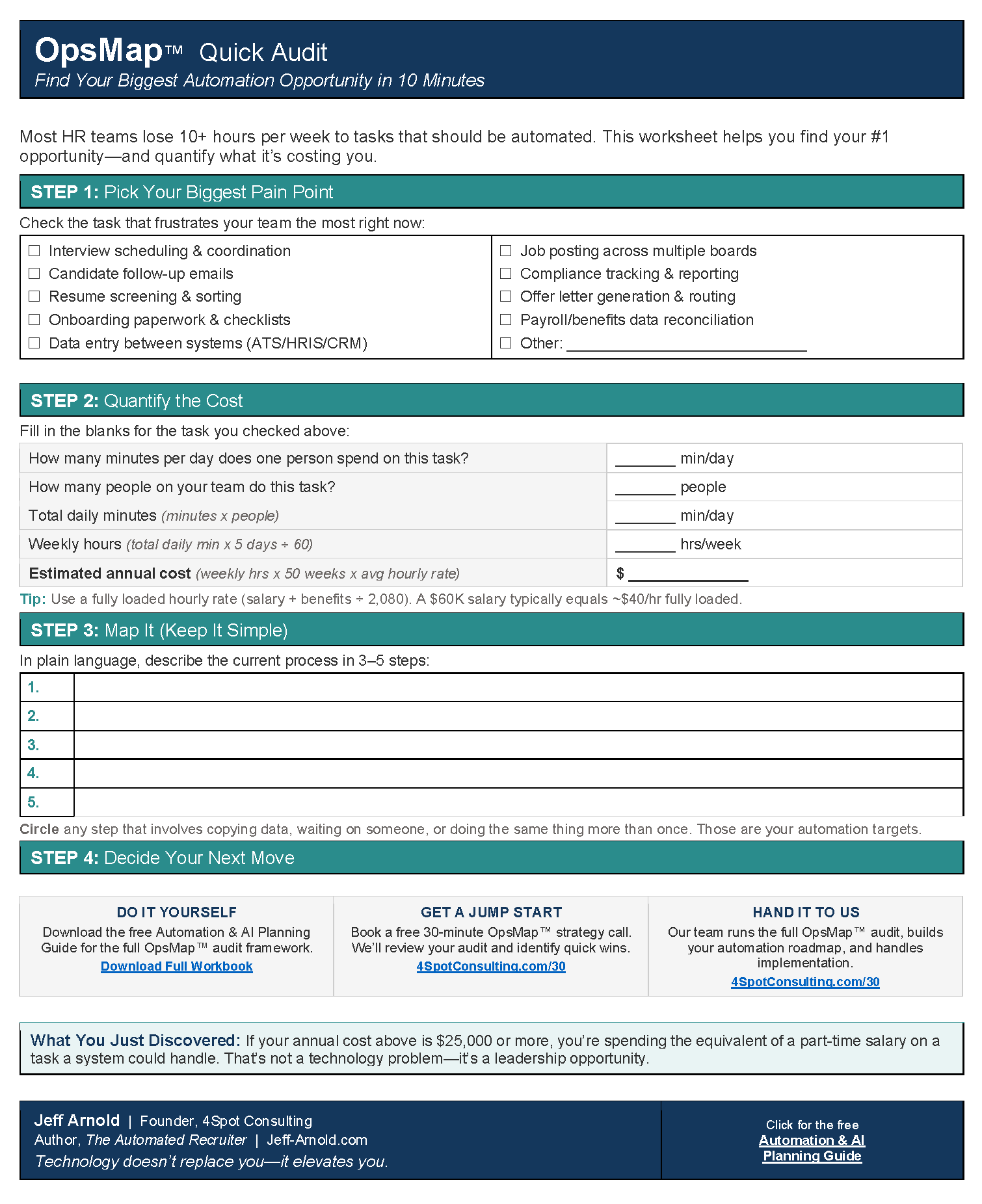
We run this phase as an OpsMap™ assessment – a structured process audit that produces a prioritized list of automation targets. The output is not a technology recommendation; it is a clear picture of where you are burning time on work that should not require a person.
See also: 10 Real Examples of Why Clean Processes Must Come Before Any HR Automation
Step 2: Build the Automations
Target the highest-volume, most repetitive tasks first – the ones where skipping automation costs you the most time per week.
For each target, define three things before you build:
- The trigger – what event starts the workflow
- The action – what needs to happen next
- The exception – what a human needs to handle when something breaks
We build these in Make.com because it handles complex, multi-step workflows without requiring a developer for every change. An OpsSprint™ engagement covers 8-12 automation builds in a focused window, with error handlers built into every branch.
Common first-wave automation targets:
- Contact form submission → CRM record creation + follow-up sequence
- New hire paperwork → task assignments + system access requests
- Lead stage change → assigned rep notification
- Invoice approval → payment trigger + accounting record update
Each automation needs a clear success condition and an error handler. An automation that fails silently is worse than the manual process it replaced.
Step 3: Measure Before Moving On
Run your new automations for a minimum of 30 days before adding AI, and track three things during that window: error rate, exception volume, and time-to-complete versus your manual baseline.
Error rate tells you whether the trigger logic is clean. Exception volume tells you whether the process definition was complete. Time-to-complete tells you whether you solved the actual bottleneck or just moved it downstream.
If error rate is above 5% after the first two weeks, fix the trigger logic before moving forward. AI on top of a leaky automation produces leaky outputs – at higher cost and lower visibility than the original manual process.
Step 4: Layer AI on Stable Ground
With automations running cleanly, you now have structured, reliable data inputs – and that is exactly what AI needs to produce accurate outputs.
The clearest first use cases for AI on top of automation:
- Lead scoring – AI evaluates incoming contacts against defined criteria and assigns a priority score
- Response drafting – AI generates first drafts of outreach that a human reviews before sending
- Anomaly detection – AI flags records that fall outside expected patterns
- Queue prioritization – AI ranks open tasks by urgency and business impact
What makes this work is that the underlying data is clean and the handoff points are defined. Without the automation layer underneath, AI produces confident-sounding outputs from inconsistent inputs – and that is a harder problem to diagnose than a manual error.
We build this layer as part of an OpsBuild™ engagement when clients are ready to move past automation into active AI deployment. For real-world examples of how this plays out, see 10 Real Examples of Automation First, Then AI.
Step 5: Build a Feedback Loop
Every AI output needs a structured mechanism for humans to flag when the AI got it wrong so the system can improve over time.
This does not have to be complex. A thumbs-up/thumbs-down on AI-drafted emails. A “flag for review” button on AI-scored leads. A weekly audit of AI outputs against actual outcomes. The data from those flags drives prompt refinement, model adjustments, and process corrections.
OpsCare™ is how we handle this post-deployment: ongoing monitoring, error triage, and performance tuning so the system keeps improving instead of quietly degrading.
Expert Take
The failure mode we see most often is not bad AI – it is good AI running on bad inputs. A business that feeds AI months of inconsistent, manually-entered data gets inconsistent outputs delivered faster and with more confidence than the human who created the underlying mess. The automation layer is not optional groundwork. It is the reason the AI produces anything worth trusting.
Frequently Asked Questions
How long does the automation phase take before we can add AI?
Four to eight weeks of clean runtime is the minimum for most businesses before the data is stable enough to support reliable AI outputs. The timeline depends on how much exception-handling you built into the automations and how consistent the incoming data is. Higher exception rates mean the process definition is incomplete – resolve that before AI enters the picture.
Can we run automation and AI at the same time?
Running both simultaneously works only when the AI is operating on a separate, already-clean data source – not on the same processes you are still automating. In practice, most businesses do not have a clean data source sitting idle. Start with automation, measure it, then layer AI in. The 30-day window is not bureaucratic caution; it is the minimum time needed to know whether the trigger logic is sound.
What if we already have AI tools deployed?
Audit what those tools are reading from. If the source data is inconsistent or the inputs are unstructured, the AI is producing results you cannot trust – even if they look plausible. The fix is to build the automation layer beneath the existing AI deployment and run both in parallel for a measurement window. Once the automated inputs stabilize, you will see the output quality shift noticeably.
Do we need a developer to implement this?
Not for the automation layer – Make.com handles complex, multi-step workflows through a visual builder that does not require code. For AI integration, the complexity depends on what you are connecting and how the outputs need to behave. An OpsMesh™ engagement covers both layers and handles the technical implementation so your team can focus on defining what the process should do, not on how to wire it up.
Not sure if your operation is ready for this sequence? Start with 10 Signs You Need Automation First, Then AI before you build anything.
Part of our complete guide: Automation First, Then AI: Why Order Is the Whole Game.