Post: Case Study: Automation First, Then AI
When a growing HR staffing firm came to 4Spot Consulting asking for AI, the audit uncovered a more urgent gap: no reliable automation existed underneath. 4Spot built the automation layer first, then added AI on top. The result was a system that scaled without constant firefighting – and kept running without manual intervention.
The Client’s Starting Point
The client ran a 40-person HR staffing operation with a CRM, an ATS, and a set of manual processes that had grown organically over several years. Revenue was climbing. Headcount was not keeping pace. Leadership had heard the pitch on AI – smarter matching, predictive analytics, automated outreach – and wanted it immediately.
The problem: none of their core workflows were automated. Candidate data moved between systems by hand. Follow-up emails went out whenever someone remembered. Onboarding checklists lived in a shared spreadsheet. When a recruiter left, institutional knowledge walked out the door with them.
They did not need AI. They needed a foundation.
What the Audit Revealed
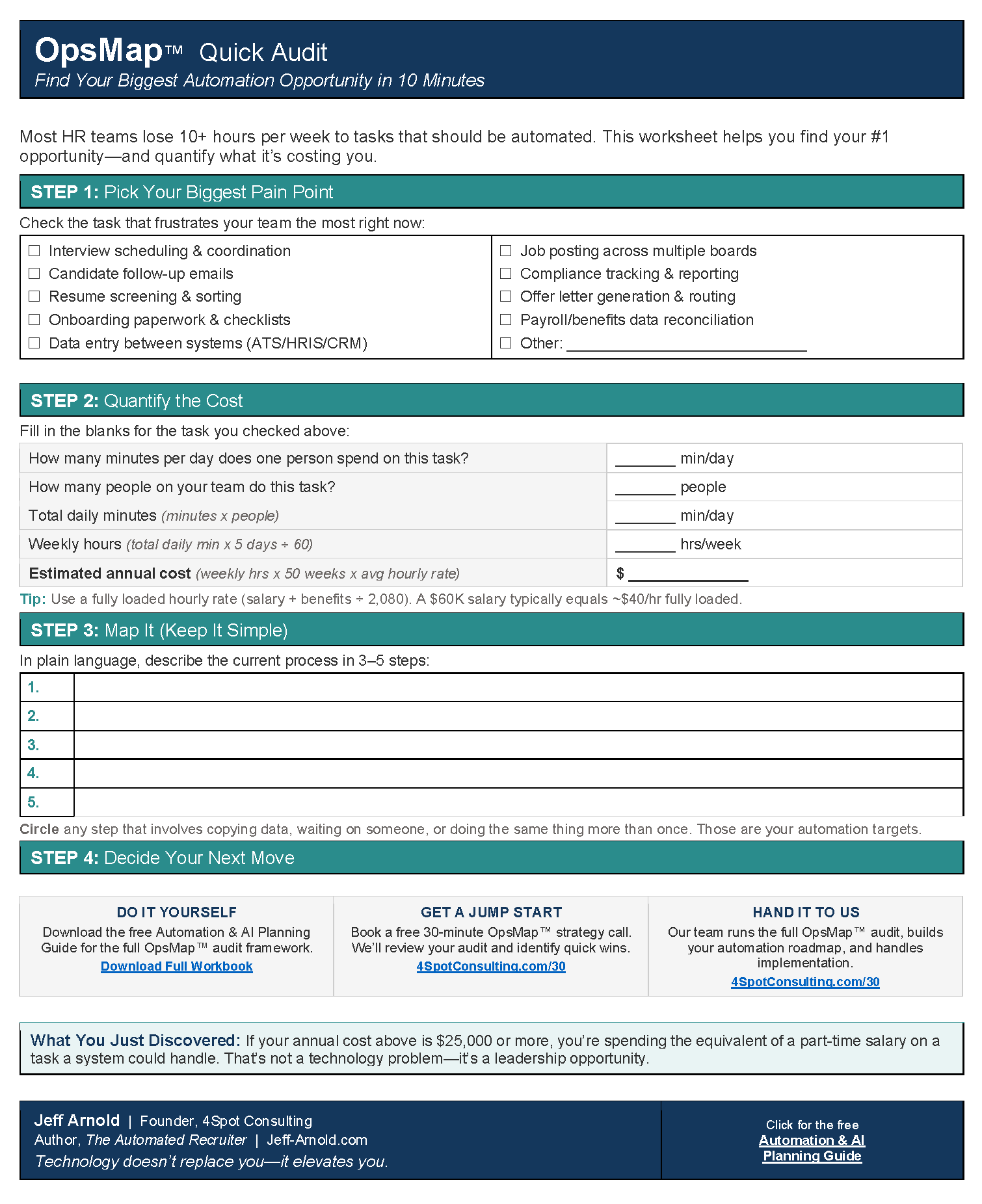
The first step was an OpsMap™ – a structured audit of every process touching candidate acquisition, onboarding, and client reporting. The findings were consistent with what 4Spot sees across most mid-size staffing operations: the manual work was not the root problem. The lack of documented, repeatable processes was.
- Candidate intake had seven handoff points, none of them tracked in the CRM
- Client reporting required three hours of manual data pulls every week
- Follow-up sequences existed in one recruiter’s memory, not in the system
- No automation connected the ATS to the CRM – data was re-entered by hand
Deploying AI onto this stack would have automated the chaos, not eliminated it. The case for clean processes before automation is not theoretical – it surfaces in every engagement structured like this one.
Phase One: Building the Automation Layer
The OpsBuild™ phase ran six weeks. Every core workflow got documented, simplified, and automated before anything AI-related was introduced. The stack: Make.com as the automation backbone, Keap as the CRM, and the existing ATS connected via API.
What got built:
- Automated candidate intake routing from form submission to CRM contact creation to ATS record – zero manual data entry
- Follow-up sequences triggered by pipeline stage changes, not by recruiter memory
- Weekly client reports auto-generated from live CRM data and delivered on schedule
- Onboarding checklists migrated into the CRM with automated task assignment and deadline tracking
This is the phase most clients want to skip. It is also the phase that determines whether the AI layer works six months later. See the 10 signs your operation needs automation before AI for the diagnostic version of this conversation.
Phase Two: AI on a Solid Foundation
With the automation layer running cleanly for four weeks, the OpsMesh™ integration work began. AI was introduced in three specific areas where clean, structured data already flowed in real time:
- Candidate scoring: AI evaluated incoming applications against role criteria using structured data flowing automatically from intake forms – no gaps, no stale fields
- Outreach personalization: AI-drafted initial outreach messages pulled from CRM data fields that automation kept current – no hallucinated details, because the data was real
- Pipeline forecasting: AI analyzed historical placement data, now clean and complete after weeks of automated logging, to surface stall patterns by role type
The AI worked because the data was clean. The data was clean because automation ran before AI was introduced. This sequence is not a preference – it is the only order that produces reliable output. Real examples of automation first, then AI follow this same pattern across every industry vertical.
Results Eight Weeks Post-Launch
Eight weeks after go-live, the operation had changed in measurable ways:
- Manual data entry between systems dropped to near zero
- Follow-up response rates climbed because sequences ran on time, every time, regardless of which recruiter owned the contact
- Client reporting shifted from a three-hour weekly manual process to a scheduled, automated delivery
- The AI scoring layer flagged high-fit candidates faster than the previous manual screen
- New recruiters onboarded to a documented, automated system instead of learning by asking the tenured team
The client’s original ask – AI – was delivered. But only after the foundation made it viable. For a look at the labor scale these builds address, see the 103K annual labor hours Make automation case study.
Expert Take
The most common failure in AI implementation is sequencing. Organizations chase the visible, impressive layer – the AI – and skip the invisible, essential layer underneath. Automation is not a prerequisite because of ideology. It is a prerequisite because AI needs clean, structured, real-time data to produce reliable output. You do not get that from a manual process. Build the pipes first. The AI has somewhere to run.
Why the Order Is Non-Negotiable
The OpsSprint™ model 4Spot runs for time-constrained engagements compresses this sequence without skipping steps. Automation comes first because every AI layer downstream depends on it. This is not a consulting preference – it is an operational reality backed by the stats behind automation-first implementations.
When clients push back on the phased approach, the answer is direct: AI built on unautomated processes automates the problem, not the solution. The extra weeks spent on the automation foundation pay back in the first month of AI operation, when the system runs without human correction loops eating the time savings you expected.
Frequently Asked Questions
How long does the automation phase take before AI is introduced?
For most mid-size operations, four to eight weeks covers core workflow automation – intake routing, follow-up sequencing, reporting, and system data sync. Larger or more complex stacks take longer. The benchmark is not a calendar target; it is data quality: when your CRM reflects operational reality without manual intervention, the AI layer is ready.
Can AI tools be used during the automation build phase?
AI tools that assist with the build itself – drafting automation logic, generating test scenarios, reviewing data mappings – are useful throughout. AI tools that operate on production data belong after the automation foundation is stable. The distinction is AI as a build tool versus AI as a production system running on live records.
What happens when organizations skip the automation layer?
The AI produces unreliable output, because the data feeding it is incomplete, inconsistent, or stale. Teams spend time correcting AI output instead of acting on it. Adoption drops. The tool gets blamed for a sequencing problem. The investment fails – not because AI does not work, but because the foundation was never built.
Does automation-first sequencing apply to small teams?
Small teams benefit from automation-first sequencing more than large ones, not less. A three-person operation running clean automation handles volume that would otherwise require additional headcount. Adding AI to that foundation extends the leverage further. See HR-of-one tools that actually reduce admin load for the small-team version of this build.
Part of our complete guide: Automation First, Then AI: Why Order Is the Whole Game.