Post: A Customer Story: Automation First, Then AI
A business owner called us wanting AI. They had already bought three AI tools, none of which were working. Fourteen weeks later, their operation runs on a Make.com automation foundation that eliminated the manual work feeding those tools bad data – and the AI tools they already owned started producing results worth acting on.
The Call That Started It
The client called on a Tuesday afternoon with a single agenda item: their AI tools were not working. They had subscribed to an AI candidate scorer, an AI communication drafting tool, and an AI pipeline forecasting add-on inside their ATS. All three had been in place for six months. None had made it into their team’s regular workflow.
The conversation went the way it always goes. The tools looked impressive in demos. Implementation was smoother than expected. The team ran a pilot. The outputs came back inconsistent – sometimes useful, often wrong enough to be unusable. After a few weeks of reconciling AI recommendations against what recruiters already knew from working the accounts, the team quietly stopped opening the dashboards.
The assumption, when they called us, was that they needed better AI. What they actually needed was better data going into the AI they already had.
What We Found When We Got There
The audit started with a simple question: where does a new candidate record go when it arrives?
The answer was different for every recruiter on the team. Some logged directly into the ATS. Some captured in email first and updated the ATS later. One senior recruiter kept a personal spreadsheet and batch-updated the ATS on Fridays. A shared inbox collected applications from two job boards, and whoever happened to check it that day decided what to do with what was in it.
That inconsistency is not a hiring problem or a training problem. It is an automation problem. When there is no automated process enforcing a single intake path, people create their own – and every personal system produces different data shapes, different field completions, different timing. The AI tools the business had purchased were reading from all of those variations simultaneously and producing outputs that reflected the noise, not the signal.
The same pattern showed up in follow-up, in status updates, in client communication, and in offboarding. Every workflow that should have been automated was instead running on recruiter memory and personal habit. Every place that ran on habit was a place where the data was inconsistent. And inconsistent data, fed into an AI tool, produces the kind of outputs teams stop trusting after two weeks.
Expert Take
The warning signs of this kind of operation are visible before you open a single tool. Multiple intake paths for the same data. Manual processes that run on whoever remembers. Status fields that nobody updates consistently. Spreadsheets that live alongside a CRM instead of inside it. Each one is a flag that the foundation is not ready for AI – and that adding AI will make the inconsistency more expensive, not less visible.
The Conversation Nobody Wanted to Have
Telling a client they need to set aside their AI tools is not a popular message.
This team had invested in those tools. They had run implementation workshops. They had presented the AI roadmap to their board. Walking back into that conversation with a recommendation to pause the AI layer and spend the next eight weeks building Make.com automation scenarios was not what anyone in the room had expected to hear.
We made the case with the data we had found. The candidate scorer was reading from ATS records that were missing data on most of the fields it weighted most heavily. The communication tool was generating drafts that pulled context from notes fields – the least consistently filled fields in the entire system. The pipeline forecast was running off status data that was updated days after the actual status change, not on the day it happened. The tools were not underperforming. They were performing exactly as designed, on inputs that made their outputs unusable.
The conversation shifted when we put it this way: the AI tools they had were fine. The data those tools needed to work was not there yet. Building that data foundation was not a setback from the AI roadmap – it was the prerequisite that made the AI roadmap executable. The 11 common mistakes HR teams make automating internally documents why this gap shows up so consistently: teams add capability before they add consistency, and the capability stalls every time.
Building the Foundation They Skipped
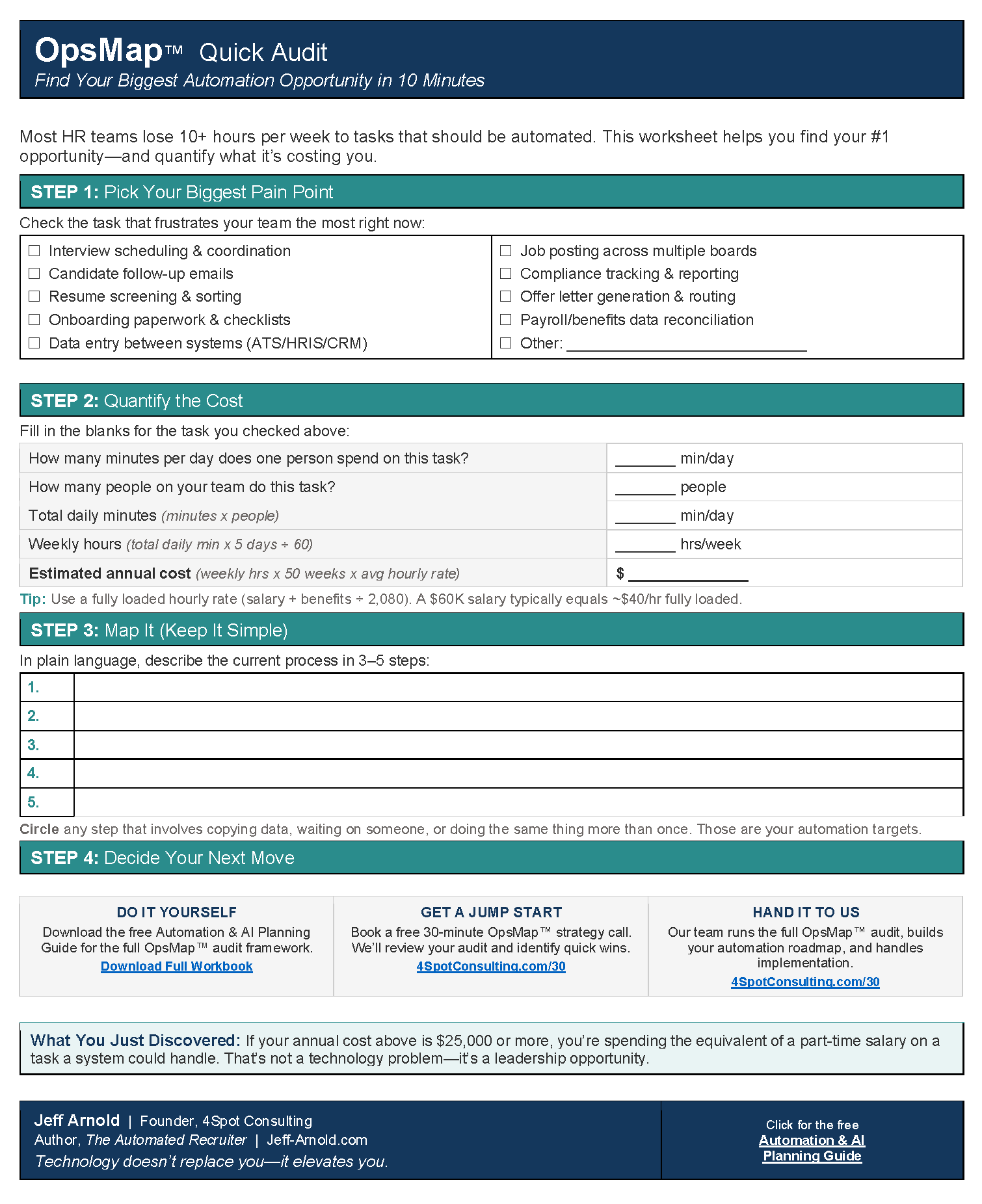
The OpsMap™ produced a prioritized list of manual steps that should have been automated before any AI tool was introduced. We sequenced the build by downstream impact – which gaps were creating the most data noise in the systems the AI tools were reading from.
Candidate intake came first. A single Make.com webhook routed every application – regardless of source – into a standardized flow. Fields mapped consistently. Duplicates ran through a deduplication check before a record was created. The ATS received a complete, structured record within minutes of an application arriving, regardless of which recruiter was on shift or which job board sent it.
Follow-up sequences came next. Every stage transition in the ATS fired a trigger. Recruiter notifications went out at the right time. Candidate communication drafted and queued for review. Client status updates sent on a defined schedule, not whenever someone remembered. The OpsSprint™ build was eight weeks of foundational infrastructure work – error handlers, retry logic, audit trails, failure alerts. Nothing visual. Nothing that impressed anyone in a demo. All of it critical to what came next.
OpsCare™ started the moment the scenarios went live – not as a future engagement, but as part of the launch. Automated health checks ran nightly. Any scenario that failed without completing triggered an alert before anyone on the team noticed a downstream gap. The foundation was built to stay reliable, not just to launch successfully.
When the AI Tools Started Working
The AI test came ninety days after the automation foundation launched.
We reconnected the same candidate scorer tool – same vendor, same configuration, same subscription. Now it was pulling from ATS records populated by ninety days of automated, consistently structured intake. The scoring outputs the team had ignored for six months were suddenly defensible. Recruiters started acting on the top-scored candidates without manually cross-checking their own notes first. Not because the tool changed. Because the data it was reading changed.
The communication drafting tool had the same turnaround. With candidate notes logged consistently through automation rather than sporadically through manual entry, the drafts it produced reflected actual relationship history. Recruiters spent their time refining a draft that was substantively accurate instead of discarding one that was wrong about the basics.
The pipeline forecast is the result the leadership team references most now. Status data updates the same day a status changes – because the automation triggers on the event, not on a recruiter’s memory. The forecasts they had stopped trusting are the ones they lead their weekly client meetings with. For a broader look at what this sequence produces across different operation types, 10 real examples of Automation First, Then AI covers the pattern in detail.
What This Changes About How They Work
The most important shift was not a technology change – it was a decision-making change.
Before the automation foundation, every decision about what the AI was telling them required validation against what the recruiter already knew. The team trusted their own judgment over the system’s outputs, because the system’s outputs had been unreliable. That validation step is expensive – it is the work that was supposed to disappear when they invested in AI tools.
After the foundation, trust moved back toward the system. Recruiters acted on the scorer’s recommendations without manual verification. Managers used the pipeline forecast in client conversations instead of hedging with caveats about accuracy. The AI layer went from a tool the team tolerated to a tool the team reached for – because the data underneath it was finally reliable.
The OpsMesh™ powering this client’s operation now is not a collection of separate tools. It is an interconnected system where automation feeds AI, AI informs recruiters, and recruiter decisions feed back into a structured data model that makes the next AI output more accurate. That flywheel only works if the automation foundation was built right first. If you want to check whether your own operation is ready for that sequence, 10 signs you need Automation First, Then AI is the diagnostic we hand clients before the first call.
Expert Take
The client in this story did not make a mistake buying AI tools early. They made a sequencing mistake. The tools they purchased are legitimate and they work. The lesson is not “buy less AI” – it is “build the foundation before you expect AI to perform.” Every operation that skips that step ends up in the same place: expensive tools their team quietly stopped using, and an automation build they need anyway before anything else gets better.
Frequently Asked Questions
Why did buying AI tools first cause problems?
AI tools process whatever data they receive, and they cannot compensate for data that is inconsistent, incomplete, or manually entered by different people in different ways. Clean, structured, automated data is the prerequisite – not something AI generates on its own. When the data coming in is unreliable, the recommendations going out are unreliable, and the team stops using the tool.
How do you know when the automation foundation is ready for AI?
The test is data consistency across a full operating cycle. When automated workflows have run for at least 60 days without manual intervention and the records they produce are complete and structured consistently, the AI layer is ready. That is not an arbitrary threshold – it is the minimum needed for AI outputs to reflect signal instead of noise from irregular inputs.
Can we run the automation build while keeping our existing AI tools active?
The tools can stay in place during the automation build. The recommendation is not to cancel subscriptions – it is to stop expecting those tools to perform while the foundation is under construction. Running them in parallel during the build creates confusion about whether any output improvements come from the tool or from better data inputs. Let the foundation stabilize, then re-evaluate from a clean starting point.
What does an OpsBuild™ engagement actually deliver?
An OpsBuild™ engagement delivers running Make.com scenarios covering every workflow gap identified in the OpsMap™ diagnostic phase, plus error handling, audit trails, failure alerting, and scenario documentation. The deliverable is not a strategy document – it is a live, tested automation layer running in production. OpsCare™ then maintains that layer as the business changes, so the foundation does not decay the moment a vendor updates an API or a team member leaves.
Part of our complete guide: Automation First, Then AI: Why Order Is the Whole Game.