Post: Inside a Successful Automation First, Then AI Implementation
A successful “Automation First, Then AI” implementation follows three non-negotiable phases: map and clean broken processes, automate the stable workflows, then layer AI where human judgment was the actual bottleneck. Companies that skip straight to AI consistently see the same result — expensive tools running on top of the same broken processes.
Why Sequence Is Everything in Automation and AI
The order of operations is the entire strategy. When 4Spot Consulting engages a new client, the first question is never “which AI tool should we add?” — it is “do you have any process worth automating?”
Most HR and operations teams do not. What they have are workarounds, tribal knowledge, and manual hand-offs that exist because the original system never worked right. Dropping AI on top of that infrastructure does not accelerate the business — it accelerates the chaos.
The OpsMesh™ framework solves this by establishing a fixed sequence: process clarity before automation, automation before AI. That sequence exists because each layer depends on the one below it. AI cannot make good decisions on dirty inputs. Automation cannot run reliably on undefined processes.
For a detailed look at what triggers this kind of engagement, see 10 Signs You Need Automation First, Then AI.
Phase One: The OpsMap Assessment
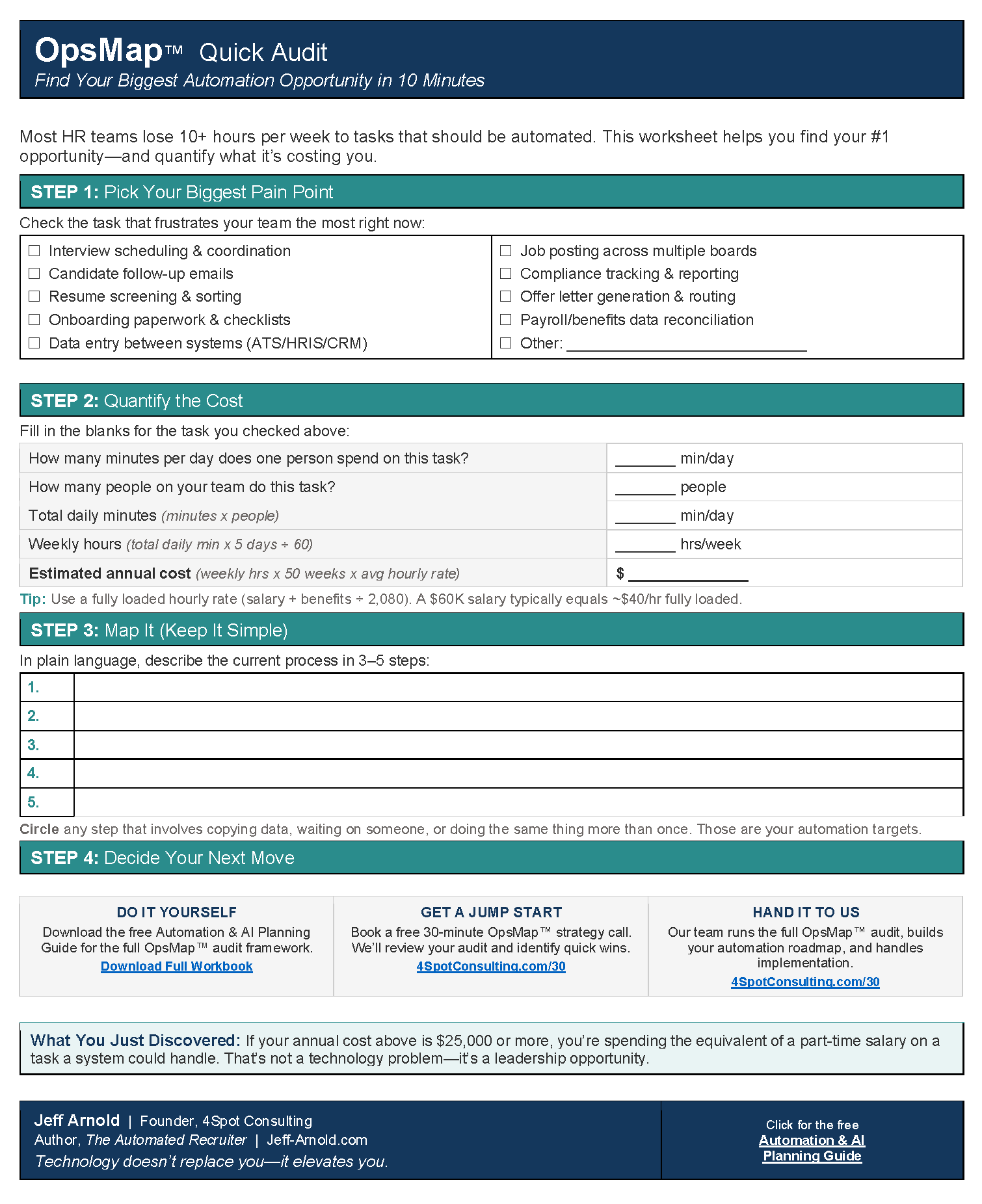
Every engagement begins with an OpsMap™ — a structured diagnostic that surfaces where the real friction lives before a single scenario gets built.
The OpsMap is not a discovery call. It is a formal audit that maps every manual touchpoint in the client’s core workflows: what triggers it, who handles it, what system it lives in, and what breaks when someone is out sick. The output is a prioritized list of automation targets, ranked by time cost, error rate, and downstream impact.
This audit also catches the process problems that would have broken any automation built on top of them. Duplicate records, undefined ownership, missing approval gates — these surface in the OpsMap and get fixed before any tool touches them.
In practice, most clients discover that the majority of their manual work is concentrated in three to five repetitive tasks that no one had thought to question because “that’s just how it’s done.” The OpsMap names them, quantifies them, and puts them first in line for the build sprint.
See also: 10 Real Examples of Why Clean Processes Must Come Before Any HR Automation.
Phase Two: The OpsSprint Build
Once the process map is clean, the OpsSprint™ converts it into running Make.com scenarios in a focused two-to-four week window — before AI gets introduced anywhere.
The OpsSprint is deliberately scoped. It does not try to automate everything. It targets the highest-impact items identified in the OpsMap and builds them to production quality: named modules, error handlers, audit trails, and failure notifications. Each scenario runs clean before anything else gets added.
This constraint is intentional. Teams that automate and add AI simultaneously lose the ability to diagnose problems. When something breaks, they cannot tell whether the automation logic failed or the AI output was bad. Separating the phases gives you clean data to answer that question.
The build phase also trains the team. By the time the OpsSprint closes, the client understands exactly what their automation does, how to read the logs, and when to intervene. That foundation is what makes AI safe to add.
Phase Three: Layering AI on Proven Automation
AI enters the stack only after automation has run stable for a defined period — and only at the decision points where human judgment was the actual bottleneck.
This distinction matters. Most AI implementations fail not because the model is bad, but because the team tried to use AI to fix a process problem rather than a judgment problem. AI does not clean up bad data. It does not fix undefined handoffs. It does not compensate for a workflow that was broken before it arrived.
What AI does well: classify incoming leads when volume exceeds what a human can review, draft first-pass communications that a human then sends, flag anomalies in data streams that automation is already processing, and surface patterns across datasets too large for manual review.
In the OpsMesh™ framework, this is the OpsBuild™ phase — where the automation infrastructure built in the OpsSprint™ becomes the data feed and trigger layer for AI-augmented decision-making. The AI layer sits on top of clean, structured, reliable data. That is the only condition under which it adds value instead of noise.
For real-world examples of this phase in action, see 10 Real Examples of Automation First, Then AI.
What a Successful Implementation Actually Looks Like
A successful implementation has four visible characteristics: the team runs fewer tools, not more; manual exceptions decrease week over week; AI outputs are auditable because the data feeding them is clean; and the client can operate the system without the consultant in the room.
That last point is the real test. Systems built on poorly understood automation require the builder to maintain them indefinitely. Systems built on the Automation First, Then AI sequence are understood by the team running them — because the team watched them get built in the correct order.
The OpsCare™ layer formalizes this: ongoing monitoring, scenario health checks, and quarterly reviews that keep the system performing as the business changes. It is not a support contract. It is the operational discipline that prevents the automation stack from drifting back into the manual chaos it replaced.
The data behind this approach is in 12 Stats That Explain Automation First, Then AI.
Expert Take
Consultants who skip the process audit and go straight to building scenarios are the same ones who get called back six months later to fix broken automation. The sequence is not a philosophy — it is an error-prevention protocol. You cannot automate your way out of a process problem, and you cannot AI your way out of bad automation. The discipline is in doing things in the right order, every time, without exceptions.
Common Mistakes That Break the Sequence
Three failure patterns account for the vast majority of failed implementations: starting with the tool instead of the process, automating too many things at once, and adding AI before the automation layer is stable.
Starting with the tool is the most common. A team signs up for an AI platform, builds workflows around its features, and discovers six months later that the platform does not fit how the business actually operates. The OpsMesh™ sequence inverts this — the process drives the tool selection, not the other way around.
Automating too many things at once creates a debugging problem with no clean solution. When ten scenarios go live simultaneously and three of them break in the first week, the team cannot identify the failure point without shutting everything down. Scoped sprints prevent this by design.
Adding AI before the automation is stable is the fastest path to distrust in the technology. The AI outputs look unreliable because the inputs are inconsistent. The team concludes that “AI doesn’t work for us” when the actual problem is that the data pipeline was never clean enough to support it.
See 10 Signs You Need Clean Processes Before Any HR Automation to identify whether your organization is at risk for these patterns.
Frequently Asked Questions
How long does a full Automation First, Then AI implementation take?
A complete implementation runs eight to sixteen weeks from OpsMap to stable AI layer, depending on the complexity of the existing systems and the number of workflows targeted in the initial sprint.
Do we need to replace our current tools before starting?
No. The OpsMap audit identifies which tools stay, which get replaced, and which are redundant. Most implementations run on the client’s existing stack with targeted additions rather than full replacements.
What if we already have AI tools deployed?
The diagnostic starts with the process audit regardless of what is already deployed. Existing AI tools get evaluated as part of the OpsMap — some stay, some get removed, and the automation layer gets built to support the ones worth keeping.
How is this different from hiring an automation developer?
A developer builds what you specify. The OpsMap™ process finds what you actually need — which is almost always different from what you think you need when you start. The sequence, the scoping, and the discipline around what gets built and when are what separate an operational system from a collection of scenarios.
Part of our complete guide: Automation First, Then AI: Why Order Is the Whole Game.