Post: How a Small Business Tackled: Automation First, Then AI
Small businesses that build the automation layer before buying AI tools end up with AI that delivers results from week one. This case study follows a 14-person professional services firm through 4Spot Consulting’s OpsMesh™ framework – from fragmented manual operations to a structured automation foundation that made their first AI deployment produce usable outputs before the trial period ended.
The Business: Growing Fast with Zero Operational Infrastructure
The firm had grown from six people to fourteen in under two years, entirely on referrals and the quality of its deliverables. Operations had never been the priority. The work was good. The systems holding the work together were not.
Client onboarding ran through a shared inbox and whoever was available to respond. Project status updates went out when someone remembered to write them – not on a schedule, not triggered by milestones. Invoicing ran two to three weeks behind project completion because billing was manually initiated and often fell to the principal, who was also running client calls.
New business inquiries landed in three different places: a contact form, a direct email, and a phone number that forwarded to a cell. Follow-up depended entirely on who happened to see the inquiry first and whether they had time to act on it that day. The firm had lost two contracts in the prior quarter to slower competitors who had simply responded faster.
They were not looking for AI when they came to 4Spot Consulting. They were looking for a way to stop losing deals to response time. The AI conversation came later – and because of the sequence they followed, it landed very differently than it does for most small businesses.
The Insight That Changed the Approach
The first conversation with 4Spot Consulting started where it always does: what is the actual problem, not the perceived solution. The firm’s instinct was to evaluate CRM software and look at AI chatbots for inquiry response. Both instincts were reasonable. Both were also pointed at the wrong layer.
The problem was not that the firm lacked tools. The problem was that the work happening between tools was entirely manual – meaning inconsistent, timing-dependent, and impossible to hand off without recreating the logic in someone’s head every time. Adding a CRM to a manual operation does not fix the operation. It gives the manual operation a more expensive place to be inconsistent.
The OpsMesh™ framework addresses this directly. Before any tool decision is made, every workflow gets mapped at the trigger level: what starts it, what decisions branch it, what breaks when nobody does it. That map produces a prioritized list of automation candidates – the manual steps that technology should be handling. Once those are automated and running cleanly, the question of which AI tool to introduce becomes answerable from evidence instead of from a vendor demo.
The firm’s principal absorbed this in one conversation and made a decision that most small businesses do not make: they committed to building the foundation before buying the AI. That sequencing discipline is what the rest of this case study is about.
If you are trying to determine whether your own operation is sequenced correctly, 10 signs you need Automation First, Then AI is the right starting diagnostic.
Expert Take
Most small businesses evaluate AI tools and automation tools in the same shopping session, as if they solve the same problem. They do not. Automation replaces manual steps with reliable, repeatable triggers. AI interprets patterns and generates outputs based on data it reads. If the data it reads comes from a manual process, its outputs reflect all the inconsistencies baked into that process. Build the automation layer first. Then the AI has something worth reading.
Phase One: Mapping the Real Operation with OpsMap
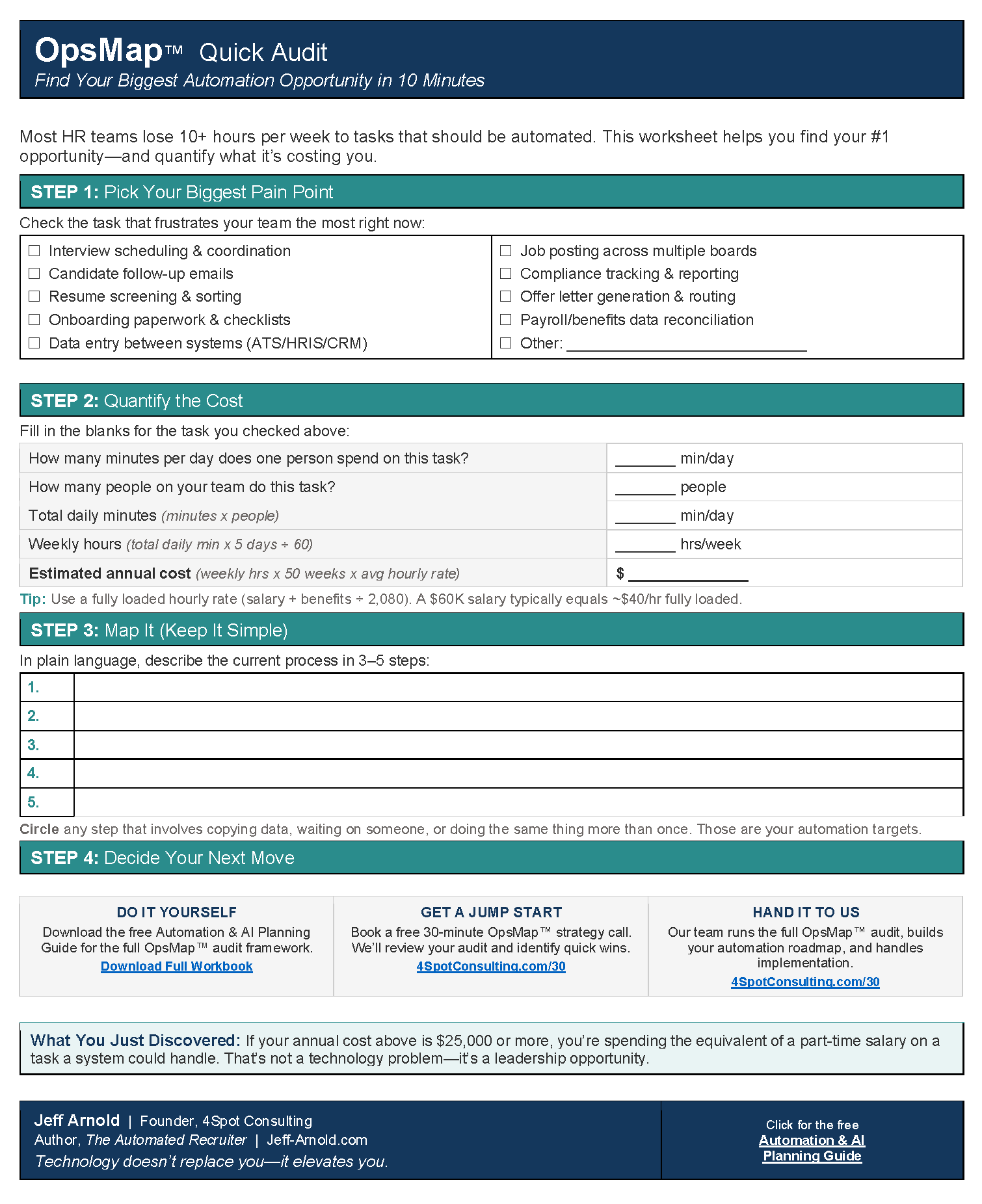
OpsMap™ is the diagnostic phase – not a gap assessment against best practices, but a literal documentation of what the operation actually does today. The output is a workflow map with trigger points, decision branches, manual steps, failure modes, and a prioritized list of automation candidates ranked by downstream impact.
For this firm, the OpsMap surfaced five core workflow gaps:
- Inquiry capture: New business inquiries arriving through three separate channels with no unified intake, no response SLA, and no handoff protocol. Whoever saw it first handled it – or did not.
- Proposal tracking: Proposals sent but not tracked in any system. Follow-up timing was based on the salesperson’s memory of when the proposal went out. No task was created. No reminder was set. No second follow-up happened unless the prospect responded.
- Client onboarding: Onboarding involved twelve steps across four people. The sequence existed in a shared document that was three months out of date and that three of the four people involved admitted they had not checked recently.
- Project status updates: Client-facing updates went out when there was news and someone had time to write the email. Internally, project status lived in a combination of a project management tool, Slack messages, and verbal updates during weekly meetings.
- Invoicing trigger: Invoices were manually initiated by the principal. The average delay between project completion and invoice creation was sixteen days. The principal acknowledged this during the OpsMap review and noted it had been a problem for at least eighteen months.
None of these were strategic problems. All of them were automation problems. Each one had a clear trigger that should have been running automatically – and was not, because no one had built the automation yet.
Phase Two: Building the Automation Layer with OpsBuild
OpsBuild™ is where the documented gaps become running Make.com scenarios. The build sequenced by downstream revenue impact – the inquiry capture and proposal follow-up failures were costing the firm deals, so those went first.
Inquiry capture: A Make.com webhook unified all three intake channels into a single flow. Every new inquiry – regardless of source – created a CRM contact, sent an auto-acknowledgment within five minutes, assigned a follow-up task to the correct team member, and logged the inquiry source for pipeline tracking. The three-channel fragmentation was eliminated in one scenario.
Proposal follow-up: When a proposal was marked Sent in the CRM, a Make.com scenario set a five-day follow-up reminder, then a ten-day second follow-up, then a fourteen-day check-in from the principal. The follow-up sequence ran on its own – the salesperson’s only job was to handle the response when it came back.
Client onboarding: A signed contract in the CRM triggered the entire onboarding sequence: welcome email to the client, internal task assignments to all four team members in sequence, project creation in the project management tool, and a client-facing checklist sent on day three. The twelve-step manual process became a five-minute review of automatically generated tasks.
Status updates: Weekly project status emails to clients were templated and triggered automatically every Monday at 8 AM from project data. The team reviewed and sent or modified. No manual assembly. No missed weeks because the deliverable did not wait for someone to have time.
Invoice trigger: Project completion milestone in the project management tool fired directly into the invoicing workflow. The invoice was created, reviewed, and out the door on the same day the project closed – not sixteen days later.
By the end of Phase Two, the operation had shifted from manual-everything to automated-first. The team spent less time on administration. The data flowing through their systems was current, consistent, and structured. The conditions for AI were in place.
For a broader look at what Make.com can drive inside a small business, 10 Make.com automations to supercharge small business productivity covers the range of use cases well.
Expert Take
The OpsBuild deliverable is not a strategy document or a recommendation deck – it is running scenarios with error handlers, retry logic, audit trails, and failure alerts. Everything in production. Nothing left for the client to configure. The only thing the team adjusts going forward is the review step before a draft email sends. The automation handles the rest until a human decision is required.
Phase Three: AI on a Foundation That Was Actually Ready
Sixty days after the automation layer launched, the firm introduced its first AI tool: an AI-assisted proposal drafting application that pulled scope data from the CRM and generated a structured first draft for the team to refine.
The tool worked immediately.
Not because it was an exceptional AI tool – it was a mid-market product with an average reputation. It worked because it was reading from CRM records that were complete, current, and structured consistently. Every prospect had a contact record with source, inquiry type, conversation notes, and scoping data – because the inquiry capture and follow-up automation had been creating those records systematically for sixty days. The AI had accurate, structured inputs. Its outputs reflected that.
The second AI application was an inquiry response drafting tool that generated a personalized first-response email for every new inquiry that arrived through the unified intake flow. The automation captured the inquiry. The AI drafted a response within minutes. The team reviewed and sent. Average first response time dropped from same-day-if-we-see-it to under 30 minutes, measured across all inquiry types.
Both applications would have failed in the firm’s original environment. The proposal drafter needs structured scope data – there was no structured scope data before the CRM automation created it. The inquiry response tool needs a single intake source and consistent inquiry fields – the three-channel fragmentation would have broken it on day one. The automation layer did not just free up time. It created the conditions under which AI was capable of performing.
For real-world documentation of this pattern, 10 real examples of Automation First, Then AI covers comparable businesses across multiple verticals.
Ninety Days After the Build: What Changed
Three months after the OpsMesh™ engagement completed, the firm’s operational picture had shifted in ways the principal had not anticipated when the project began:
- New inquiry response time: from same-day-if-available to under 30 minutes on 100% of inquiries
- Proposal follow-up coverage: from memory-dependent to 100% systematic across all open proposals
- Invoice-to-send lag: from an average of 16 days to same-day on every completed project
- Client onboarding completion rate: from inconsistent and undocumented to tracked and complete on every engagement
- Administrative hours per week: reduced by an estimated 18 hours across the team without any headcount change
The firm closed two new contracts in month two that the principal directly attributed to faster response time. One prospect mentioned during the kickoff call that the firm had responded before two larger competitors they had also contacted. The automation that handled that response had been running for six weeks.
For the data behind why this sequencing consistently outperforms AI-first approaches, 12 stats that explain Automation First, Then AI builds the quantitative case.
Expert Take
The result that matters most in this engagement is not the time savings – it is the two contracts closed because response time improved. Those deals existed before the automation. The firm just could not capture them reliably. The automation layer did not generate new opportunity. It stopped the operation from fumbling the opportunity that was already there. That is the most common win we see, and it almost always gets underestimated in the planning phase.
Frequently Asked Questions
How long does it take for AI to start working after the automation layer is in place?
For most small businesses, AI tools start producing reliable outputs within 30 to 60 days of the automation layer launching – as long as the automation has been running consistently and the data it produces is complete. Rushing AI in before that window closes typically means the tool reads from incomplete records and produces outputs the team does not trust. The 60-day threshold is not arbitrary – it is the minimum for the data model to stabilize.
What does it cost to build a Make.com automation layer for a small business?
The investment varies based on workflow complexity and the number of systems being connected. What does not vary is the comparison: the cost of building the automation foundation is almost always less than the cost of one quarter of underperforming AI subscriptions the team has stopped using. The more relevant question is what the manual operation is costing in lost deals, delayed invoices, and staff hours – because that is the baseline the automation replaces.
Do we need to replace our existing software to do this?
No. The OpsBuild™ approach connects the tools the business already uses through Make.com as the automation backbone. In most small business engagements, no existing software gets replaced – it gets connected. The CRM, the project management tool, the email platform, and the invoicing system all stay in place. Make.com handles the triggers and the handoffs between them that were previously happening manually, or not at all.
What happens to the automation layer as the business grows?
OpsCare™ is the ongoing maintenance layer that keeps scenarios running as the business changes. When a vendor updates an API, when a new workflow gets added, or when the team structure shifts, OpsCare™ keeps the foundation current. Without it, automation stacks accumulate broken scenarios over time – and a broken automation is worse than no automation, because it creates silent failures the team discovers downstream instead of catching at the source.
Part of our complete guide: Automation First, Then AI: Why Order Is the Whole Game.