Post: Behind the Scenes of: Automation First, Then AI
When a mid-market HR services firm hired 4Spot wanting AI across their recruiting workflow, we stopped them at step one. Broken processes don’t get smarter with AI – they get faster at failing. We built automation foundations across four workflow areas first, then layered in AI. Twelve weeks later, the outcome justified every pushback.
What the Client Actually Wanted (vs. What They Needed)
The client came in with a clear vision: deploy AI to speed up candidate sourcing, automate screening conversations, and get their team out of the inbox grind. They had read the case studies. They had budget. They were ready to move fast.
What they didn’t have was a working system underneath.
Their CRM had contacts in three states of completeness. Their onboarding workflow touched six tools with zero handoff automation between them. Recruiters were copying data manually between an ATS, a spreadsheet, and a messaging platform. Their offer process had no consistent trigger – it started differently depending on which recruiter closed the role.
AI on top of that structure would have been a disaster. Not because AI doesn’t work. Because AI amplifies whatever is underneath it. Feed it clean, structured, consistently triggered data and it returns consistent results. Feed it chaos and it returns confident chaos – faster.
We told them: automation first. AI second. Here’s what that looked like in practice.
Expert Take
Every AI failure I’ve seen in the HR space shares the same root cause: the team skipped the boring work. They bought the model, skipped the data cleanup, and wondered why it hallucinated or returned garbage outputs. AI is a multiplier. Apply it to a broken process and you get a faster broken process. Fix the process first. Then multiply it.
Phase One: Mapping the Chaos with OpsMap™
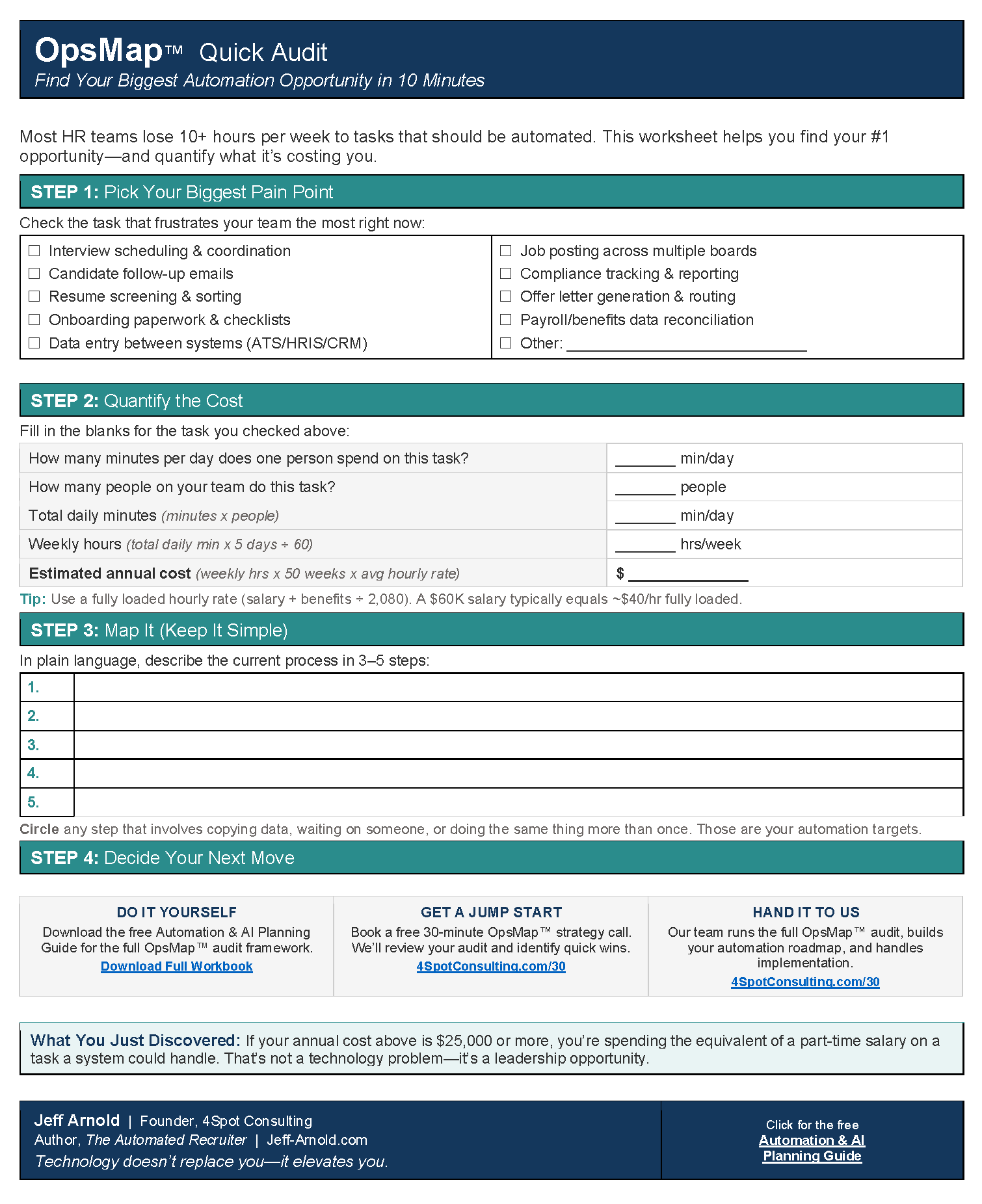
The OpsMap engagement started with a structured discovery process – not interviews, not surveys. We traced every major workflow from trigger to outcome, documenting where data entered the system, where it got touched by a human, where it got lost, and where the process actually ended versus where people thought it ended.
Four workflows rose to the top as highest priority:
- Candidate intake from inbound applications
- Recruiter-to-client status updates
- Offer generation and countersignature collection
- New placement onboarding and compliance document collection
In each case, the blockers were identical: humans acting as routers. A person whose entire job was moving information from one system to another without adding value, because no automation existed to handle it.
The OpsMap output was a prioritized list of 14 automation opportunities, ranked by frequency, error rate, and downstream dependency. We didn’t build anything yet. We mapped first. That discipline alone saved weeks of rework later – and gave the client a sequence they approved before a single scenario was built.
For a closer look at why this sequencing matters, 10 Real Examples of Why Clean Processes Must Come Before Any HR Automation walks through what skipping this step actually costs.
Phase Two: Building the Foundation with OpsBuild™
The OpsBuild phase ran six weeks. We worked through the prioritized list from OpsMap, building Make.com scenarios for each automation opportunity in ranked order.
Candidate intake first. Applications coming through the website now triggered automatic contact creation in the CRM, tag assignment based on role type, and a personalized confirmation email – all without a recruiter touching it. The same trigger started a five-day nurture sequence. Candidates who went dark got flagged automatically on day six.
Recruiter-to-client updates next. Instead of a recruiter writing a weekly update from scratch, Make assembled the update from CRM activity data and sent it on schedule. The recruiter reviewed and approved – or let it go out automatically if no changes were needed.
Offer generation followed. A single form submission now triggered document creation in PandaDoc, routed it for internal approval, and sent it to the candidate for countersignature – all with tracking built in. The “did you send the offer?” conversation disappeared from team Slack overnight.
Onboarding last. New placements triggered a document collection workflow that tracked completion status, sent reminders at set intervals, and escalated to the coordinator only when something was genuinely stuck – not just slow.
By the end of OpsBuild, the team had removed 23 manual touchpoints from four core workflows. The client’s exact words at the end of week six: “This is already better than what we came here for.”
Expert Take
The reason we sequence automation before AI isn’t philosophical – it’s practical. Automation creates data trails: consistent, structured, timestamped records of what happened, when, and to whom. AI needs exactly that to perform well. When you build automation first, you’re not just removing manual work. You’re manufacturing the raw material AI runs on. Skip that step and your AI has nothing solid to feed from – and you’ll spend more time debugging outputs than deploying features.
When We Finally Introduced AI
Week seven. Automation was running and stable. Data was clean. Workflows had consistent triggers and complete records. Now we added AI.
The first application was candidate screening summaries. Every inbound application now triggered an AI pass that pulled the resume, compared it against role requirements stored in the CRM, and wrote a structured brief for the recruiter: fit score, top three match points, top two gap flags. Reviewers went from twelve minutes per application to two.
The second application was client communication drafting. The weekly update automation already assembled the raw data. AI now wrote the narrative – a professional summary of activity that the recruiter approved in one click or edited in under a minute.
The third was an escalation triage layer. When a placement’s onboarding documents passed the deadline threshold, an AI module assessed the situation – how many documents were missing, which ones were blocking compliance, how long the placement had been active – and drafted the escalation message with the right tone and the right urgency level for the situation.
None of these applications would have worked in week one. The resume comparison had no structured data to run against. The client update draft had no assembled activity record to work from. The escalation trigger had no consistent threshold to fire on. Automation created all of it. AI consumed it.
For concrete examples of how this plays out across different HR functions, 10 Real Examples of Automation First, Then AI shows the pattern in action across multiple use cases.
What Changed – and What Didn’t
The OpsMesh™ framework connects automation and AI across a client’s full operation – not as a one-time project but as a living system with clear ownership and documented flows. After twelve weeks, here’s the honest accounting.
Recruiters spent significantly less time as data routers. The four automated workflows removed the majority of their manual data-movement work. Time shifted toward candidate relationships and client conversations – where a recruiter’s judgment and relationships produce actual results.
Client satisfaction improved. Weekly updates went out on schedule, every time, formatted consistently. Clients stopped chasing status. The firm’s responsiveness rating in their quarterly client survey jumped two tiers without a single new hire on the account management side.
New placements onboarded faster. Document collection went from a sprawling back-and-forth process to a structured workflow with clear deadlines, automated reminders, and coordinator escalation only when genuinely needed.
What didn’t change: the firm’s recruiters still made every placement decision. The AI flagged and summarized – it didn’t hire. The automation moved data – it didn’t replace relationships. The technology did what technology is supposed to do: handle the repeatable work so humans handle the judgment work.
If you want to know whether your operation is ready for this sequence, 10 Signs You Need Automation First, Then AI is the right starting point. For the data behind why this order consistently outperforms the reverse, 12 Stats That Explain Automation First, Then AI makes the case.
Expert Take
The firms that get lasting results from AI aren’t the ones who moved fastest. They’re the ones who built the right foundation before they moved at all. Twelve weeks of disciplined automation work gave this client AI that performed consistently from day one. Compare that to the teams who skipped ahead – six months later they’re debugging why the AI returns inconsistent outputs and blaming the tool instead of the process underneath it. The tool is almost never the problem.
Frequently Asked Questions
What does “automation first, then AI” mean in practice?
It means building consistent, structured, automatically triggered workflows before introducing any AI layer. Automation handles data movement and process execution. AI handles analysis, drafting, and decision support that require judgment. Running AI on top of manual, inconsistent processes produces unreliable outputs because the inputs are unreliable – garbage in, garbage out, faster.
How long does building an automation foundation take before adding AI?
A focused engagement on four to six core workflows runs four to eight weeks. The timeline depends on how many tools are in play, how clean existing data is, and how many manual handoffs need replacement. The OpsMap™ phase, which typically runs one to two weeks, produces a prioritized roadmap before any building starts – so scope is defined, not guessed.
Can small HR teams afford this approach?
The tools that power this work – Make.com, PandaDoc, CRM automation – are accessible at price points that fit small teams. The primary investment is time and expertise during the build phase. Most teams that go through OpsBuild™ recover that investment within the first few months because the automation eliminates manual work their people were doing every single day.
What if we already have some automation in place?
An OpsMap engagement starts by auditing what exists. Partial automation is common – a workflow automated halfway that breaks at a manual handoff, or a tool integration that works in one direction but not the other. The map identifies those gaps before you build more on top of a fragile foundation, which prevents compounding what’s already broken.
Why not use an all-in-one AI platform that handles everything?
All-in-one AI platforms perform best when your underlying data is clean and your processes are consistent. When they’re not, the platform inherits your chaos and returns it with a polished interface. The firms that get lasting results from AI – regardless of platform – have consistent data structures underneath. Build that first, and any AI platform you deploy performs dramatically better from day one.
Part of our complete guide: Automation First, Then AI: Why Order Is the Whole Game.