Post: Comparing Approaches to Automation First, Then AI: Which Path Fits Your Business
The “automation first, then AI” sequence outperforms jumping straight to AI because automated processes give AI tools clean, consistent data to work with. Businesses that automate repetitive workflows before layering in AI see faster ROI, fewer integration failures, and compounding results instead of constant troubleshooting and correction cycles.
Why the Sequence Matters Before You Compare Approaches
Sequencing automation before AI is the difference between building on solid ground and building on sand. When businesses skip automation and go straight to AI, they ask smart systems to interpret messy, inconsistent, manual data. The AI performs exactly as well as the inputs allow – and manual inputs are almost always inconsistent.
The real comparison is not “automation vs. AI.” It is about which automation approach sets up your AI layer for the greatest possible impact. The signs that you need automation first are visible in almost every operation that has struggled to get traction from an AI investment.
Here is how the main implementation approaches compare.
Expert Take
The businesses that get the most from AI are not the ones that adopted it earliest. They are the ones that automated their core workflows first. AI amplifies what is already there. If what is already there is inconsistent and manual, the AI just moves faster through the inconsistency.
Approach 1: Process-by-Process vs. Department-Wide Rollout
Process-by-process automation delivers faster wins and lower risk than attempting a department-wide rollout from the start. This approach isolates one workflow – candidate intake, invoice routing, follow-up sequences – automates it completely, validates the result, and then moves to the next. The department-wide approach sounds more efficient but regularly stalls when competing priorities surface mid-project.
| Factor | Process-by-Process | Department-Wide Rollout |
|---|---|---|
| Time to first win | Weeks | Months |
| Risk of stall | Low | High |
| Staff disruption | Minimal | Significant |
| AI readiness timeline | Faster | Delayed |
For most small and mid-size businesses, the OpsMesh™ framework starts with process-by-process automation for exactly this reason. You get proof of concept, build internal confidence, and create clean data pipelines – all before touching the AI layer. The compounding advantage of that foundation shows up six months in, when the AI has consistent data to learn from and act on.
Real examples of automation first, then AI consistently show this pattern: businesses that automated one workflow at a time got to AI faster than those that tried to automate everything at once.
Approach 2: No-Code Platforms vs. Custom Development
No-code automation platforms – Make.com in particular – deliver faster implementation, lower maintenance burden, and simpler iteration than custom-built automation for the vast majority of business workflows. Custom development makes sense for edge cases with unique technical requirements that no existing platform handles. For standard business operations, it adds months of build time and creates a dependency on a developer for every future change.
The practical difference shows up in iteration speed. When a workflow needs adjustment – and it always does – a no-code scenario takes minutes to update. A custom build requires a developer ticket, a sprint cycle, and testing time. By the time teams are ready to layer in AI, no-code teams are already three iterations ahead of where custom-build teams are.
Make.com integrations unlock cheaper, more powerful automation than most businesses realize is available without writing a single line of code. That speed-to-automation advantage is what makes no-code the right foundation for the AI layer that follows.
Expert Take
Custom development is a trap for small businesses that do not have developer-level maintenance capacity. The automation you build needs to be the automation you can actually run long-term. No-code platforms win on that criteria for 90% of the workflows we audit.
Approach 3: Consultant-Led Implementation vs. Internal DIY
Consultant-led implementation gets businesses to a working automation foundation faster and with fewer architectural blind spots than DIY attempts – especially for teams without prior automation experience. The DIY path has real value for businesses with technical staff who want deep ownership of the build. For most operators, though, it extends the timeline by months and often results in partial implementations that never reach the AI stage.
The hidden cost of DIY is not the tool subscription. It is the 60 to 120 hours of staff time spent learning platform mechanics, troubleshooting failed scenarios, and rebuilding workflows that were not designed with scale in mind. An OpsSprint™ engagement delivers a working build in a fraction of that time and includes the architectural decisions that most DIY builds get wrong on the first attempt.
The data on this is consistent: businesses that used outside guidance during the automation phase added AI faster and saw better performance from that AI layer once it was in place. The sequence and the architectural decisions made during the build determine how well the AI performs downstream.
Approach 4: Tool-by-Tool Integration vs. Unified Platform Strategy
A unified platform strategy – connecting all business tools through a single automation layer – outperforms ad-hoc tool-by-tool integration in every measurable way. Tool-by-tool integration creates a patchwork where each automation exists in isolation, making AI orchestration nearly impossible later. A unified approach treats the entire operation as one connected system from day one.
This is where the OpsMesh™ framework creates its compounding advantage. When candidate data, client communications, invoice workflows, and reporting all route through the same automation backbone, adding an AI layer means wiring it into one system – not retrofitting it across a dozen disconnected point solutions. That distinction is the difference between an AI deployment that works and one that underperforms despite the investment.
| Criteria | Tool-by-Tool Integration | Unified Platform Strategy |
|---|---|---|
| AI readiness | Low | High |
| Maintenance burden | High | Low |
| Data consistency | Inconsistent | Standardized |
| Scalability | Limited | Designed for it |
The stats behind automation first, then AI reinforce this consistently. The businesses with the cleanest AI results had unified automation architectures underneath them – not fragmented point solutions.
Expert Take
Every business that has told me their AI tool did not work had the same root cause: the data feeding the AI was inconsistent because the automation layer was fragmented. Unified platform strategy is not a nice-to-have. It is what makes the AI investment actually perform.
Which Approach Fits Your Business Right Now
The right starting point depends on where you are operationally, not where you want to be eventually. Businesses with fewer than 10 employees and no automation in place start process-by-process with no-code tools. Businesses with 10 to 50 employees and some manual workflows already identified benefit from a consultant-led unified strategy. Businesses already using automation but struggling to get results from their AI investment need an architectural audit before adding anything new.
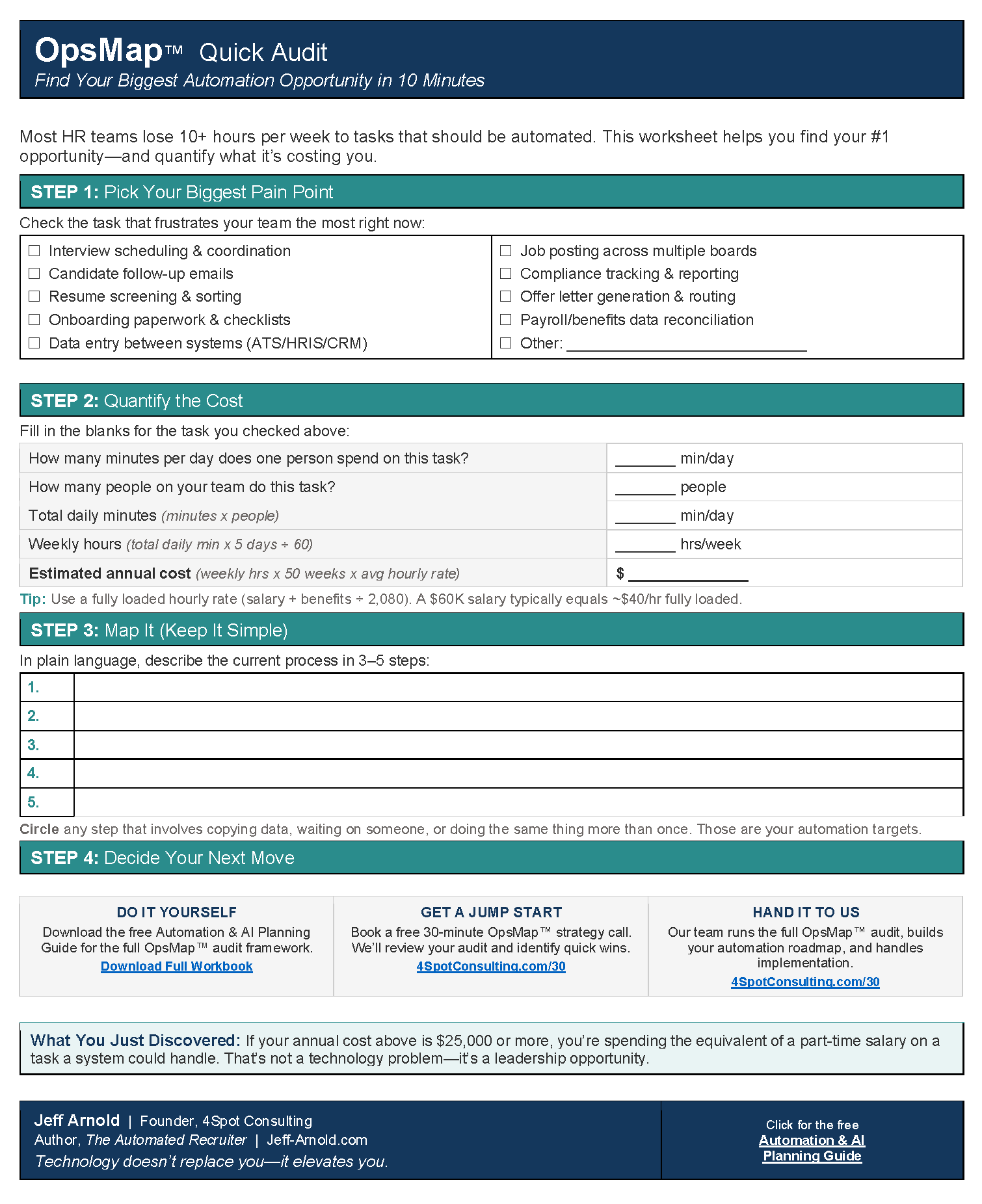
An OpsMap™ assessment identifies exactly which approach fits your current operation and produces a sequenced roadmap – automation decisions first, AI decisions second, in the right order. That roadmap is what turns “automation first, then AI” from a concept into a concrete execution plan with a timeline your team can actually follow.
The approach matters less than getting the sequence right. Every comparison above comes back to the same conclusion: businesses that built clean automation foundations first got more from their AI investments than businesses that tried to shortcut the sequence.
Frequently Asked Questions
What is the automation first, then AI approach?
Automation first, then AI is a sequencing strategy where businesses fully automate their core workflows before layering in AI tools. The automation creates clean, consistent data flows that AI can actually use. Skipping this step results in AI tools that produce unreliable output because the inputs are inconsistent.
Which automation approach works best for small businesses?
Process-by-process automation using no-code platforms like Make.com works best for small businesses. This approach delivers quick wins, minimal disruption, and a clean data foundation at a fraction of the cost of custom development or enterprise platforms. Most small businesses can automate their first workflow in two to four weeks.
How long does it take to build an automation foundation before adding AI?
For most small and mid-size businesses, the core automation foundation takes four to twelve weeks depending on the number of workflows and their complexity. An OpsSprint™ engagement compresses this timeline significantly by front-loading the architectural decisions that DIY teams spend weeks figuring out on their own.
Is a consultant required for automation first, then AI?
A consultant is not strictly required, but data consistently shows that consultant-led implementations reach AI readiness faster and with fewer architectural mistakes. The value is not in the tools – it is in the sequencing decisions made during the build phase that determine how well the AI layer performs later.
What is OpsMesh and how does it connect to this approach?
OpsMesh™ is 4Spot Consulting’s framework for connecting business operations through a unified automation backbone. It applies the automation-first principle across every business function so that when AI is layered in, it has a clean, consistent data environment to operate in. OpsMesh is the architectural approach; automation first, then AI is the sequencing principle that drives it.
Part of our complete guide: Automation First, Then AI: Why Order Is the Whole Game.