Post: In-House vs Outsourced: Automation First, Then AI
Outsourcing wins for most mid-market companies attempting an automation-first transformation because in-house teams lack the tool depth, integration experience, and capacity to sequence process work correctly before AI enters the picture. The right partner compresses your timeline, transfers the methodology, and leaves your team owning the stack – not dependent on a vendor forever.
What “Automation First, Then AI” Actually Means
The sequence is the strategy. Before any AI tool earns a place in your operations, your underlying processes need to be documented, repeatable, and clean. AI built on top of inconsistent, manual workflows produces inconsistent, manual-quality results at machine speed – which is worse than doing nothing. Automation first means removing human error from the routine so AI has something reliable to accelerate.
This is not a technology question. It is a discipline question. The companies that get this right treat automation as a prerequisite, not a phase. They map their workflows, eliminate redundant steps, build reliable data pipelines, and only then introduce AI-driven decision-making into the mix. See why clean processes must come before any automation.
The Case for In-House Automation
In-house teams carry real advantages: institutional knowledge, direct access to stakeholders, and no communication lag between the people who know the problem and the people building the solution.
The strengths are genuine:
- Deep domain knowledge. Your team knows the nuance in your workflows better than any outside consultant will at kickoff.
- No vendor dependency. When the build is done, the team that built it is still there.
- Cultural alignment. In-house builders understand your internal politics, your approval chains, and which stakeholders will block a deployment if they feel left out.
But the gaps are just as real. Most internal teams have not built more than a handful of integrations. They carry a full job alongside the automation project. They lack the pattern recognition that comes from watching fifty similar projects succeed and fail. And when something breaks at 11pm, the burden falls on whoever is still checking their phone. Here are the 11 most common mistakes HR teams make when automating internally.
Expert Take
In-house automation succeeds when there is a dedicated operator – not someone carrying automation as a side project – who has both the technical skill to build and the authority to enforce process changes. Without both, the build stalls at the complexity wall.
The Case for Outsourced Automation
Outsourced automation partners bring what in-house teams take years to build: repetition, tooling depth, and a library of what works.
The advantages compound quickly:
- Pattern recognition. A firm that has built the same integration category thirty times spots the failure points in the first conversation.
- Tool-native expertise. Platforms like Make.com have hundreds of modules, error handling nuances, and rate-limit behaviors that take months to learn through trial. A specialist already knows them.
- Speed to first working build. What takes an internal team six months frequently ships in six weeks with a focused external engagement.
- No capacity conflict. The automation work does not compete with your team’s operational responsibilities.
The risk is real too. A vendor who builds and exits leaves you with a system nobody on your team can maintain, debug, or extend. The best outsourced engagements are structured to transfer ownership, not create dependency. Read how to evaluate an HR automation consultant before you sign anything.
Expert Take
The single biggest predictor of outsourced automation success is whether the engagement includes a knowledge transfer plan. If the vendor’s proposal does not name who on your team will own the system post-launch and what training they will receive, that is a red flag – not a negotiating point.
Head-to-Head: In-House vs Outsourced
The comparison shifts depending on where you are in the automation journey. Neither path is universally right, but the decision variables are clear.
| Factor | In-House | Outsourced |
|---|---|---|
| Speed to production | Slower – learning curve plus capacity conflict | Faster – established patterns and dedicated hours |
| Domain knowledge | High from day one | Lower at start, closes fast with good discovery |
| Tool depth | Limited unless team has dedicated automation experience | High – specialist-grade platform knowledge |
| Long-term ownership | Natural – team stays with the system | Requires a structured handoff plan |
| Error handling and maintenance | Depends on team bandwidth | Covered during engagement; post-launch support varies by contract |
| Best for | Simple workflows, internal tooling, teams with a dedicated automation operator | Complex integrations, time-sensitive builds, first automation initiative |
The decision is not binary. Many companies start outsourced, build the methodology into their team, then internalize it. The data on automation-first outcomes backs this up.
Where OpsMesh Fits
The OpsMesh™ framework exists precisely because most organizations need both – an outsourced build phase that transfers knowledge, followed by in-house operators who own and extend the system. OpsMesh is not a product. It is an operating model that sequences automation correctly, installs AI where the data is clean enough to support it, and leaves clients running the stack themselves.
The four engagement phases inside OpsMesh each carry a defined scope:
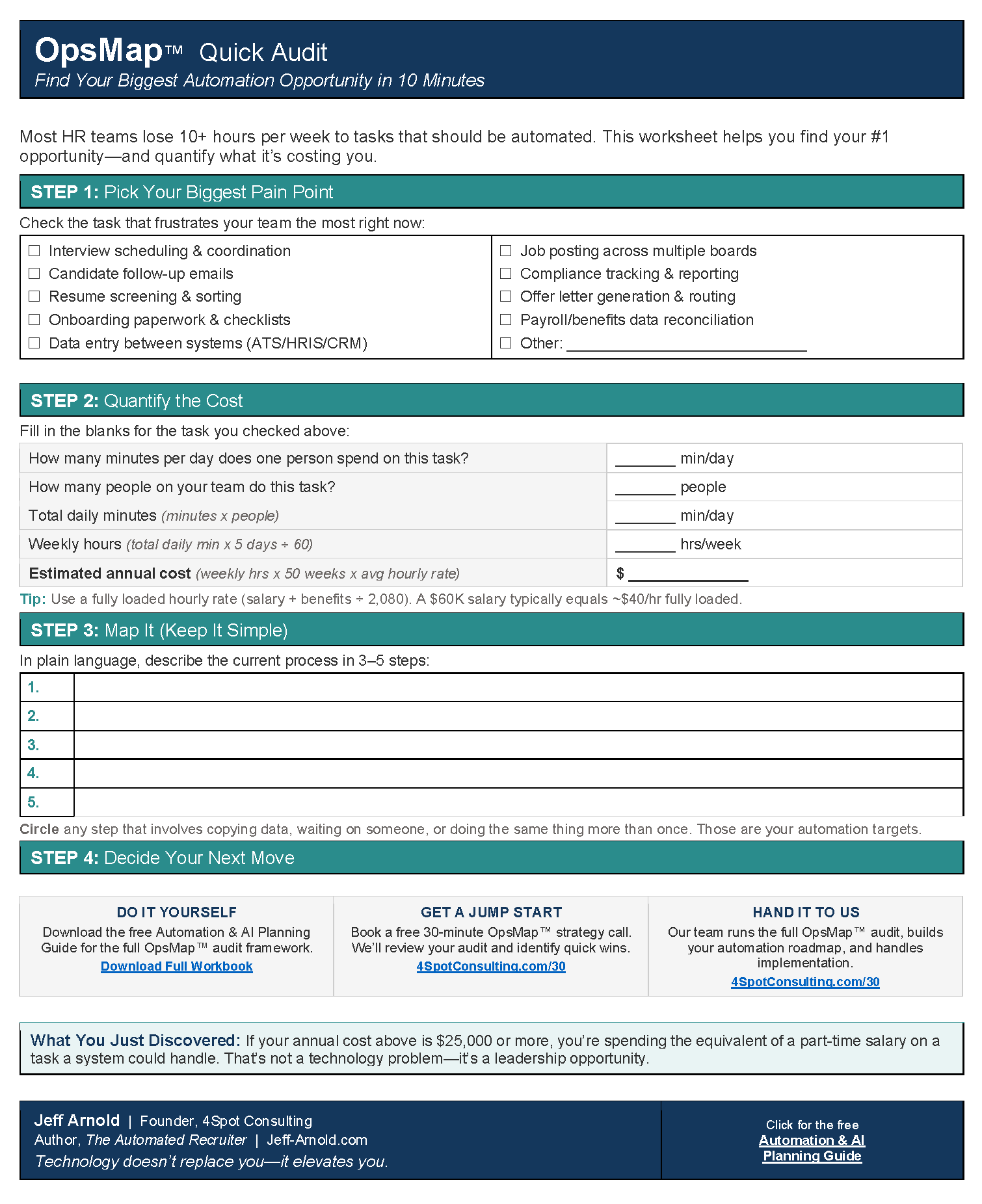
- OpsMap™ – workflow mapping and gap analysis before any build begins
- OpsSprint™ – focused build cycles targeting the highest-impact automations first
- OpsBuild™ – deeper integration work connecting systems that do not natively talk to each other
- OpsCare™ – ongoing maintenance, monitoring, and optimization after launch
Companies that skip OpsMap and go straight to build almost always rebuild. The sequence is not ceremonial – it is how you avoid six months of rework. Check these 10 signs you are ready for automation first.
Frequently Asked Questions
Is it cheaper to automate in-house or outsource?
The total cost comparison favors outsourcing when you factor in the full picture: internal learning time, project delays, rebuilds after first attempts fail, and the opportunity cost of pulling your best operators into a build project instead of running the business. Outsourced engagements with a structured scope deliver faster and at lower total cost than equivalent in-house builds in most cases.
Can a small company afford outsourced automation?
Yes – and the leverage is higher at smaller companies because the workflows are less entrenched and the wins surface faster. The key is scoping the first engagement tightly: one process, one integration, one measurable outcome. That proof of concept earns the next phase without requiring a large upfront commitment.
What happens if the outsourced partner builds something we cannot maintain?
That is the most common failure mode in outsourced automation. Vet every vendor on whether they build in platforms your team can access and learn, whether they document every scenario they build, and whether their engagement includes hands-on training for your internal operator. A well-structured outsourced engagement leaves you more capable, not more dependent. These 13 questions help you evaluate any automation investment before you commit.
When does in-house automation make sense?
In-house wins when you have a dedicated automation operator with genuine platform depth – not someone who knows a little Make.com but someone who lives in it daily. If you have that person and the process is well-defined, keep it internal. If either condition is missing, the outsourced path gets you to working faster with less rework.
How do I know if my processes are ready for AI?
Your processes are ready for AI when the same task, run by two different people, produces the same output every time. If the outcome varies by who does it, you have a process problem – not an AI opportunity. Fix the process first, then layer intelligence on top. Real examples of automation-first in action show exactly what that looks like.
Part of our complete guide: Automation First, Then AI: Why Order Is the Whole Game.