Post: Manual vs Automated: Automation First, Then AI Is the Right Sequence
Manual processes create the chaos that derails AI projects before they start. Companies that skip straight to AI without first automating their workflows waste budget on tools that cannot perform without clean, structured data flowing through reliable systems. Automation first, then AI is the sequence that actually works.
The Core Difference Between Manual and Automated Operations
Manual operations depend on people remembering to do the right thing at the right time. Automated operations depend on systems doing the right thing every time without anyone remembering anything.
That difference sounds simple. It is not. When you run manual operations, you are betting that every person on your team will execute every step correctly, every time, under every workload condition. That bet loses constantly – not because people are bad at their jobs, but because humans are not optimized for repetitive, rule-based execution at scale.
Automated operations remove that bet. A trigger fires, a workflow runs, a result is recorded. No one has to remember. No one has to be available. No one has to care.
But here is where most businesses get it wrong: they assume AI fixes manual operations. It does not. AI amplifies whatever infrastructure sits underneath it. Feed AI a manual, inconsistent operation and you get faster chaos. Feed it a clean, automated operation and you get leverage.
That is the entire argument for automation first, then AI. Get the infrastructure right before you add intelligence on top of it.
What Manual Operations Actually Cost
Manual operations cost more than time – they cost consistency, scalability, and the ability to know what is actually happening in your business.
When a process is manual, the data it generates is incomplete. Someone forgets to log a call. A follow-up falls through because someone was out sick. A status field gets updated three different ways by three different people. By the time you try to run a report or build an AI model on top of that data, the foundation is sand.
The other cost is ceiling. Manual operations do not scale. You add volume and you add headcount – that is the only option. Every new client, every new hire, every new campaign requires more hands. The math never improves.
Automated operations break that ceiling. The same workflow that handles 10 leads handles 1,000. The same onboarding process that runs for one new hire runs for twenty. Cost per unit drops as volume grows.
That is not an argument against people. People should do the work that requires judgment, creativity, and relationship. Automation handles the repetitive infrastructure so your team can focus on the high-value work that actually moves the business.
Expert Take
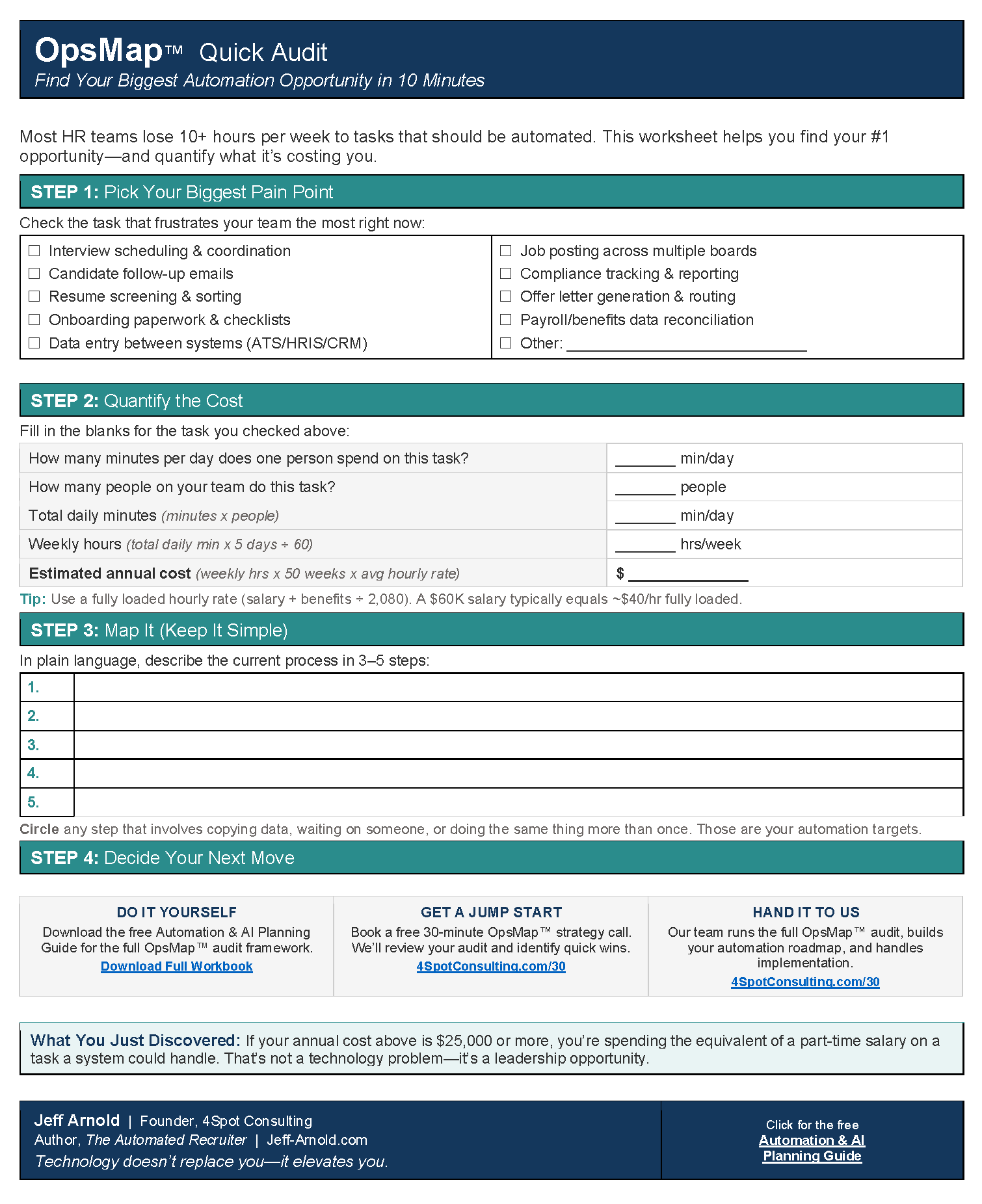
The companies stuck in manual operations are not stuck because they lack technology. They are stuck because no one has ever mapped the process clearly enough to know what is actually happening. Before you automate anything, you need to know what the right sequence of steps is. Most businesses do not. That mapping work – OpsMap™ in our framework – is the prerequisite most consultants skip, which is why so many automation projects fail at implementation rather than execution.
Why AI Without Automation Fails
AI requires structured, consistent, reliable data to deliver accurate results. Manual operations do not produce that data.
When you deploy AI on top of a manual operation, you are asking a sophisticated pattern-recognition system to find patterns in data that was entered inconsistently, at different times, by different people with different interpretations of what the fields mean. The AI will find patterns – but they will not be the patterns you want. They will be patterns in your team’s inconsistency.
This happens constantly. A business invests in AI-powered lead scoring and the model returns nonsense because the CRM data underneath it was never cleaned or standardized. A company deploys an AI email system and it sends follow-ups to contacts who were already disqualified because the status fields were not being updated by the manual process.
The fix is not a better AI model. The fix is the automation layer that ensures clean, consistent data enters the system every time before AI ever touches it.
See 10 real examples of Automation First, Then AI to see how this plays out across different business functions.
The Automation First Framework
Automation first means building reliable, rule-based workflows before you add any AI layer on top of them.
In practice, that sequence looks like this:
- Map the current process. Document what actually happens, not what is supposed to happen. These are often not the same thing.
- Clean the process. Remove steps that do not need to exist. Fix handoff points where data gets lost. Standardize how information is captured.
- Automate the clean process. Build workflows that execute the standardized steps reliably without human intervention.
- Verify the output. Confirm the automation is producing clean, consistent data before moving to the next phase.
- Layer in AI. Now that the data infrastructure is solid, AI can do what it is designed to do: identify patterns, generate insights, and make recommendations based on reliable inputs.
Skip step 3 and go straight to step 5 and you have built an expensive tool on a broken foundation. That is the mistake most businesses make.
Our OpsSprint™ engagement is designed specifically for businesses at steps 2 and 3 – cleaning and automating the core workflows before any AI layer is introduced.
Manual vs Automated: A Direct Comparison
Here is how the two operational models compare across the dimensions that matter most for growing businesses.
| Dimension | Manual | Automated |
|---|---|---|
| Consistency | Depends on individual execution | Identical output every run |
| Scalability | Requires more headcount to grow | Volume grows without proportional cost |
| Data quality | Inconsistent, incomplete | Structured, reliable |
| AI readiness | Low – dirty data undermines models | High – clean data enables accurate results |
| Operational visibility | Limited – requires asking people | Full – systems log every action |
| Error rate | High – human execution varies | Low – logic executes identically |
| Cost over time | Grows with volume | Drops per unit as volume scales |
Manual operations are a starting point, not a strategy. Every business starts manual. The ones that scale move to automation before they hit the ceiling.
Read 10 signs you need Automation First, Then AI to identify where your operation sits today.
Where Most Businesses Get Stuck
Most businesses land between manual and automated – not fully either.
They automate one piece of a workflow but leave the adjacent pieces manual. They buy a tool but do not connect it to the systems that feed it data. They automate the easy steps and leave the critical handoffs to people.
The result is a hybrid that carries the costs of both models and the benefits of neither. The automation does not work because the manual steps around it feed it bad data. The manual steps do not work because people assume the automation is handling something it is not.
This is the half-automated trap, and it is where the majority of SMBs live. They have bought tools. They have built some workflows. But the operation is not clean or consistent enough to layer AI on top without getting unreliable results.
The path out is a systematic audit of what is automated, what is not, and where the breaks in the chain are. Our OpsBuild™ process maps the full workflow end-to-end, identifies the gaps, and builds the connections that turn a patchwork of tools into a coherent operational system.
The data behind this problem is significant. 12 stats that explain Automation First, Then AI breaks down why sequence matters.
How to Move From Manual to Automated the Right Way
Start with the process that costs you the most time and produces the most errors. That is your first automation target.
Do not start with the process that seems most interesting or the tool your vendor is pushing. Start with the one causing the most friction in your operation right now. Fix that first. Build one clean, working automation. Prove the model. Then expand.
The sequence that works:
- Identify the highest-friction process. Where are people spending time on steps that do not require human judgment?
- Map it completely. Every step, every handoff, every system involved.
- Clean it before you automate it. Automating a broken process just breaks things faster.
- Build the automation. Make.com handles most SMB workflow automation without requiring a developer.
- Verify it works. Run it, check the outputs, confirm the data is clean.
- Maintain it. Automation requires ongoing care as systems and business rules change. OpsCare™ keeps workflows running reliably over time.
Once you have that first clean automation running, you have a template. The second one takes less time. The third takes less than the second. You are building an operational foundation that AI can actually use.
Expert Take
The businesses that get the most out of AI are not the ones that moved fastest to adopt it. They are the ones that did the automation groundwork first. Clean data, reliable workflows, connected systems – that is the substrate AI needs to perform. Without it, AI is just an expensive way to produce bad outputs faster. The OpsMesh™ framework exists specifically to build that substrate before any AI layer is introduced.
Frequently Asked Questions
Can I skip automation and go straight to AI?
Skipping automation produces AI results built on dirty, inconsistent data. The AI runs, but the outputs are unreliable because the inputs were never standardized. You will spend more fixing bad AI recommendations than you would have spent building the automation layer first.
How long does it take to automate before adding AI?
A focused engagement on a single high-friction process takes four to six weeks from mapping to a working automation. That is a short runway before AI becomes viable – and most businesses see workflow improvements in the first month that make the AI investment worth more when it arrives.
What tools do I need to automate my operations?
Make.com handles the majority of SMB workflow automation without requiring a developer. It connects to nearly every major business tool – CRM, email, document systems, HR platforms – and builds the logic that moves data between them reliably. What else you need depends on which systems you are already running.
Does automation replace my team?
Automation replaces repetitive, rule-based tasks – not people. The work it removes from your team is the work that was slowing them down and generating errors. What remains is judgment work, relationship work, creative work – the parts that actually require people. Most teams find automation gives them capacity to do more of what they are good at.
When is the right time to add AI after automating?
Add AI when your automated workflows have been running long enough to produce clean, consistent data – three to six months of reliable operation is a reasonable baseline. At that point AI has something real to work with. Earlier than that and you are asking the model to learn from data sets that are too small and too inconsistent.
Part of our complete guide: Automation First, Then AI: Why Order Is the Whole Game.