Post: Choosing the Right Approach to Automation First, Then AI
The right approach to automation-first, then AI depends on where your processes stand today. Teams with chaotic, manual workflows need automation to stabilize operations before AI adds leverage. Teams with clean, documented processes can accelerate into AI faster. Skipping the automation foundation forces AI to learn and amplify your broken habits, not fix them.
Why the Sequence Is the Whole Game
Your automation stack is the foundation AI sits on – and a cracked foundation does not get stronger when you add weight to it. Most HR and recruiting teams make the mistake of chasing AI features before they have stable, documented workflows. The result is AI that generates inconsistent outputs, misroutes candidates, and sends your team back to manual correction – exactly the problem you hired AI to solve.
The automation-first approach is a sequencing discipline, not a technology preference. It answers one question before you invest in AI: are your inputs clean enough that a machine can trust them?
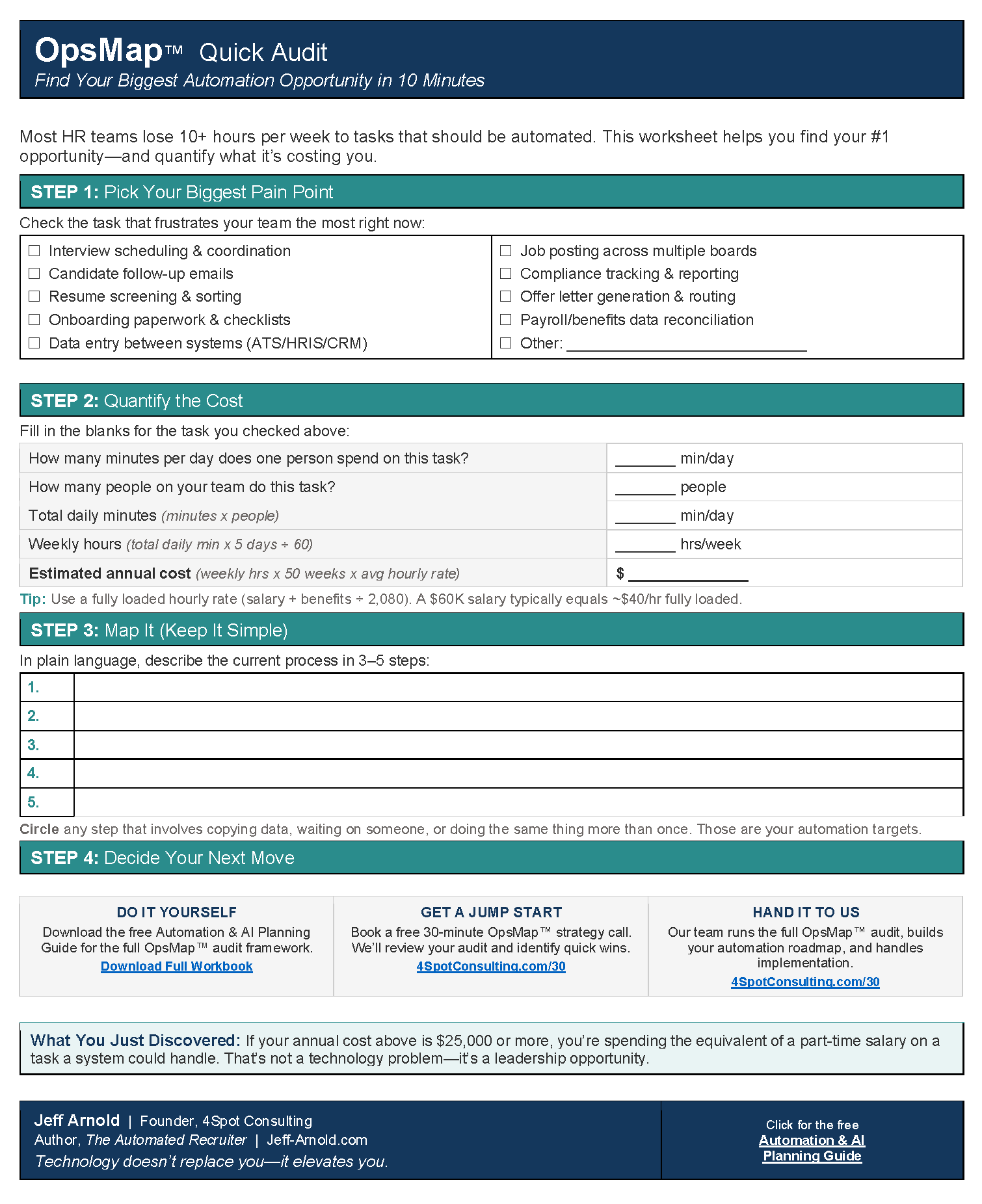
4Spot Consulting’s OpsMesh™ framework is built around this exact sequence – map and stabilize first, then amplify with intelligence. Every client engagement we run starts with a process audit before a single AI tool gets evaluated.
Related: 10 Signs You Need Automation First, Then AI
Approach 1: Automate First and Stabilize Your Operations
The first approach – and the right starting point for most growing teams – is to use automation to document, standardize, and stabilize workflows before introducing any AI layer. This is not the slow path. It is the path that makes every AI investment after it actually work.
What this looks like in practice:
- Map every manual touchpoint in your recruiting or HR workflow using an OpsMap™ diagnostic
- Build automation scenarios in Make.com that handle repeatable steps – application acknowledgments, status updates, document routing, onboarding task triggers
- Validate that your CRM data is clean and your tagging logic is consistent before any AI tool reads from it
- Run your automation for 30 to 60 days and measure error rates before layering AI on top
The OpsSprint™ is how we compress this stabilization phase. Instead of a six-month rollout, we identify the three to five highest-friction workflows, automate them in a concentrated sprint, and prove the model before scaling it.
Teams that start here see two things happen: immediate time savings from automation alone, and a clean data environment that makes AI useful when they get there. See 10 Real Examples of Why Clean Processes Must Come Before Any HR Automation for what goes wrong when teams skip this step.
Expert Take
The single most expensive mistake in automation projects is adding AI to a workflow no one has documented. AI does not discover your process – it reflects whatever you feed it. If your team’s workflow lives in email threads and verbal handoffs, your AI is going to produce email-thread-level results at machine speed. Stabilize the workflow first. Then let AI accelerate it.
Approach 2: Add AI After Automation Is Stable
Once your automation layer runs cleanly – consistent inputs, low error rates, documented logic – you are ready to add AI as an intelligence layer on top. This is where the leverage compounds.
AI earns its value in this phase because it has something worth analyzing: structured, consistent data flowing through proven automation paths. Specific wins this unlocks:
- Resume screening and scoring against a consistent rubric
- Candidate communication drafted in your voice, triggered by automation milestones
- Predictive flags for candidate drop-off risk based on engagement pattern data
- Interview prep summaries generated from structured intake data
- Anomaly detection on recruiter performance metrics that clean data makes visible
The OpsBuild™ phase is where this happens in our client engagements. We add AI tools as modules inside the automation architecture already in place – never as standalone tools that bypass the process.
The practical difference: AI running on top of your Make.com automation reads structured outputs and fires actions back into your CRM. AI installed as a standalone tool reads whatever someone manually pastes into it. One scales. The other is a productivity toy.
See what this looks like across a real engagement: $1.2M Saved: 4Spot Consulting’s AI and Automation Transformation for Global Talent Solutions
Approach 3: Parallel Deployment and Why It Usually Backfires
Parallel deployment – running AI and automation projects simultaneously from day one – is the approach most teams attempt when they are under pressure to show results fast. It fails more often than it succeeds, and the failure mode is expensive.
Here is what goes wrong:
- AI tools surface insights from data that automation has not yet cleaned, producing false positives that burn recruiter trust in the tools
- Automation builds get re-scoped mid-sprint to accommodate AI requirements that were not known at the start, adding time and rework
- Teams split attention between two complex projects and execute neither at full quality
- Vendor timelines diverge – automation goes live but AI is not ready, or AI launches before the data it needs is structured
Parallel deployment works in one narrow scenario: when automation and AI are deployed in completely separate, non-overlapping workflows with no data dependency between them. That is rarely the case in HR and recruiting operations, where everything feeds a single candidate and employee record.
If a vendor or internal stakeholder is pushing you toward parallel deployment, the right question is: which project gets fully resourced first? Splitting resources is how both projects get halfway done.
Expert Take
Parallel deployment is almost always a symptom of leadership pressure, not a technical strategy. The ask is “show us AI wins faster.” The result is two half-built systems that each underperform, and a team skeptical of both automation and AI for the next budget cycle. Set the sequence, hold the sequence, and the results arrive faster because neither project is fighting the other for attention.
How to Choose Your Starting Point
Three questions determine which approach fits your organization right now.
Can you describe your current process in writing, step by step, without asking three people for input? If the answer is no, start with Approach 1. You do not have a process – you have a habit. Automation documents and enforces it; AI needs it to already exist before it adds value.
Is your CRM data clean enough that a query returns reliable answers? If you pull a candidate list and immediately distrust the results, your data is not ready for AI. Run automation to enforce data entry standards first.
Do you have bandwidth for one major initiative or two? If you have one capable operations lead and a team of six, run one project at a time. Sequence matters less than focus.
OpsCare™ plays a role here too – even after your automation and AI layers are running, they need monitoring, refinement, and updates as your business changes. Building ongoing care into your plan from the start prevents the decay that causes teams to rebuild from scratch 18 months later.
If you want to know where you fall on this spectrum, start with 10 Real Examples of Building an AI Roadmap for HR Without Replacing Your Team and 12 Stats That Explain Automation First, Then AI.
Side-by-Side Comparison: Three Approaches
Each approach has a different ideal use case and a different failure mode. Understanding both tells you which choice your team is actually ready to make.
| Approach | Best For | Primary Risk | Time to ROI |
|---|---|---|---|
| Automation First | Teams with manual, inconsistent processes | Underestimating the discipline needed to hold the sequence | 30-90 days for automation wins; 90-180 days for AI layer |
| AI First | Teams with clean, structured, well-maintained data already in place | AI surfaces accurate insights into processes no one is ready to act on | Variable – depends entirely on data quality at the start |
| Parallel Deployment | Separate, non-overlapping workflows only | Divided resources, compounding rework, eroded team trust in both tools | Delayed – both projects compete for the same team attention |
Frequently Asked Questions
What does “automation first” actually mean in practice?
Automation first means you build repeatable, documented workflows in a tool like Make.com before you evaluate or deploy any AI features. You define the steps, automate the handoffs, clean the data, and run the system until it produces consistent outputs – then AI gets layered in as a decision-support or generation tool on top of that stable foundation.
Can small HR teams afford to run automation before AI?
Small teams benefit more from the automation-first sequence, not less. With fewer people, each manual touchpoint costs a higher percentage of total capacity. Automating five repetitive steps frees up the equivalent of a part-time hire before you invest in AI tooling.
How do I know when my automation is stable enough to add AI?
Your automation is ready for AI when three conditions are true: your key workflows run without manual intervention for at least 30 days, your CRM or ATS data passes a basic audit with fewer than 5 percent error records, and your team trusts the outputs enough to act on them without double-checking every result.
What is the biggest mistake teams make with the automation-first approach?
The biggest mistake is treating automation as a one-time project instead of a foundation. Teams automate their workflows, see the time savings, and stop maintaining the system. Six months later, new tools and team changes have broken three scenarios and nobody knows it. Ongoing care is the difference between a system that compounds and one that decays.
Is there ever a good reason to start with AI instead of automation?
Yes – one specific scenario justifies it. If you have a clean, structured data set that already exists – an established ATS with years of consistent data, a CRM that has been actively maintained – and you need to extract insights from that data before designing new workflows around it, starting with AI analysis makes sense. The AI output tells you which workflows to automate first. That is the exception, not the rule.
Part of our complete guide: Automation First, Then AI: Why Order Is the Whole Game.