Post: The Smarter Choice for: Automation First, Then AI
Automation-first is the smarter choice because AI amplifies what already exists – if your workflows are broken, AI makes broken faster. Build reliable, repeatable processes through automation first, then layer AI on top to add intelligence and scale. This sequence cuts implementation waste, delivers faster ROI, and prevents the costly rebuilds that plague AI-first projects.
Why Automation First Beats AI First
The core difference is stability: automation enforces consistent process execution, while AI introduces judgment – and judgment applied to a broken process produces broken results at scale. HR and recruiting teams that jump straight to AI tools skip the foundation and spend months undoing the damage.
Automation removes the human bottlenecks from repetitive, rule-based tasks – routing candidates, triggering follow-ups, syncing data between systems, sending confirmations. These tasks do not require intelligence. They require consistency. When you automate them first, you create a stable data layer that AI can actually use.
AI models are only as good as the data they run on. Inconsistent inputs, duplicate records, missing fields, and manual-entry errors do not disappear when you add AI – they get amplified. The OpsMesh™ framework exists to prevent this: build the automated foundation, clean the data pipeline, then introduce AI where judgment adds real value.
Teams that follow this sequence report faster time-to-value than teams that deploy AI tools on top of manual workflows. The automation layer creates the audit trail, the clean data, and the reliable triggers that make AI decisions trustworthy and actionable. See the 10 signs your operation needs automation before AI.
Expert Take
Most AI implementations fail not because the AI is bad but because the process underneath it is manual and inconsistent. You cannot automate chaos with AI – you just get faster chaos. Get the workflow right first. Then the AI has something worth amplifying.
What Happens When You Skip Automation
Skipping automation and going straight to AI creates three compounding problems: data chaos, trust collapse, and rebuild cycles that consume the gains the AI was supposed to deliver.
Data chaos comes first. AI tools running on top of manual workflows inherit every inconsistency in those workflows. A recruiter who enters candidate status three different ways produces an AI assistant that gives three different recommendations – because it learned from three different inputs. The OpsMesh™ framework addresses this at the source, not after the fact.
Trust collapse follows. When AI recommendations are unpredictable, teams stop following them. Within weeks the AI tool becomes shelfware while people return to spreadsheets. The technology did not fail – the sequence failed. The patterns across teams that hit this wall are remarkably consistent.
Then come the rebuild cycles. After trust collapses, pressure mounts to fix the AI. But the fix is not in the AI – it is in the underlying process. Teams then spend months cleaning data and standardizing workflows they should have automated from the start. Real examples confirm this sequence plays out the same way every time.
The Automation-First Sequence That Works
A working automation-first sequence follows four phases: map, automate, verify, then augment with AI.
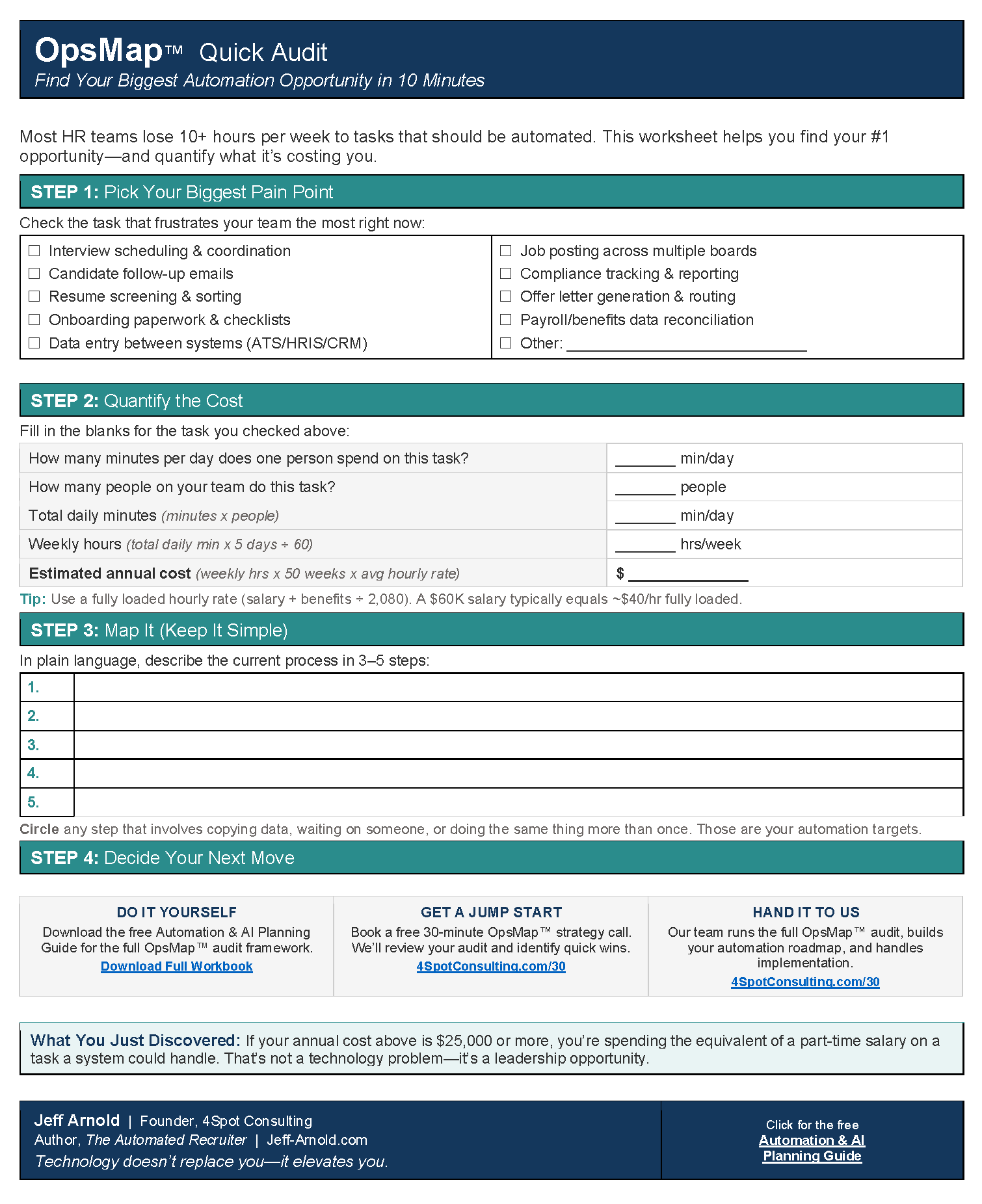
Phase one is process mapping. Before writing a single automation scenario, document every workflow that touches a candidate, employee, or client record. The OpsMap™ process identifies exactly where manual handoffs create delay, error, or data loss. You cannot automate what you have not defined.
Phase two is targeted automation. Build automations for the highest-volume, most rule-based tasks first – candidate status routing, interview scheduling triggers, document delivery, follow-up sequences, data sync between your ATS and CRM. The OpsSprint™ model runs these builds in focused 30-day cycles with defined outcomes, not open-ended implementation projects that drift for quarters.
Phase three is verification. Run the automated workflows long enough to generate clean, consistent data. Every workflow exception gets logged, diagnosed, and closed. By the end of this phase, you have an audit trail, clean records, and confidence in the process output.
Phase four is AI augmentation. Now the AI has something worth working with – consistent inputs, reliable triggers, clean data. AI layered on top of this foundation produces recommendations teams follow because the foundation is trustworthy. The data behind this approach confirms what practitioners already know: sequence matters as much as technology.
Expert Take
The OpsMap phase is where most projects succeed or fail before a single line of automation is written. Teams that skip mapping because they are eager to build always come back to it – after the build breaks. Do the map first. It takes less time than the rebuild.
Automation First vs. AI First: Side-by-Side
The differences between the two approaches are concrete and measurable across every implementation phase.
| Factor | AI First | Automation First, Then AI |
|---|---|---|
| Data quality at launch | Inconsistent, manual-entry errors intact | Standardized and clean through automation |
| Time to trusted output | Extended by tuning and correction cycles | Compressed by reliable, consistent inputs |
| Team adoption rate | Low – recommendations feel unpredictable | High – results match what the team expects |
| Rebuild risk | High – process fixes required mid-project | Low – process defined before the AI layer |
| ROI timeline | Delayed by rework and re-implementation | Delivered in defined sprint cycles |
The OpsCare™ model sustains this foundation after launch, monitoring automated workflows and AI performance together as a unified system rather than two separate concerns. See how this plays out at scale: 103K annual labor hours eliminated through automation-first implementation.
Frequently Asked Questions
What does “automation first, then AI” actually mean in practice?
It means you build automated workflows for your repetitive, rule-based processes before introducing any AI tool. The automation creates the consistent data and reliable process execution that AI needs to perform well. Without this foundation, AI tools produce inconsistent outputs that teams stop trusting.
Isn’t AI more powerful than automation? Why not start there?
AI and automation solve different problems. Automation enforces consistency – the same trigger always produces the same output. AI adds judgment and pattern recognition on top of that consistency. Starting with AI on a manual process means the AI applies judgment to an inconsistent, unpredictable input stream, which produces poor results regardless of how capable the AI model is.
How long does the automation phase take before you can add AI?
Most teams complete the foundational automation phase in 60 to 90 days with a focused implementation approach. The OpsSprint™ model structures this into defined cycles with clear outcomes so you know exactly when the automation layer is ready for AI augmentation – and you have the data to prove it.
What if we have already deployed AI tools without automating first?
The fix is to build the automation layer underneath the AI tools you already have. This is a process-mapping and workflow-build project, not an AI project. Once the automated foundation is in place, your existing AI tools perform significantly better because they have clean, consistent data to work with. Real examples of this recovery path show it moves faster than most teams expect.
Does 4Spot Consulting apply this sequence with every client?
Yes. Every engagement starts with the OpsMap™ process to define and document workflows before any automation or AI build begins. Every project that has skipped this step has required a rebuild. The map protects the investment in everything that follows.
Part of our complete guide: Automation First, Then AI: Why Order Is the Whole Game.