Post: A Plain-English Guide to: Automation First, Then AI
“Automation First, Then AI” is a build sequence, not a philosophy. You automate your rule-based, repeatable business processes before layering AI on top. Automation routes, triggers, and syncs data without judgment. AI scores, drafts, and decides with judgment. Skipping the automation layer and going straight to AI creates unreliable output on top of broken workflows.
What “Automation First, Then AI” Actually Means
The phrase describes a specific order of operations for building your business tech stack.
Your business runs on two types of tasks. The first type follows rules: a new lead fills out a form, so they get added to your CRM, tagged by service interest, and sent a follow-up email. No judgment required. Every time it should work the same way. That is automation territory – and it works best when you build it first, cleanly, before anything else touches it.
The second type requires judgment: which leads are worth a personal call, what subject line gets this specific person to respond, which applicant has the right background for this role. That is AI territory. AI reads context, weighs inputs, and makes recommendations. But it does this well only when the data feeding it is structured and reliable.
The problem most businesses run into is skipping step one. They buy AI tools before their data is clean, before their workflows are documented, before their processes are consistent. The AI runs on top of chaos and returns chaotic output. Then they blame the AI.
The OpsMesh™ framework at 4Spot Consulting is built around this sequence. The automation layer – the rule-based, reliable connective tissue – goes in first. The AI layer runs on top of it. When the foundation is solid, the AI output is trustworthy.
Expert Take
The businesses that get the most out of AI invested in their automation foundation first. When your CRM data is complete, your lead routing is consistent, and your follow-up sequences run without human intervention, AI has something real to work with. Without that foundation, you are training your AI on noise – and wondering why the signal is weak.
Why the Sequence Matters More Than the Technology
Automation done before AI is not a preference – it is a structural requirement for AI to return accurate results.
Here is the practical reason. AI tools – whether they are scoring leads, generating copy, or routing support tickets – pull from your existing data. If that data is inconsistent, duplicated, or incomplete, the AI has no way to know. It reads whatever is there and works with it. Garbage in, garbage out is not a cliche here. It is the actual failure mode.
Automation fixes this at the source. When you automate the data collection and entry process, the data coming in is consistent by design. When you automate the routing and tagging, records are structured the same way every time. When you automate the follow-up sequences, you also document what the follow-up process actually is – which is knowledge you need before AI can help you improve it.
The OpsSprint™ at 4Spot is specifically designed to build this foundation fast. It targets the highest-volume, highest-error manual processes first – the ones where inconsistent data is most likely to poison an AI layer later. You get immediate operational wins and a cleaner platform for AI to run on.
The sequence also matters for budget. AI subscriptions are not cheap. Running an AI tool on a broken workflow compounds the cost: you pay for the AI, the AI produces unreliable output, and you still pay someone to manually correct it. Automating the workflow first – even if it takes a few weeks – removes that ongoing drag before you start the AI spend.
See the 12 stats that explain why this sequence works in practice.
What Automation Does vs. What AI Does
Automation and AI solve fundamentally different problems, and knowing the line between them tells you which to build first.
Automation handles deterministic tasks. A deterministic task has a known, repeatable answer. If a contact submits a demo request, add them to a follow-up sequence. If an invoice is paid, update the project status and send a receipt. If a new employee starts, trigger the onboarding checklist. These tasks never need judgment. They need reliability and speed. Automation delivers both.
AI handles probabilistic tasks. A probabilistic task requires weighing context to make a judgment call. Which of these 200 open leads is most likely to close this month? What tone should this email take given this person’s previous responses? Is this resume a strong match for this role? These tasks benefit from pattern recognition across large data sets – something AI does well and humans do slowly.
The OpsBuild™ process at 4Spot maps every workflow against this distinction before building anything. Tasks that belong in automation go into the automation layer. Tasks that belong in AI go into the AI layer. And the automation layer always gets built first, because the AI layer depends on it.
A practical way to test which category a task belongs in: ask “does this task have a correct answer, or a best answer?” Correct answers belong in automation. Best answers belong in AI.
Expert Take
Most business owners underestimate how many of their judgment calls are actually deterministic tasks in disguise. When you map the actual decision tree, you find that roughly 80 percent of the decisions follow clear rules and the remaining 20 percent require genuine judgment. The 80 percent belongs in automation. Leaving it in AI wastes AI capacity on tasks a simple if-then rule handles better and faster.
How This Plays Out in Business Operations
The clearest way to see the Automation First, Then AI principle is to watch what breaks when businesses ignore it.
A business buys an AI lead-scoring tool. The tool scores leads based on CRM data – job title, company size, engagement history, deal stage. But the CRM data was entered manually by three different people who used different naming conventions, left fields blank at different rates, and updated deal stages inconsistently. The AI scores every lead it can, but the scores reflect the quality of data entry more than the quality of the leads. The sales team loses confidence in the scores within two weeks and goes back to gut instinct.
The fix was not a better AI tool. The fix was automating the data entry and tagging before the AI touched it.
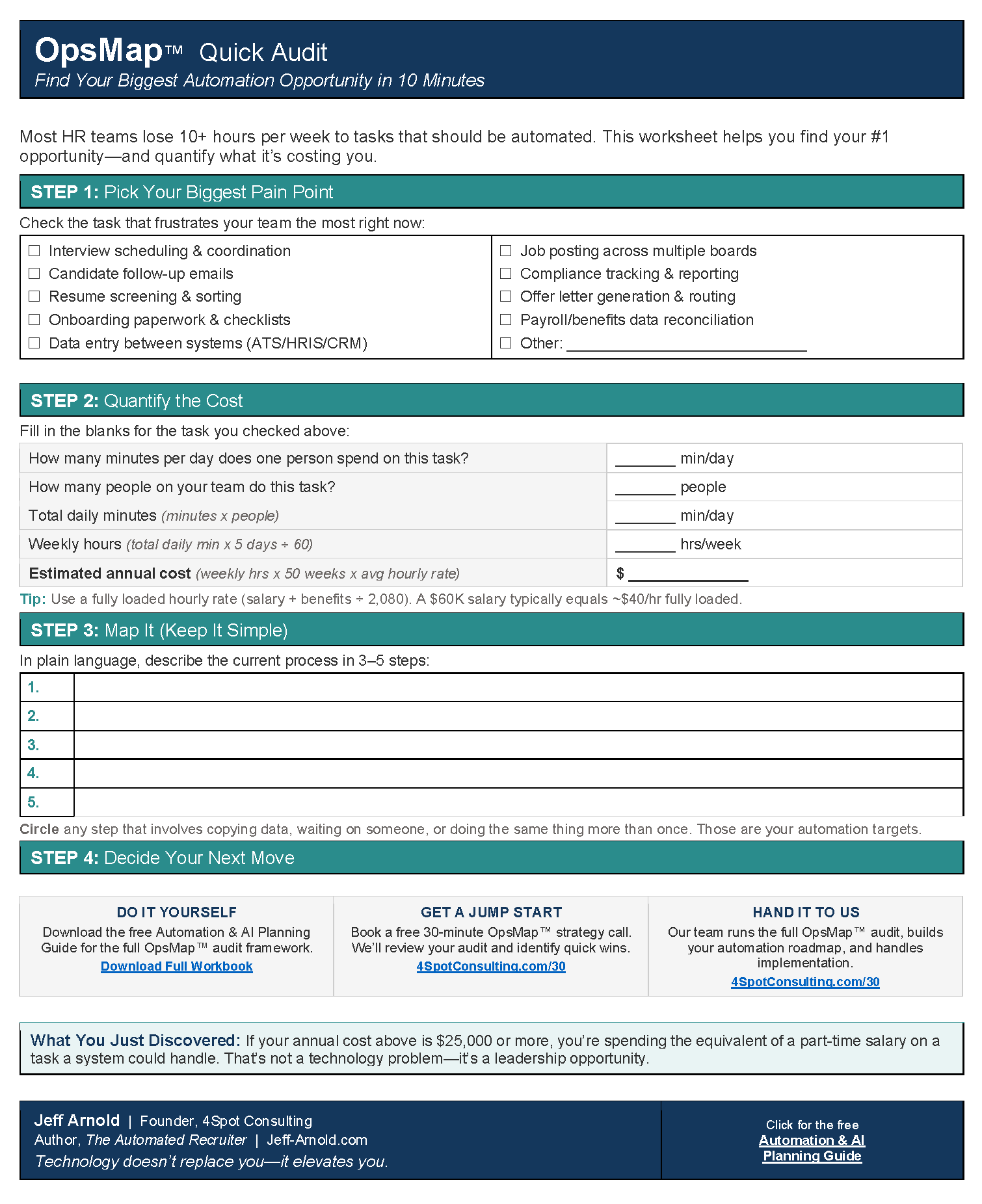
The businesses that get it right do it in order. They use OpsMap™ to document their current workflows and identify where data is inconsistent. They automate data collection, routing, and follow-up first. Then they bring in AI to work on top of that clean foundation. The AI output is reliable because the input is reliable.
This is not a theory. It is the pattern behind every successful AI implementation built for clients at 4Spot. The ones that went automation-first got sustainable results. The ones that jumped to AI first came back to rebuild the foundation anyway – just with more sunk cost.
Read 10 real examples of Automation First, Then AI in action.
When You Are Ready to Add the AI Layer
The right moment to add AI is when your automation layer runs reliably without manual intervention.
That means your lead data is consistent and complete. Your follow-up sequences run on time without someone manually triggering them. Your onboarding, offboarding, invoicing, and reporting workflows fire automatically and without errors. Your team is not spending hours on tasks that automation handles.
At that point, AI has a clean data foundation to work with, and your team has capacity to review and act on AI recommendations instead of firefighting operational errors.
The OpsCare™ function at 4Spot monitors the automation layer on an ongoing basis – catching errors, updating broken connections when third-party APIs change, and flagging data quality issues before they reach the AI layer. A reliable automation layer is not a one-time build. It requires maintenance, especially as your business and software stack evolve.
When your OpsCare layer is stable, AI additions become lower-risk and higher-return. You are not fighting fires while trying to evaluate AI output. You are making deliberate decisions about where AI adds the most value because your baseline operations are under control.
Check the 10 signs your business is ready for this sequence.
Frequently Asked Questions
Is “Automation First” just another way of saying “don’t use AI yet”?
No – it is a sequencing principle, not a delay tactic. The goal is to use AI faster and get better results from it. Businesses that skip automation and go straight to AI spend months debugging bad AI output and eventually rebuild the automation layer anyway. Doing it in order gets you to reliable AI results faster than skipping steps.
How long does building the automation layer take before we can add AI?
It depends on how many manual, high-volume processes you have and how messy your current data is. A focused OpsSprint can deliver a working automation foundation in 30 to 90 days for most small and mid-size businesses. That is not a long delay relative to the time most businesses waste on manual processes every year.
We already have AI tools running. Is it too late to apply this principle?
No – and the symptoms that led to this question are visible already. If your AI tool results feel inconsistent, if your team ignores AI recommendations, or if you spend time manually cleaning up AI output, those are signs the automation foundation is missing. You can build it now, under the existing AI layer, and watch AI results improve as data quality improves.
Does this apply to small businesses, or only to larger organizations?
This applies at every business size. Small businesses benefit most from automation-first because they have fewer people to absorb operational errors. A solo operator or five-person team running on consistent, automated workflows gets the leverage of a much larger team. AI on top of that foundation multiplies the output further.
What is the simplest way to explain automation vs. AI to a non-technical person?
Automation is a light switch. You set the rule: flip this and that happens, every time, without variation. AI is a recommendation engine. You give it context and it tells you what it thinks is the best answer. Light switches do not need recommendations. Recommendation engines need reliable inputs. That is why the light switch goes in first.
For more on how this plays out in practice, see why clean processes must come before any automation and the signs your business needs to apply the Automation First sequence now.
Part of our complete guide: Automation First, Then AI: Why Order Is the Whole Game.