Post: Explained: Automation First, Then AI
“Automation First, Then AI” is a sequencing principle: fix and automate your repeatable business processes before layering AI on top. AI amplifies whatever is already there – clean processes get sharper, broken ones break faster. Build the operational foundation first, then let AI work on a system that is actually ready for it.
What “Automation First, Then AI” Means
This principle is a deliberate sequencing decision, not a technology preference. It tells you in what order to introduce tools – not which ones to pick.
AI makes decisions based on the data and processes it inherits. If those processes are manual, inconsistent, or undefined, AI has nothing solid to build on. A salesperson manually copying form data into a CRM is not a data problem – it is a process problem. Dropping an AI layer on top of that workflow does not fix the copy-paste. It adds a smarter layer on top of a broken foundation.
Automation closes that loop first. Then AI can interpret, route, prioritize, and improve what is flowing through a clean pipe.
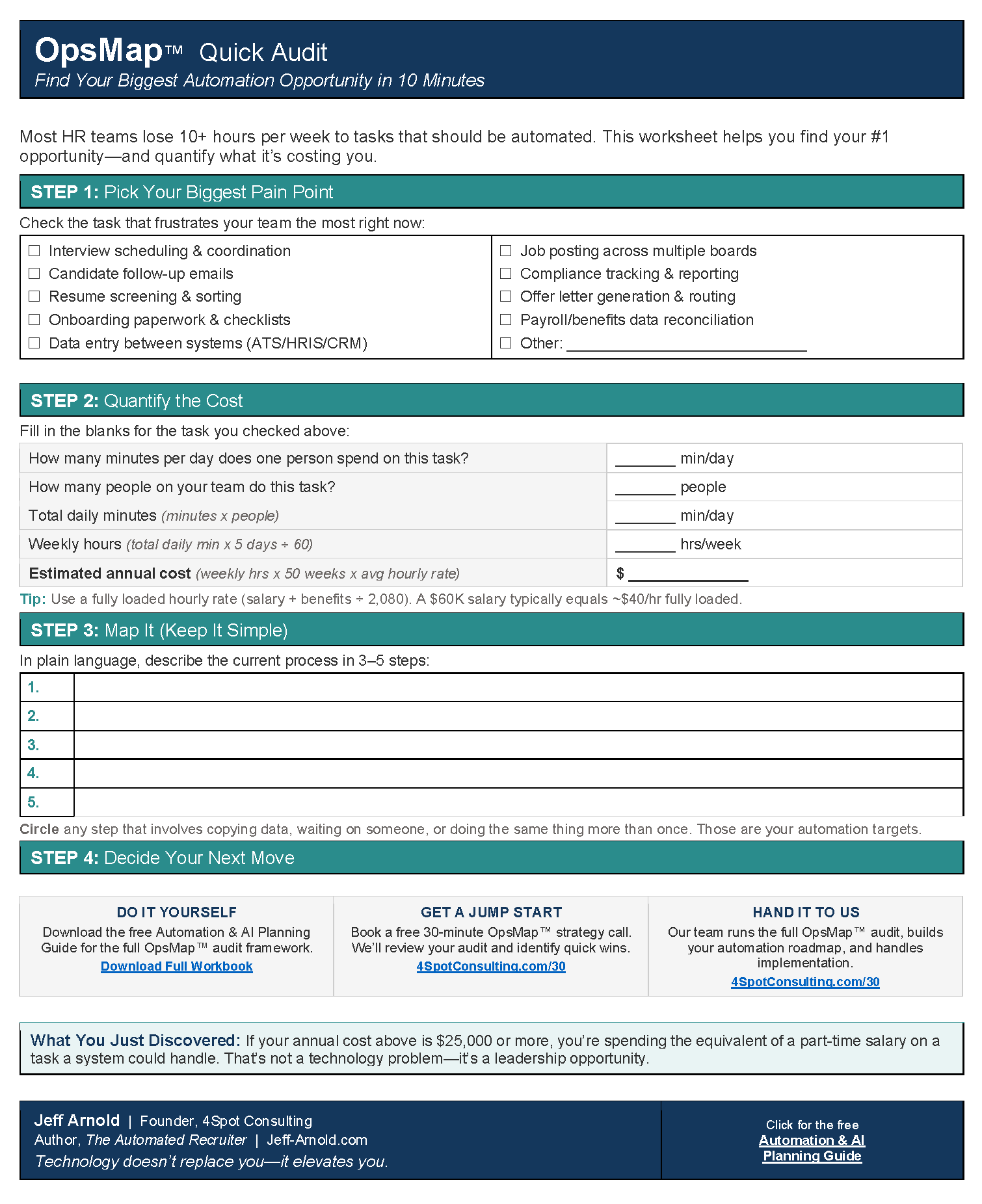
At 4Spot, we apply this inside the OpsMesh™ framework. Every client engagement starts with an OpsMap™ – a process audit that identifies where manual work lives and whether that work is defined clearly enough to automate. You cannot automate what you have not documented, and you cannot get AI value from a process that is not running reliably.
Why Sequence Matters
The order you introduce technology determines whether it solves problems or multiplies them. Automation handles rule-based, repeatable steps – the “if this, then that” logic that does not require judgment. AI handles pattern recognition, language, decision support, and tasks that benefit from contextual reasoning. These are different jobs.
When you skip automation and go straight to AI, you are asking a judgment layer to compensate for missing structure. That is the wrong ask. AI is not a process fixer. It is a process amplifier.
Here is a concrete example: your hiring workflow generates 400 applicants a week. An AI resume screener sounds like the right move. But if your intake form collects inconsistent data, your ATS fields are half-populated, and no one has defined what “qualified” means in structured terms, the AI screener has no clean signal. First, automate the intake – standardized form fields, automated ATS data push, defined tagging logic. Then the AI screener has something useful to sort.
The case for sequencing is not philosophical – it is operational. See 12 stats that explain Automation First, Then AI for the numbers behind this approach.
Expert Take
The clients who get the most out of AI are never the ones who bought the AI tool first. They are the ones who cleaned up their processes, automated the routine steps, and brought AI in to do what AI is actually good at. Sequence is the whole game.
What Breaks When You Skip the Foundation
Companies that jump straight to AI without an automation foundation hit the same three walls every time.
Garbage in, garbage out. AI outputs are only as reliable as the data fed to them. Unstructured manual processes produce dirty data. The AI cannot fix that – it just makes confident decisions on bad inputs.
No feedback loop. Automation creates logs, triggers, and observable handoffs. Without it, AI decisions happen in a black box with no audit trail. You cannot improve what you cannot measure.
Adoption collapse. Teams reject AI tools that feel unreliable. Unreliable outputs are exactly what you get when the underlying process is inconsistent. The tool gets blamed for a process problem.
The 11 most common mistakes HR teams make when automating internally traces most failures back to skipping process definition entirely – then compounding it by adding AI before automation is stable.
A related failure pattern: teams build automation, see early wins, and immediately reach for AI to accelerate – without checking whether the automation is actually running clean. Automation running at 80% is not a foundation for AI. It is a source of AI errors at scale. The OpsSprint™ phase of our work addresses this directly: we verify automation stability before any AI layer gets proposed.
For real context on what this costs in practice, see how these warning signs show up in operations bleeding money before any technology is introduced.
How to Apply This Framework in Practice
The framework starts with a process audit, not a software evaluation. You identify what work is currently manual, which of it is repeatable, and which steps require actual human judgment. Repeatable steps without judgment are automation candidates. Steps requiring judgment on top of repeatable inputs are AI candidates.
In practice, the progression looks like this:
- Document the process – write down every step, owner, and trigger before touching any tool
- Automate the handoffs – replace manual data movement, notifications, and status updates with triggered automations
- Verify reliability – run the automation long enough to confirm error rates are acceptable and the team trusts the output
- Layer AI on stable ground – introduce AI where pattern recognition, language generation, or contextual routing adds value on top of a clean automated flow
Our OpsMap™ phase documents and prioritizes. OpsSprint™ captures quick automation wins. OpsBuild™ delivers the full connected system. OpsCare™ monitors ongoing health before any AI layer is introduced at scale.
One client result illustrates the sequence: after auditing, automating, and stabilizing their talent operations, 103,000 annual labor hours were recovered before a single AI tool entered the picture. That is the foundation you want.
For more on what this looks like across different business types, see 10 real examples of Automation First, Then AI and 10 signs you need to apply this framework now.
Frequently Asked Questions
Does this mean I should avoid AI tools right now?
No – the framework is about sequence, not avoidance. If you already have stable, documented automation in a given workflow, AI is a natural next step in that area. The principle applies per workflow, not as a company-wide moratorium on AI adoption.
What counts as “automation” in this context?
Automation here means any rule-based, trigger-driven system that moves data or completes steps without human intervention – form-to-CRM pushes, status update notifications, document generation, scheduled reporting, and similar repeatable handoffs. If a human is doing it every time the same way, it is an automation candidate.
How do I know my automation is stable enough to add AI?
Stability means your automation logs successfully, error rates are low, and your team trusts the output without manually double-checking every run. If people are spot-checking outputs or the automation runs inconsistently, it is not stable enough to anchor AI decisions.
Can AI help me build better automation?
Yes – this is one area where AI fits before a stable automation layer exists. Using AI to help write automation logic, map processes, or draft workflow documentation is different from using AI as an operational decision-maker on top of a broken process. AI as a builder’s tool is fine at any stage.
Where does 4Spot start when a client wants to use AI?
We start with the OpsMap™ process audit every time. We need to see what is already automated, what is manual, and whether the manual work is defined clearly enough to systematize. That assessment drives the sequence – and the fastest path to reliable AI output runs through automation-first work first.
Part of our complete guide: Automation First, Then AI: Why Order Is the Whole Game.