Post: What You Need to Know About: Automation First, Then AI
Automation First, Then AI is a sequencing discipline that requires businesses to eliminate manual data entry, connect disconnected systems, and establish clean workflows before layering AI on top. AI tools produce unreliable outputs when the underlying data environment is broken. Automation builds the structured, consistent data foundation that AI needs to generate results worth acting on.
What “Automation First, Then AI” Actually Means
The phrase describes a deliberate build order for operations: wire up your systems, eliminate manual hand-offs, and get clean data flowing before you introduce any AI layer. Automation is the foundation. AI is the structure built on top. Without the foundation, the structure collapses.
Automation handles deterministic work — moving data from one place to another, triggering actions based on rules, and enforcing consistent process steps. AI handles probabilistic work — classifying intent, generating content, predicting outcomes, and making judgment calls. Both are valuable. Order matters.
The 4Spot OpsMesh™ framework names this explicitly: automation creates the connective tissue that lets AI tools operate on reliable, consistent inputs. When every step in your process runs through a structured workflow, AI has something solid to work with. When processes are manual and ad hoc, AI amplifies the inconsistency instead of solving it.
Why the Sequence Matters
AI tools fail in chaotic operations for one reason: bad inputs produce bad outputs, no matter how sophisticated the model. Automation solves the input problem first.
Before automation, most businesses have data scattered across inboxes, spreadsheets, and half-updated CRM records. AI trained or prompted against that data returns results that reflect the mess. The model is not broken. The environment is.
Automation standardizes inputs. When a lead submits a form, automation captures every field, creates the CRM record, assigns the owner, sends the confirmation, and logs the timestamp — without anyone touching a keyboard. Now AI has structured, complete, timestamped data to work with. That is when AI produces results worth acting on.
The practical sequence: map the process, build the automation, verify it runs cleanly for 30 days, then add AI as a decision-making or generation layer on top of that clean data stream. Clean processes must come before any automation — the principle applies even more forcefully when AI enters the picture.
Expert Take
The businesses that get the most out of AI are not the ones that bought the best models. They are the ones that spent six months fixing their data flows first. AI is a multiplier — it multiplies what you give it. Give it clean, automated data and you get powerful output. Give it manual, inconsistent, siloed data and you get expensive noise that someone acts on.
The Most Common Mistake
The most common mistake is buying AI before building automation. A business purchases a predictive scoring platform, an AI-powered CRM feature, or an AI writing tool — then immediately runs it against unstructured, incomplete data. The outputs disappoint. The team concludes AI does not work for their use case. The real problem was the environment, not the model.
A second version of this mistake is implementing automation and AI at the same time. Teams try to fix broken processes and add AI decision-making simultaneously. When something goes wrong — and it will — there is no clean way to isolate whether the automation or the AI layer is the problem. Sequential implementation keeps troubleshooting tractable.
A third version: using AI to compensate for missing automation. Some teams ask AI to parse unstructured email threads because they never built a structured intake form. The AI works harder than it needs to and still produces inconsistent results because raw inputs vary too much. Build the form. Automate the capture. Then let AI do something genuinely difficult.
The 10 signs your business needs to apply Automation First, Then AI covers a diagnostic checklist for identifying where you are in this sequence right now.
How to Apply This Framework in Your Business
Start by auditing every manual step in your highest-volume workflows. Manual steps introduce variability, delay, and data gaps — each one is a candidate for automation before AI ever enters the picture.
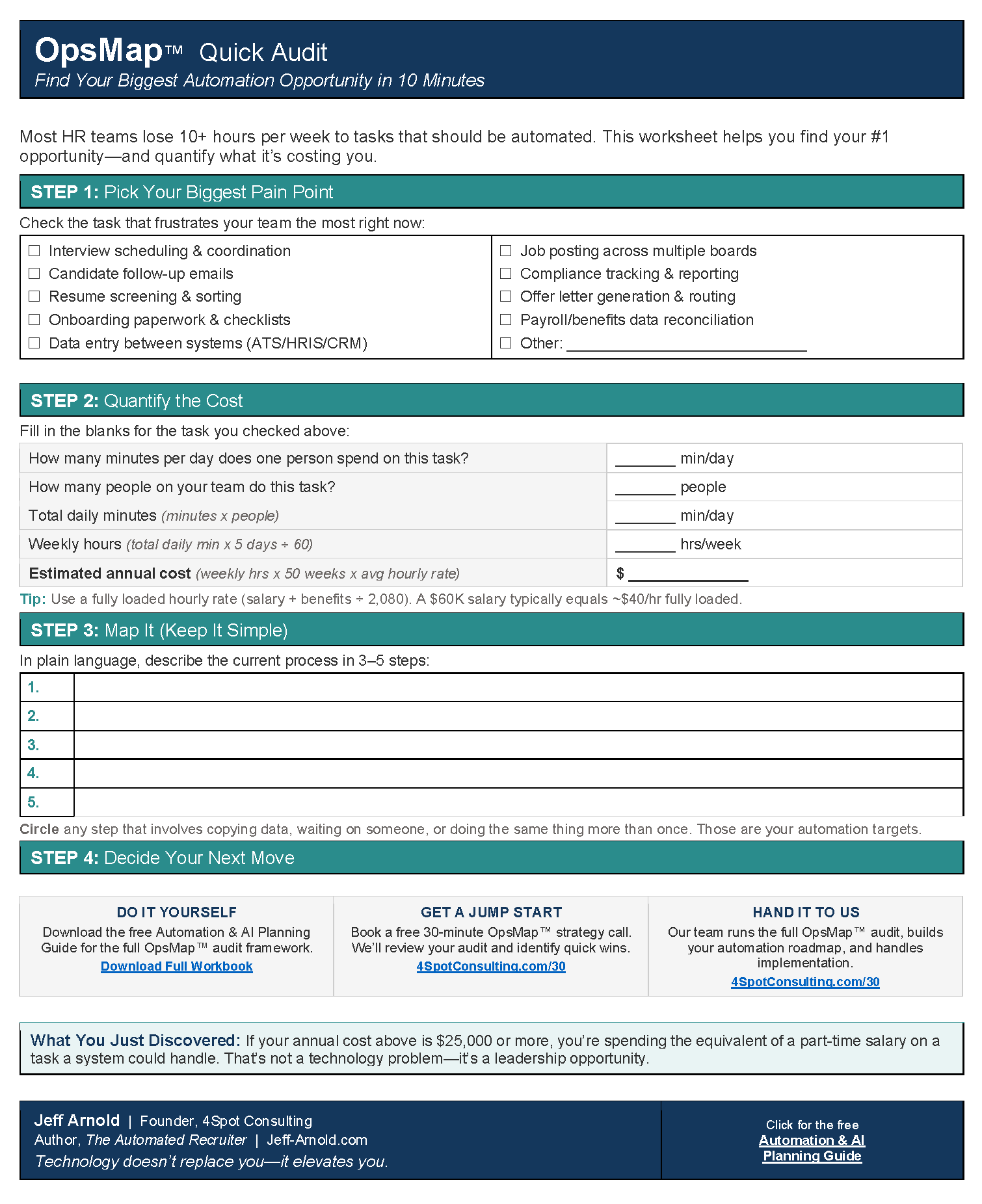
The 4Spot OpsMap™ process starts here: document every step in the workflow, identify where data is entered manually or transferred by hand, and rank those steps by volume and error rate. The highest-volume manual steps with the highest error rates are your first automation targets.
Once automation runs cleanly for 30 days — no errors, consistent outputs, data flowing into the right fields — you have a stable foundation. Now identify where AI adds genuine value: classifying leads by intent, generating first drafts from structured intake forms, scoring candidates against defined criteria, or summarizing activity logs for managers.
The 4Spot OpsBuild™ process handles the AI integration step: automation and AI are wired together so the AI layer only fires when upstream automation confirms a clean, complete input. No automation confirmation, no AI trigger. This prevents AI from processing broken data and producing outputs someone then acts on incorrectly.
For businesses running Make.com as their automation backbone, the path is direct: build your scenarios first, get them stable, then add AI modules at the decision points where judgment is genuinely needed. The 10 real examples of Automation First, Then AI show exactly how this plays out across common business functions.
What This Means for HR and Recruiting Operations
HR and recruiting are among the highest-stakes environments for this sequencing discipline. Candidate data arrives through multiple channels, in multiple formats, at unpredictable times. Without automation to standardize capture and routing, AI tools produce inconsistent scores, missed follow-ups, and candidate experience failures.
The automation layer handles intake: form submission triggers CRM record creation, tags fire based on source, follow-up sequences start, and hiring manager notifications go out — all without a recruiter touching the record. The AI layer then works on structured data: scoring the resume against role criteria, flagging high-potential candidates for immediate outreach, or summarizing the candidate profile for the hiring manager.
This sequence also protects against the most common HR automation failure: AI-generated outreach sent to candidates whose records are incomplete or incorrectly tagged. Automation ensures the record is complete before AI is allowed to act on it. The 4Spot OpsCare™ layer monitors both automation and AI outputs to catch drift before it affects candidate experience or compliance.
The 12 stats that explain Automation First, Then AI include data points specific to HR and talent operations that quantify why sequencing matters at scale.
Frequently Asked Questions
What is the definition of “Automation First, Then AI”?
Automation First, Then AI is an operational sequencing principle that requires businesses to build and stabilize rule-based workflow automation before introducing AI tools. The automation layer standardizes data inputs. The AI layer then operates on that clean, consistent data to produce reliable, actionable outputs.
Why can’t I implement AI and automation at the same time?
Simultaneous implementation makes troubleshooting nearly impossible when outputs are wrong — and they will be during the build phase. Sequential implementation keeps each layer’s performance visible and correctable. Automation errors and AI errors look completely different; seeing them at the same time obscures both.
How long should automation run before I add AI?
Thirty days of clean automation runs with no data errors is a reasonable threshold for most businesses. The goal is confidence that the data flowing through your system is consistent and complete. Rushing past this step is the primary reason AI implementations disappoint at rollout.
Does “Automation First, Then AI” apply to small businesses?
The principle applies at every scale. A small business with one high-volume manual process — every new lead entered by hand, for example — benefits from automating that step before adding any AI tool. A single automated capture point creates a cleaner foundation for whatever AI the business adopts next.
What automation platform does 4Spot recommend?
4Spot builds on Make.com as the primary automation backbone. Make.com’s visual scenario builder, broad integration library, and reliability at scale make it the right foundation for the automation layer. AI modules are introduced on top once that foundation is stable and verified.
Part of our complete guide: Automation First, Then AI: Why Order Is the Whole Game.