Post: An Introduction to: Automation First, Then AI
“Automation First, Then AI” is a sequencing principle that tells you to build reliable, rules-based workflows before layering in AI tools. Businesses that reverse this order spend more, get worse results, and create systems that break under pressure. Get the foundation right first, and AI amplifies it. Skip it, and AI exposes every gap.
What “Automation First, Then AI” Actually Means
The phrase describes a deliberate build order for any business that wants to use technology to work more efficiently. Automation handles the predictable: routing a form submission to the right inbox, triggering a follow-up sequence when a candidate reaches a new status, generating a document when a deal closes. These are rules-based processes – if this happens, do that. Same input, same output, every time.
AI handles the unpredictable: summarizing a transcript, scoring a resume against a job description, drafting a personalized reply based on context. AI thrives on ambiguity and judgment calls. It struggles when the underlying data is messy, the process it sits inside is broken, or there is no consistent workflow feeding it clean inputs.
The principle says to solve the predictable problems first. Once your workflows are clean and consistent, AI has structured data to reason over, reliable triggers to activate it, and clear outputs to write results into. The combination becomes genuinely powerful. Without the automation layer underneath, AI tools produce inconsistent results because they are working with inconsistent inputs – and no amount of prompt engineering fixes a broken process.
Why the Order Matters More Than the Technology
Most businesses fail at AI adoption not because they chose the wrong tool, but because they added AI to a broken process. The sequence – automation before AI – is what separates teams that see real ROI from teams that see a growing SaaS bill and declining patience.
Consider what happens when a company skips automation and goes straight to AI for recruiting. They deploy an AI screening tool, but their intake form captures data inconsistently. Different recruiters use different field names. Applications arrive through email, a web form, and a spreadsheet a manager emailed over on a Tuesday. The AI does its best, but garbage in means garbage out – and because it is AI, the garbage looks polished and confident. The team ends up reviewing and correcting AI outputs rather than saving any time.
Now contrast that with a team that standardized their intake first. Every application enters through one channel. Every record gets the same fields populated. Every status change triggers the next step automatically. When they layer AI on top, the tool has clean, structured inputs to work from. It scores accurately. It drafts follow-ups that actually reflect the candidate’s background. The AI looks smart because the process underneath it is smart.
That is the whole principle in one comparison.
Expert Take
The teams that get the most from AI tools are almost always the ones that already automated the repeatable work. They did not add AI because they were struggling – they added it because their foundation was solid enough to amplify. The principle is not anti-AI. It is pro-results. Sequence is the strategy.
The Two Layers of the Framework
Breaking this into two distinct layers makes it easier to assess where you are and what to build next.
Layer 1: Rules-based automation. This covers everything that follows a predictable pattern. A form gets submitted, a record gets created. A candidate changes status, a task gets assigned. A contract gets signed, an invoice gets generated. These steps are deterministic – the same input always produces the same output. Tools like Make.com handle this layer exceptionally well, connecting your systems and executing workflows without anyone having to remember to do the next thing. The OpsMesh™ framework starts here, mapping every workflow before a single AI tool enters the picture.
Layer 2: AI-assisted judgment. This layer handles tasks that require interpretation. Summarizing a long document. Scoring candidate fit against a job description. Drafting a message in a specific tone. Flagging anomalies in a data set. AI belongs here because these tasks are not perfectly deterministic – context matters, nuance matters, and the right answer changes with the inputs. But this layer only works reliably when Layer 1 is feeding it structured, consistent data.
Most organizations that struggle with AI adoption have either skipped Layer 1 entirely or have a Layer 1 that is inconsistent enough to undermine everything above it. Fixing the bottom layer is always the first move.
How This Shows Up in HR and Recruiting Operations
The pattern holds across industries, but it is especially visible in HR and recruiting – where process complexity is high and the cost of errors is real. A missed candidate, a dropped follow-up, a compliance gap: these are not abstract risks. They have names attached to them.
A recruiting firm that follows this principle starts with their intake pipeline. Every application enters through one channel. Every applicant gets tagged in the CRM. Every status change triggers the next workflow step. The team stops relying on people to remember to do the next thing. The system handles it.
Once that foundation is stable, AI enters where judgment is needed. A tool reads the application and writes a preliminary scorecard. Another drafts an outreach email personalized to the candidate’s background. A third flags applicants who have been dormant for too long and prompts a recruiter to check in. The AI works because the data underneath it is clean.
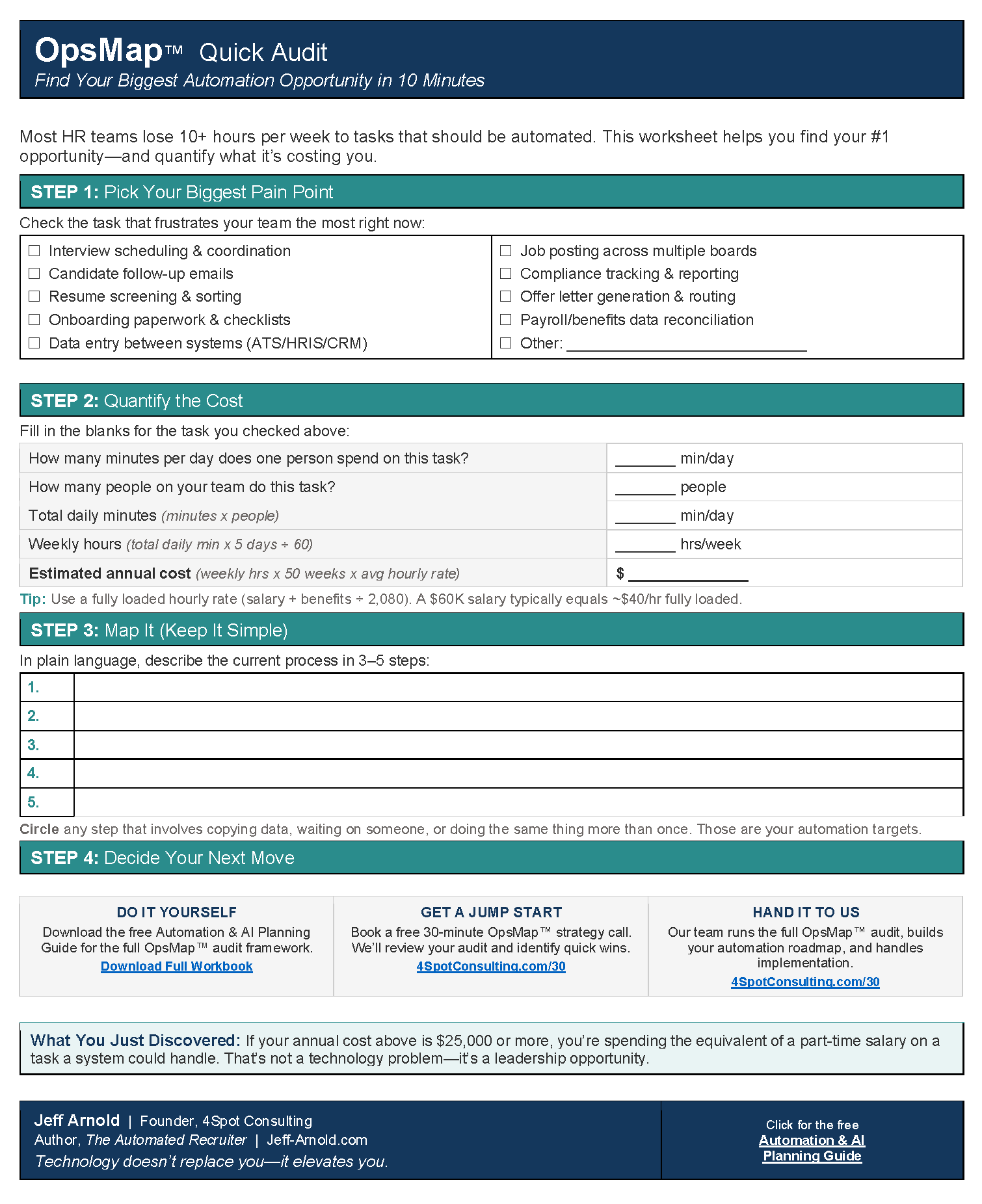
This is exactly what an OpsMap™ assessment surfaces – the gaps in Layer 1 that would undermine any AI investment. Before recommending a single AI tool, the first step is identifying where workflows are inconsistent, where data quality is poor, and where manual handoffs are introducing errors. Clean processes must come before automation, and clean automation must come before AI. Skip either step and you are building on sand.
The Most Common Mistake – and Why Teams Make It
Businesses reverse the order because AI is exciting and automation feels like infrastructure. The AI demos are impressive. The automation work is unglamorous. So they buy the AI tool first, connect it to a messy process, get inconsistent results, and conclude that AI does not work for their business.
The conclusion is wrong. The sequence was wrong.
A CRM full of duplicate contacts cannot be fixed by an AI that summarizes contact histories – it will summarize the wrong contact half the time. A recruiting pipeline where applications arrive through five different channels cannot be meaningfully improved by an AI screening tool, because the AI will score some applicants twice and miss others entirely. An onboarding process where task assignments depend on which manager happens to be available that day cannot be accelerated by AI-generated checklists, because no checklist will match what the handoffs actually look like on the ground.
The OpsSprint™ engagement exists specifically for this scenario – teams that bought the technology before solving the process, and need to work backwards to get the foundation right. The signs that you need this approach are consistent: AI tools that underperform, high manual override rates, and results that vary by person rather than by logic.
Expert Take
When a client tells me their AI tool is not working, the first question is always about what data is feeding it. In almost every case, the problem is not the AI. The process underneath was never clean to begin with, and the AI is just making that mess more visible – and more expensive.
How to Start Applying This Principle
Starting right does not require a large project or a long timeline. Pick one workflow that is currently manual, inconsistent, or error-prone. Map every step. Identify where inputs vary and where outputs are unpredictable. Then automate the predictable parts first – the triggers, the routing, the status updates, the notifications. Get that single workflow running consistently without manual intervention.
Once it holds, it is ready for AI augmentation. Add AI where judgment is genuinely required – scoring, summarizing, drafting, flagging. Measure whether the AI’s outputs are consistent and accurate. Adjust the inputs it receives until they are. Then repeat for the next workflow.
This is how the OpsBuild™ engagement works in practice – not a big-bang transformation, but a workflow-by-workflow build that creates a stable foundation before adding intelligence on top. Real examples of this approach show the same pattern every time: start narrow, get it right, then expand.
The data behind this approach is consistent. Teams that sequence correctly spend less time debugging AI failures and more time acting on AI outputs. The foundation is the multiplier. There is no shortcut around it.
Frequently Asked Questions
What is the difference between automation and AI in a business context?
Automation executes rules – if this happens, do that. The same input always produces the same output. AI interprets context and makes judgment calls – the output depends on how well the model understands the input and the nuance in the situation. Both solve real problems, but they solve different problems. Automation handles the predictable. AI handles the ambiguous. And automation creates the structured data environment that makes AI reliable.
Can you use AI without building the automation layer first?
Yes, but results are inconsistent and the ROI case falls apart quickly. AI tools work on whatever inputs they receive. If those inputs are messy – inconsistent field names, multiple entry points, manual handoffs that vary by day – the AI outputs reflect that messiness. Teams that skip the automation layer spend more time reviewing and correcting AI outputs than they save on manual work. The signs that the sequence is wrong show up fast: high error rates, low adoption, and results that depend more on luck than logic.
How long does it take to build the automation foundation?
A single well-defined workflow takes days to weeks, not months. The timeline depends on data quality, the number of systems involved, and how clearly the current process is documented. Teams with clean CRM data and defined process steps move faster than teams that are mapping their workflow for the first time. The goal is not to automate everything at once – it is to automate one workflow correctly, prove the model, and use it as a template for the next one.
Does this principle apply outside of HR and recruiting?
The principle applies to any business function with repetitive workflows and an interest in AI. Sales operations, finance, customer service, and marketing all follow the same pattern – automate the predictable steps, then layer AI where judgment is required. Small business automation follows the same build order regardless of industry. The sequence is not industry-specific. It is how technology stacks work.
What tools are best for building the automation layer?
Make.com is the primary tool 4Spot uses and recommends for Layer 1. It handles complex multi-step workflows, connects to hundreds of business applications, and provides the execution logs needed to debug problems quickly. The right automation platform logs every run and surfaces errors clearly, because that transparency is what makes the AI layer above it trustworthy. The right Make.com integrations form the connective tissue between your existing systems and give the AI layer the clean inputs it needs to perform.
Part of our complete guide: Automation First, Then AI: Why Order Is the Whole Game.