Post: Answers to Your Questions on: Automation First, Then AI
“Automation First, Then AI” means building reliable, rules-based workflows before layering AI on top. AI amplifies whatever it runs on – broken or manual processes become bigger problems at machine speed, not smaller ones. Fix the process, automate the workflow, then add AI where judgment and scale create compounding returns.
This question comes up in nearly every conversation 4Spot has with HR and operations leaders who are curious about AI but uncertain where to start. The short answer: start with automation. The longer answer is below.
What does “Automation First, Then AI” actually mean?
It means sequencing your technology investments in the right order instead of chasing the newest tool.
Automation handles repetitive, rules-based work – the same steps, triggered the same way, every time. AI handles judgment – recognizing patterns, generating language, scoring and ranking, making decisions in ambiguous situations. The problem is that AI needs clean, structured inputs to function well. If your data is messy, your handoffs are inconsistent, and your workflows live in someone’s inbox, AI runs on garbage and produces garbage faster.
The sequence is deliberate: document the process, automate the steps, verify the outputs, then introduce AI where decision-making creates leverage. See 10 real examples of what this looks like across HR and operations teams.
Expert Take
The teams that get the most out of AI aren’t the ones who moved fastest – they’re the ones who moved in order. Automation is what makes AI inputs trustworthy. Without it, you’re not accelerating your business; you’re accelerating its chaos.
Why can’t I just skip straight to AI?
You can skip the automation layer – but the results show up fast and they aren’t pretty.
AI tools that write job descriptions, score resumes, or draft candidate communications need consistent data to work from. If that data lives in spreadsheets people update inconsistently, in email threads, or across disconnected systems with no single source of truth, the AI has nothing reliable to anchor to. It hallucinates. It surfaces irrelevant candidates. It generates off-brand communications. And your team spends more time cleaning up AI outputs than they would have spent doing the work manually.
That’s not an AI problem – that’s a sequencing problem. Check these signs that clean processes need to come before any HR automation.
What processes should I automate before introducing AI?
Start with the processes that are high-volume, low-judgment, and currently manual.
In HR and recruiting, the best candidates for first-wave automation are:
- Application intake and acknowledgment
- Resume routing to the right hiring manager
- Interview scheduling and confirmation
- Offer letter generation from a CRM-triggered template
- Onboarding task sequencing and document delivery
- Status update communications to candidates
These are the workflows where a human is doing the same thing 40 times a week. Automate those first. Once they run cleanly and your data flows without manual intervention, you have a foundation AI can actually use.
How do I know when my automation layer is AI-ready?
Three signals tell you the foundation is solid enough to introduce AI.
First, your data enters the system in one place and moves through it predictably – no one is manually copying fields between tools. Second, your automations run without daily babysitting; errors are exceptions, not the norm. Third, you have a clear record of what happened to every contact, applicant, or task – a timeline you can audit without calling someone to explain it.
When those three things are true, AI has clean inputs, structured context, and a reliable feedback loop. That’s when the investment pays off. These 12 stats explain why the sequencing matters.
What tools does 4Spot use to build the automation foundation?
Make.com is the primary automation platform in 4Spot’s stack, and it’s the only one we endorse in technical work.
Make.com handles multi-step, multi-system workflows without requiring a developer. It connects CRMs like Keap to applicant tracking systems, document tools like PandaDoc, and communication platforms in ways that create a reliable, auditable data backbone. That backbone is what AI runs on when you’re ready to add it.
For HR teams specifically, the OpsMesh™ framework layers automation across the full employee lifecycle – from first application through offboarding – before any AI layer is introduced. The automation handles the volume; AI handles the exceptions and decisions that require judgment.
Does this approach apply specifically to HR and recruiting teams?
Yes – and HR and recruiting teams are where the sequencing gap is most expensive.
HR teams process high volumes of structured, repeatable touchpoints – applications, interviews, offers, onboarding steps, review cycles – that are ideal automation targets. But HR is also the function that has most aggressively adopted AI tools as a shortcut before the underlying workflows are in shape. The result is AI-generated content that conflicts with what’s in the CRM, or scoring systems that pull from incomplete applicant data and produce rankings no one trusts.
The fix is the same for every team: build the automation layer first. See the 10 signs your team needs to start with automation before AI.
What does the OpsMesh framework have to do with Automation First, Then AI?
OpsMesh™ is 4Spot’s proprietary framework for building the automation layer before AI enters the picture.
Rather than treating automation and AI as interchangeable or concurrent investments, OpsMesh sequences them deliberately. The framework maps your current workflows with OpsMap™, builds the automation infrastructure through OpsBuild™ or OpsSprint™, and maintains it through OpsCare™. Each phase produces cleaner data and more predictable outputs. By the time AI is introduced, it’s running on a foundation that was specifically designed to feed it reliable inputs.
That’s the difference between AI that accelerates your operation and AI that surfaces problems faster than you can fix them.
How long does it realistically take to go from manual to AI-ready?
For most HR and recruiting teams, the automation foundation takes 60 to 120 days to build and stabilize.
The first 30 days go to mapping current workflows, identifying the highest-volume manual touchpoints, and making sure data entry is happening in one system instead of several. Days 30 to 90 go to building and testing the core automations – the ones that handle intake, routing, scheduling, and communications. Days 90 to 120 go to monitoring, fixing edge cases, and verifying the data is clean enough to be trusted.
AI integration starts after that foundation is stable. Teams that try to compress this timeline end up doing it twice.
Expert Take
Sixty to 120 days feels long when you’re excited about what AI can do. But the teams who skip the foundation phase don’t get AI faster – they get AI that doesn’t work, followed by a foundation-building project anyway. Do it once, in order.
What’s the biggest mistake companies make when adding AI before automation?
The biggest mistake is treating AI as a data-collection tool instead of a data-consumption tool.
Companies buy an AI-powered ATS or resume screener expecting it to organize their recruiting data. It doesn’t. AI reads and reasons on top of structured data – it doesn’t create structure where none exists. When teams discover this, they’re already three to six months into a deployment that hasn’t delivered promised results, and the fix requires going back to build the automation layer they skipped. These 10 real examples show what happens when automation gets skipped.
Where do I start if I want to implement Automation First, Then AI?
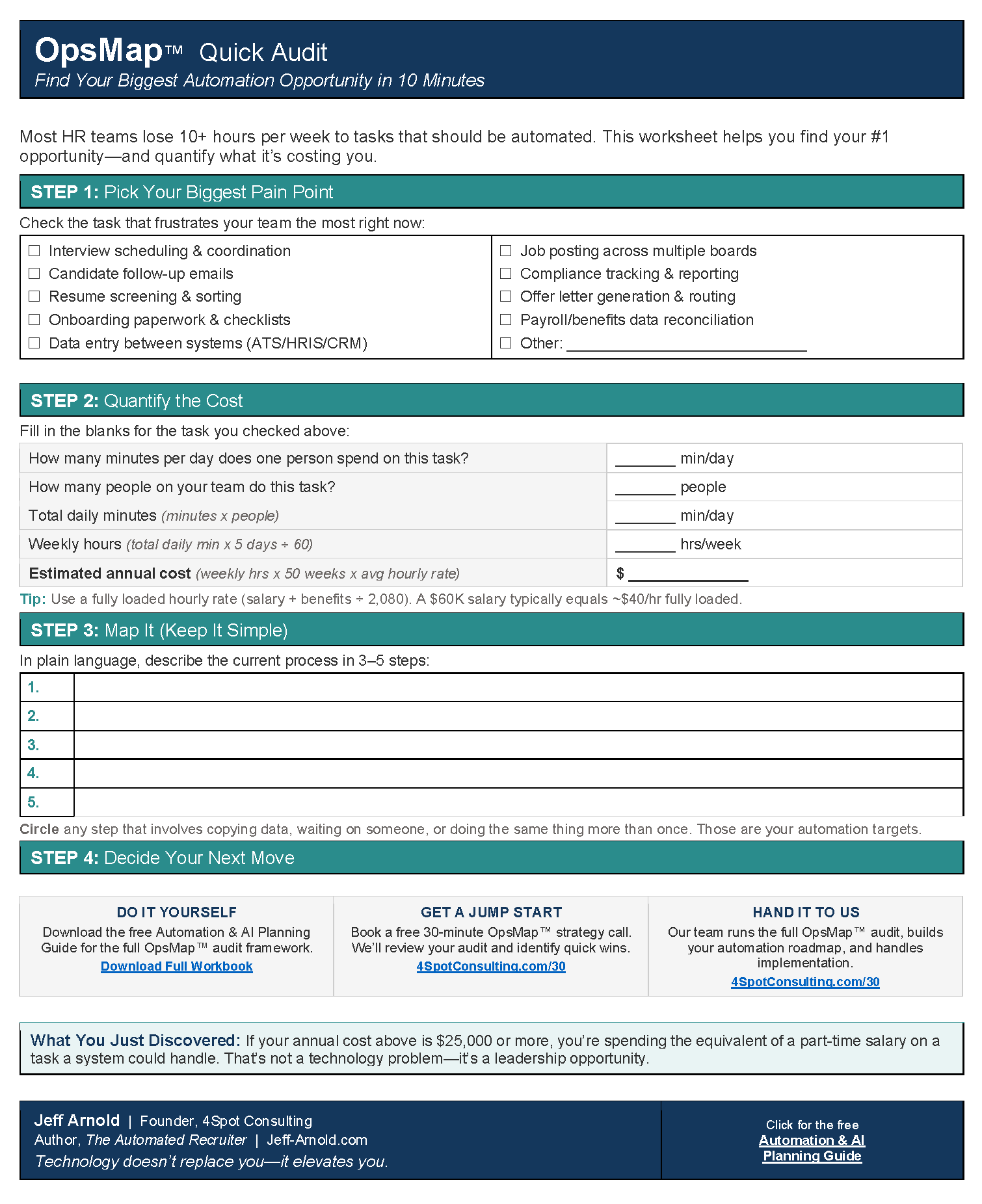
Start with a process audit – not a tool purchase.
Pick one high-volume workflow your team runs manually more than 20 times a week. Document every step, every decision point, and every system the data touches. Identify where data falls out of the system or gets entered by hand. Then automate that one workflow end to end before moving to the next one.
Once you’ve run one workflow cleanly through automation and verified the outputs are trustworthy, the pattern repeats. The OpsMesh™ methodology formalizes this process across your entire operation – but the first step is always the same: document, automate, verify. Then AI.
If you want a structured starting point, read through these real examples of how the Automation First approach works in practice.
Part of our complete guide: Automation First, Then AI: Why Order Is the Whole Game.