Post: Frequently Asked: Automation First, Then AI
“Automation First, Then AI” is a build-sequence discipline: you document your processes, automate the repeatable steps, and verify that data flows cleanly before AI touches anything. AI requires consistent, structured inputs to produce reliable outputs. Skip this order and AI amplifies your broken processes instead of fixing them – faster and at greater cost.
What Does “Automation First, Then AI” Mean?
It is a sequencing rule, not a buzzword. Automation and AI are two different layers of your operations stack, and they have to be built in the right order to produce results instead of technical debt.
The automation layer handles deterministic work: routing, triggering, syncing, sequencing, and data-moving tasks where the same input should always produce the same output. That layer goes first. Once it runs cleanly, you add AI to the parts of the workflow where variable inputs, unstructured data, or genuine judgment calls make rule-based logic impractical.
The distinction matters because the two layers fail in different ways. A broken automation is easy to diagnose – a rule fired incorrectly or a trigger misfired. A broken AI output is much harder to trace, especially when the root cause is dirty input data that no one flagged before the AI tool was installed.
For a real-world breakdown of how this plays out across business functions, see 10 Real Examples of Automation First, Then AI.
Why Can’t You Just Start With AI?
AI requires clean, consistent inputs to produce reliable outputs – and most businesses do not have clean, consistent inputs before they build an automation foundation.
AI tools ingest data, apply learned patterns, and produce outputs. If the data going in is inconsistent (entered differently by different people), incomplete (fields left blank, records never created), or mistimed (events logged hours after they happen), the outputs will reflect all of that noise. The AI does not know your data is bad. It processes what it receives.
Automation creates the clean inputs AI needs: standardized field mapping, triggered record creation, consistent timestamps, and structured handoffs between systems. Without those pipelines in place, you are asking AI to reason on top of chaos – and then wondering why the outputs do not match your expectations.
Expert Take
The most common AI implementation failure we see is not a technology problem – it is a sequencing problem. The client bought an AI tool before their data was clean, their workflows were structured, or their team trusted the outputs. The tool works exactly as designed. The foundation it was built on does not. Fix the sequence, and the same tool produces entirely different results.
What Should You Automate Before Adding AI?
Start with the high-volume, rule-based tasks your team currently handles manually on a repeatable schedule.
Specifically, look for:
- Lead and contact routing – new records assigned to the right person or pipeline without manual intervention
- Follow-up sequences – timed touchpoints triggered by actions or inactions, not calendar reminders
- Data syncing – records written to all relevant systems at the point of creation, not reconciled later by hand
- Document generation – agreements, summaries, or confirmations produced automatically when a workflow stage completes
- Status updates – internal and external notifications fired by workflow events, not by someone remembering to send them
When these run reliably without human intervention, you have a stable foundation. AI tools built on top of that foundation get clean triggers, consistent data, and measurable outputs – everything they need to produce results you can act on.
For context on why the underlying process has to be clean before automation even begins, see 10 Real Examples of Why Clean Processes Must Come Before Any HR Automation.
How Do You Know When You’re Ready to Add AI?
Four conditions need to be true simultaneously before AI is the right next investment.
First, your data is clean and consistently structured – the same event type always produces the same record format across every system. Second, your workflows run without manual intervention – your team is not fixing broken automations on a weekly basis. Third, you can measure the outputs – you know what the automation did, when it did it, and whether it produced the expected result. Fourth, your team trusts the system – they act on automation outputs rather than double-checking them manually before moving forward.
If any of those four conditions are missing, adding AI creates a more expensive version of the problem you already have. The answer is always to fix the foundation first, then evaluate AI against a baseline you can actually measure.
To see whether your operation is already showing the signs this sequence is overdue, see 10 Signs You Need Automation First, Then AI.
What Happens If You Skip the Automation Layer?
You get AI-amplified chaos – every process gap your manual operation had, now running at machine speed with no audit trail.
Without the automation layer, AI tools pull from inconsistent, incomplete data. The outputs they produce – candidate summaries, lead scores, content drafts, decision flags – reflect the quality of their inputs. Bad data in, unreliable outputs out. The team loses confidence in the system and starts verifying everything manually, which eliminates any efficiency gain the AI was supposed to deliver.
Beyond data quality, skipping the automation layer removes traceability. When a workflow runs through structured automations, you have a log of every step, every trigger, every outcome. When AI acts directly on unstructured processes, diagnosing a failure means reconstructing what happened from memory and email threads. That is not a sustainable operating model.
Does This Apply to HR and Recruiting Operations Specifically?
HR and recruiting are among the highest-stakes environments for getting this sequence right, because the cost of a dropped handoff or an unreliable AI output is measured in candidate experience, compliance exposure, and placed-candidate outcomes.
Consider the standard candidate workflow: application received, screening triggered, interview scheduled, offer generated, background check initiated, onboarding started. Every one of those transitions involves a data handoff between systems and people. If the automation layer is handling those handoffs reliably – record created, status updated, next step triggered – AI can be layered in to do genuinely useful work: flagging qualification mismatches, drafting personalized outreach, or scoring engagement patterns across a pipeline.
Without the automation layer, AI is trying to do both jobs simultaneously and does neither well.
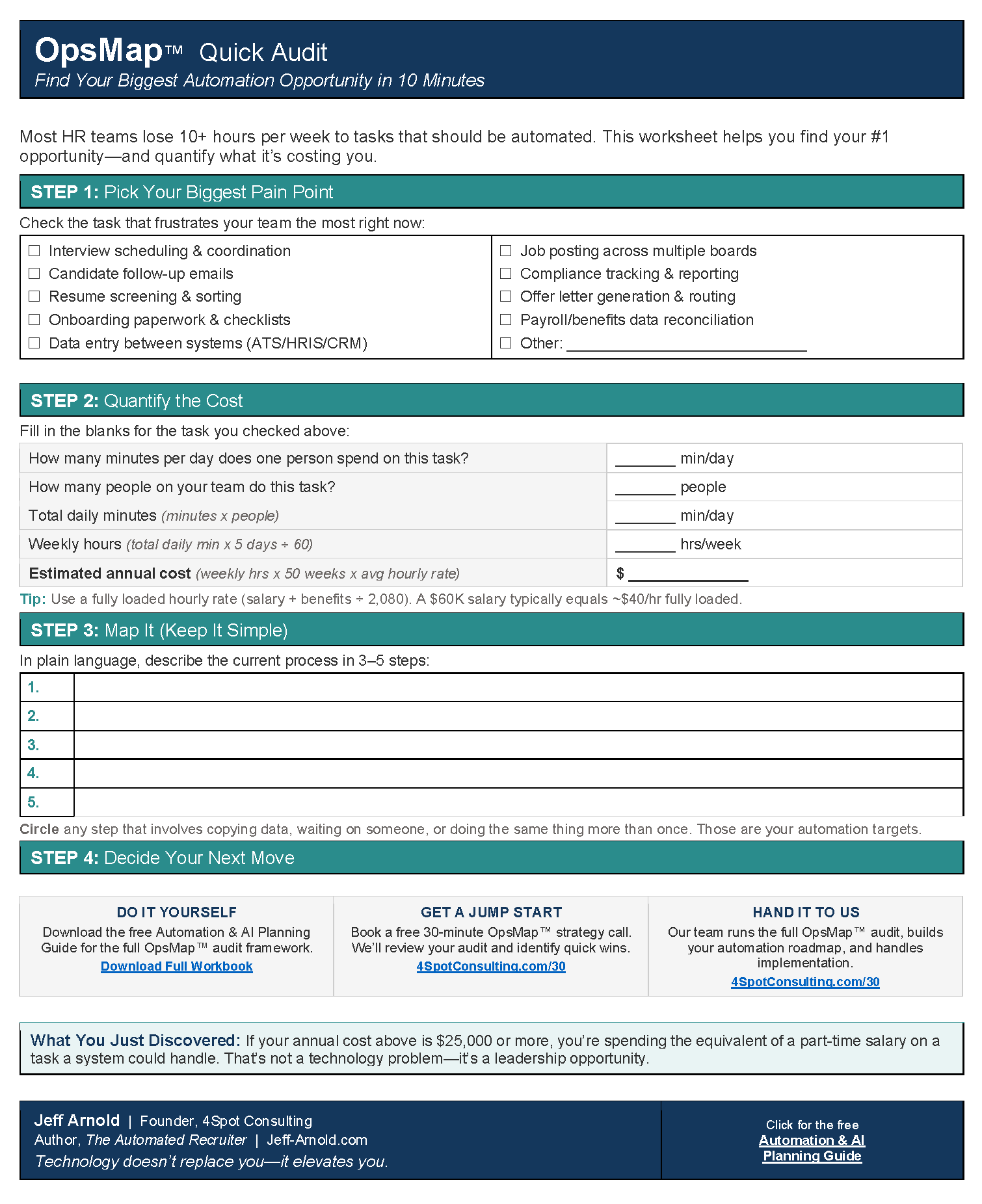
The OpsMesh™ framework addresses this sequencing for HR and recruiting operations specifically. The OpsMap™ phase documents the current workflow. The OpsSprint™ phase automates the repeatable handoffs. The OpsBuild™ phase introduces AI tooling on top of that clean foundation. OpsCare™ then monitors the full stack to keep both layers running as the business scales.
How Does 4Spot Apply This Sequence in Practice?
Every 4Spot engagement follows the same build order regardless of the client’s starting point or the tools already in place.
The first step is always process documentation – mapping what actually happens today, not what the org chart says should happen. From there, we identify the repeatable, rule-based steps and automate those using Make.com as the primary integration layer. Only after that automation foundation is running cleanly do we evaluate which AI tools add genuine leverage and where.
This sequence holds even when a client arrives convinced they need AI right now. The conversation always starts in the same place: show us the workflow, and we will tell you where automation ends and where AI begins. In most cases, clients are surprised by how much the automation layer alone delivers – before a single AI tool is introduced.
For the data behind why this sequence matters at scale, see 12 Stats That Explain Automation First, Then AI.
Quick-Reference FAQ
Is “Automation First, Then AI” a framework or a philosophy?
It is both, applied in a specific order. The philosophy holds that AI needs clean, structured inputs to produce reliable outputs. The framework is the sequenced build process: document the workflow, automate the deterministic steps, then layer AI on top of a foundation that is already working and measurable.
Can small teams afford to build the automation layer before getting to AI?
Small teams benefit the most from getting this sequence right, because they have no margin to absorb the operational cost of AI outputs they cannot trust. The automation layer does not have to be complex – it has to be reliable. Ten well-built Make.com scenarios that run without manual intervention are a better foundation than fifty that require constant human correction.
What is the most common mistake businesses make when they skip this sequence?
The most common mistake is buying an AI tool to solve a workflow problem that is actually a data quality problem. The AI tool surfaces the problem more visibly – it does not fix it. The fix is always upstream: clean the data, structure the workflow, establish consistent triggers, then evaluate what AI adds on top of that foundation.
How long does building a solid automation foundation take?
The timeline depends on workflow complexity and current data quality. A focused build on a single core workflow – candidate intake through offer generation, for example – can produce a working automation foundation in weeks. Larger operational overhauls take longer, but the sequencing principle holds regardless of scope: automate the deterministic steps first, then bring AI in.
Do I have to choose between automation and AI, or can I run both?
You run both – in the right order. Automation and AI are not competing approaches; they are complementary layers of the same operational stack. The goal is an operation where automation handles the high-volume, rule-based work reliably and AI handles the judgment-intensive work on top of clean, structured data. That is the OpsMesh™ model.
Part of our complete guide: Automation First, Then AI: Why Order Is the Whole Game.