Post: Quick Answers About: Automation First, Then AI
“Automation First, Then AI” is a sequencing rule: standardize your repeatable workflows with automation before layering in AI decision-making. AI needs clean, consistent inputs to produce useful outputs – and automation creates those inputs. Reverse the order and AI amplifies your broken processes instead of solving them.
The Basics
This framework answers the question every business asks when AI enters the conversation: where do we start?
Q: What exactly is “Automation First, Then AI”?
It is a build sequence. You identify your highest-volume, rule-based processes, automate them end-to-end using tools like Make.com, and only then introduce AI layers that analyze, generate, or decide within those flows. The automation creates consistency; the AI creates leverage on top of that consistency.
Q: Is this just for HR teams, or does it apply across the business?
It applies across every function – HR, sales, operations, finance, client delivery. The principle is universal: any department running inconsistent manual processes will get inconsistent AI outputs. HR and recruiting teams see this problem acutely because their data volume is high and the cost of a bad decision compounds quickly.
Q: What counts as “automation” in this context?
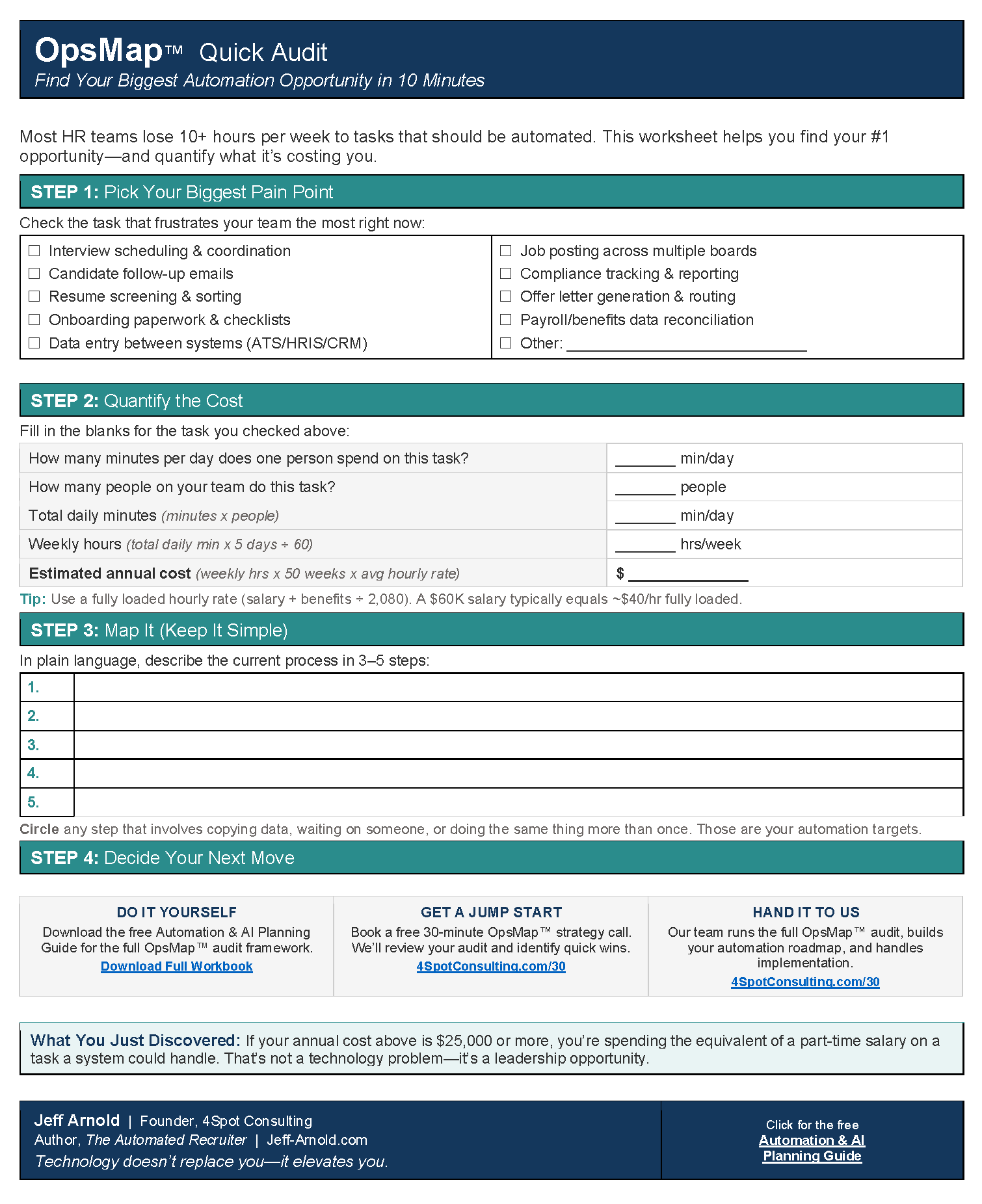
Automation means a repeatable, rule-based workflow that runs the same way every time without human intervention. Lead routing, onboarding task creation, document generation, status update emails, data sync between systems – these are all candidates. If a human is executing the same sequence of steps more than a handful of times per week, that workflow is automatable.
Why This Order?
The sequencing is not arbitrary – it reflects how AI actually works.
Q: Why can’t I just start with AI and skip the automation foundation?
AI learns from and acts on the data it receives. When that data is inconsistent – because different people handle the same task differently every time – AI outputs are unpredictable. Automation standardizes the inputs so AI has something reliable to reason over. Starting AI on top of messy manual processes produces messy AI results, faster.
Q: What happens when businesses skip the automation step?
The AI tool becomes a sophisticated wrapper around a broken process. Speed increases, but errors increase proportionally. A recruiting team that manually enters candidate data inconsistently will get AI recommendations built on inconsistent data – faster wrong answers, not better ones. Clean processes have to come before automation, and automation has to come before AI.
Q: Isn’t modern AI smart enough to handle messy data?
Modern AI handles ambiguity better than older systems did – but it cannot manufacture data that was never captured. If your hiring process does not consistently record candidate source, interview scores, or rejection reasons, no AI tool fills those gaps. It works with what it has, and what it has is incomplete.
Expert Take
The businesses that get the most out of AI are not the ones who adopted it earliest – they are the ones who spent months before AI adoption tightening their workflows and standardizing their data. When AI arrived, they had something worth amplifying. The others are still cleaning up the mess that AI made faster and at greater volume.
In Practice
Applying this framework looks different by business size and function, but the steps follow the same pattern.
Q: How do I know when my automation foundation is ready for AI?
Three signals tell you the foundation is ready: your automated workflows run without human intervention at least 95% of the time, your core data fields are consistently populated across records, and your team is no longer firefighting the same process breakdowns every week. When operations are boring and predictable, that is the green light for AI.
Q: What does 4Spot’s approach look like in practice?
We map the process landscape first using the OpsMesh™ framework – understanding what exists, what is manual, and where data inconsistencies live. Then we sequence automation builds starting with the highest-volume, lowest-exception workflows. AI tools get introduced once those workflows are stable and producing clean data. The result is an AI layer that performs because the foundation under it actually works. You can see this sequencing in action in our real examples of Automation First, Then AI.
Q: How long does the automation foundation phase take?
For most mid-market HR and recruiting operations, the automation foundation phase runs 60 to 90 days. That covers process mapping, workflow builds in Make.com, CRM data cleanup, and integration testing. Larger operations with more process complexity run closer to 120 days. That investment pays back through every AI tool you add afterward – because each one runs on a foundation that works.
Getting Started
The first move is identifying where your process inconsistency lives before you spend anything on AI tools.
Q: What are the signs I need to follow this framework?
You need this framework if your team answers the same questions repeatedly, if data in your CRM is inconsistent across records, if onboarding or offboarding runs differently depending on who handles it, or if you have already bought AI tools that are not delivering results. Ten signs you need Automation First, Then AI walks through the full diagnostic list.
Q: How do I start without a dedicated operations team?
Start with one process – your highest-volume, most repeatable, most painful manual workflow. Map every step. Automate it completely using a tool like Make.com. Run it for 30 days and measure the output quality. That single workflow becomes the proof of concept and the template for every build that follows. You do not need a large team to start – you need one well-scoped process.
Q: Where can I go deeper on the data behind this approach?
The research supporting this sequencing is covered in the 12 stats that explain Automation First, Then AI. For the broader context on why process cleanup is a prerequisite for both automation and AI, 10 real examples of why clean processes must come before HR automation covers the most common failure patterns we see with clients.
Part of our complete guide: Automation First, Then AI: Why Order Is the Whole Game.