Post: Build Your AI Recruiting Strategy: Agentic AI & Verification
Applicable: YES
3 Actions to Make Agentic AI Deliver Real Automation Value
Context: A recent playbook highlighted in this edition outlines ways to boost the impact of “agentic” AI across business functions. For small and mid-sized firms, that promise looks attractive, but without operational rigor it often becomes a sunk-cost experiment. This note translates that playbook into a pragmatic HR and recruiting automation plan that 4Spot clients can use immediately.
What’s Actually Happening
Providers and partners are packaging agentic AI—systems that can plan, execute, and iterate tasks—with claims they’ll automate complex workflows end-to-end. The playbook shows how to move beyond pilots to production by clarifying the problem, designing an AI plan, and integrating AI into the tools teams already use. For recruiting and HR, that means smarter candidate sourcing, automated interview scheduling, role-specific onboarding workflows, and dynamic skills-matching that touch hiring speed and quality.
Why Most Firms Miss the ROI (and How to Avoid It)
- They start with the tech, not the problem. Vendors demo capabilities; firms buy features. Instead, define the exact hiring workflow you want to improve (time-to-offer, quality of hire, interview throughput) and measure baseline performance first.
- They don’t map data and handoffs. Agentic AI needs reliable inputs (profiles, ATS data, calendar APIs). Without a clean data map, outputs are noisy and adoption stalls. Build the data flow before you automate decision logic.
- They neglect change management and failover plans. Automation changes roles. HR teams need clear guardrails and simple escalation paths when the agent can’t decide. Start with human-in-the-loop designs and clear SLAs.
Implications for HR & Recruiting
- Speed: You can compress sourcing and screening cycles by automating repetitive triage tasks (resume parsing, skills inference, screening questionnaires).
- Consistency: Agentic AI can apply role-specific criteria consistently, reducing bias introduced by shifting human reviewers—but only with audited criteria and monitoring.
- Reskilling: HR teams will shift toward orchestration and exception handling; invest in upskilling to design prompts, validate outputs, and manage vendor integrations.
Implementation Playbook (OpsMesh™)
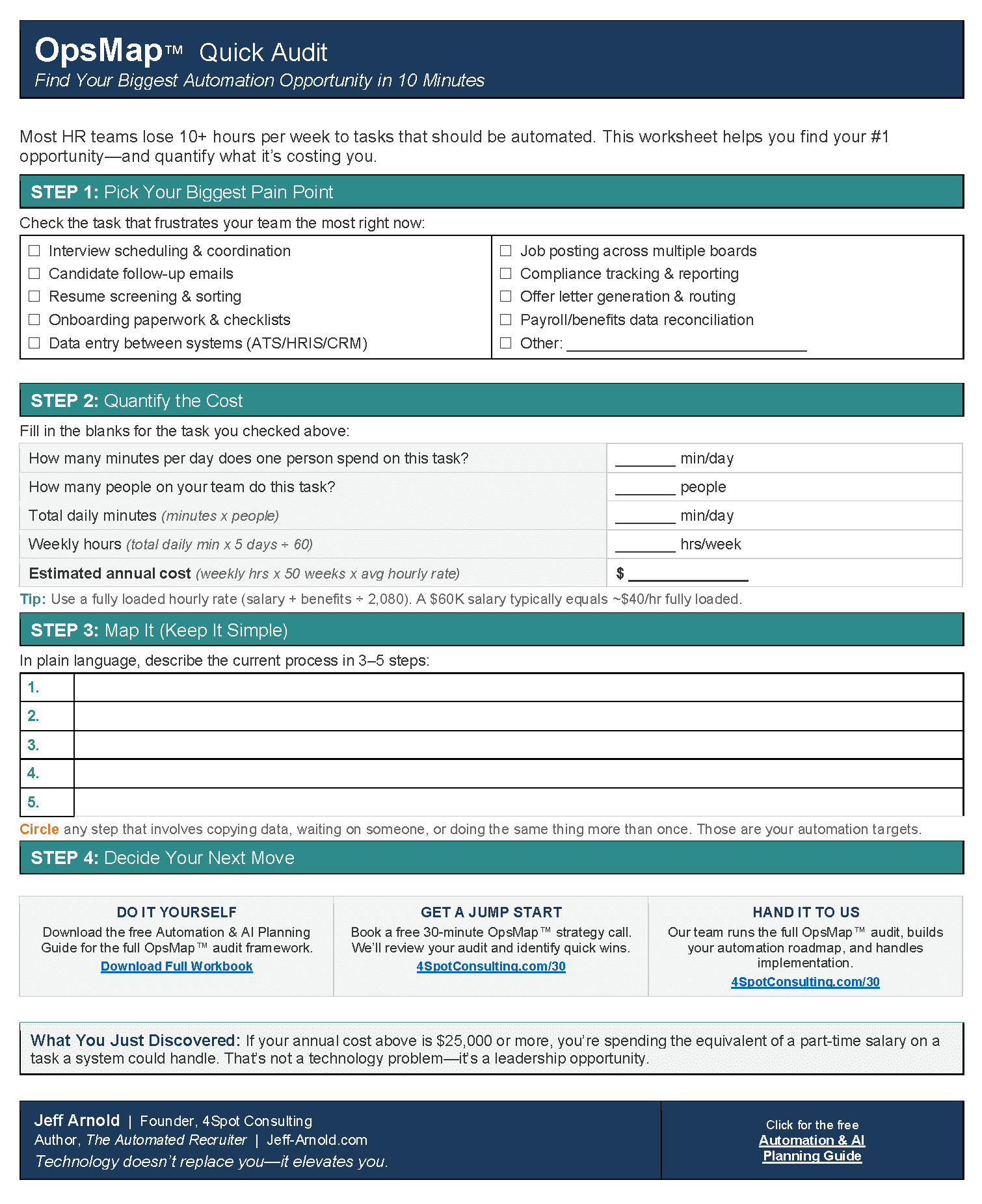
Below is a pragmatic three-phase OpsMesh™ approach that maps to OpsMap™, OpsBuild™, and OpsCare™.
OpsMap™ (30–60 days)
- Identify 1–2 hiring workflows with clear metrics (e.g., reduce time-to-offer by 30%, or increase interview-to-offer ratio by 20%).
- Create a data inventory: ATS fields, calendar systems, assessment outputs, and candidate touchpoints. Note API availability and data owners.
- Define decision boundaries where AI is allowed to act autonomously versus human-in-the-loop checkpoints.
OpsBuild™ (60–120 days)
- Prototype lightweight agents for one workflow (for example: screening + interview scheduling). Use sandbox data and instrument every decision.
- Integrate with existing tools (ATS, calendar, HRIS). Keep the first integration read-only where possible, then move to action modes after QA.
- Build a simple dashboard for exceptions, confidence scores, and audit trails so recruiters can review and trust outputs.
OpsCare™ (Ongoing)
- Monitor performance weekly for drift and false positives; keep a rolling 30–90 day feedback loop to retrain or re-prompt agents.
- Assign ownership: designate an HR automation owner and a platform owner to handle incidents, model updates, and vendor coordination.
- Document escalation, consent, and privacy handling—especially for candidate data subject requests and compliance checks.
ROI Snapshot
Conservative baseline: assume one recruiter spends 3 hours/week on repetitive sourcing and scheduling tasks that the agent can automate. Use a mid-career FTE cost of $50,000/year for calculations.
- 3 hours/week saved x 52 weeks = 156 hours/year saved per recruiter.
- 156 hours / 2,000 annual work hours ≈ 0.078 FTE equivalent saved.
- 0.078 x $50,000 ≈ $3,900 annual labor value recovered per recruiter.
Apply the 1-10-100 Rule: validate small changes early. $1 invested in clear acceptance criteria and tests avoids roughly $10 in rework during review and $100 in production failures. That argues for a low-cost, instrumented pilot (OpsMap™ + OpsBuild™) before broad rollout.
Original Reporting: The playbook referenced above is available via the original link in the email: https://u33312638.ct.sendgrid.net/ss/c/u001.4wfIbFtYNOGdhGJ4YbAhu3zPdt8wIaoK0iuNH-BtvQSXZf4fM3Wm5EAi1dq4lntiMJzR0FLd0l20cqofw5kNm_aR1KY-2eq-BX7UH-H2TFJblVZAOBX-PyMeeUVkwTdjT4DC3bwxxjqv_5NFpSV33slP0-m7cKDQ24jZ_fGaUEuo4rMirGZqUNjPgYiPjq_1fxohz3gnGwQst4z57An3YiU7XYzEWxb_TthmR8qi5EoMl_Sw9xz8V4A-wsSKj4mTMofy-lJ-ckMklt_aeaNmcWPI937n3GKnw6Z-4JQWjT1oVobR5lsGqPxADKPMqyNxAuJJEwjXBE9wDWVuoaOZriTDuhjbLQGC5oIGoJUeF5vNAI_pjAs69XQLF5tdPL8X/4kd/vEk8d8l_RBmCHtvXF3mfVQ/h7/h001.TJ5BELtEbBn-3OaiLs4T5tlQMPVvgdUYoJF_frA0_m8
Work with 4Spot to map and deploy a measured agentic AI pilot (OpsMap™ → OpsBuild™ → OpsCare™).
Sources:
Applicable: YES
Recruiting Risk & Opportunity: OpenAI’s Sora and Short-Form AI Video
Context: OpenAI’s Sora (text-to-video model) and a paired social video app are being promoted as tools to generate ultra-realistic short clips and “AI doubles” from user-submitted video. This capability has direct implications for employer branding, candidate-supplied content, and identity/risk management in hiring workflows.
What’s Actually Happening
Sora 2 promises more physically plausible video generation and a Cameo feature that creates an AI likeness from a person’s uploaded clip. The social app blends AI visuals and real footage in an algorithmic feed. From a recruiting perspective, this affects two areas immediately: employer-generated content (ads, job spotlights, recruitment videos) and candidate-provided content (video resumes, audition clips, or personal-branding reels).
Why Most Firms Miss the ROI (and How to Avoid It)
- They treat it as a creative experiment only. Firms chase novelty videos without linking them to measurable talent outcomes. Tie every content use to a candidate funnel metric (apply rate, quality of inbound applicants, retention at 90 days).
- They ignore identity and consent controls. Allowing AI likenesses without explicit consent or verification invites legal and reputational risk. Build consent flows and verification checkpoints into recruitment touchpoints.
- They forget verification and provenance. Candidate video evidence needs provenance checks. Without verification, you increase the risk of fraudulent identity claims or manipulated content entering the hiring process.
Implications for HR & Recruiting
- Employer Branding: Teams can scale video content cheaply, increasing reach—but content quality and authenticity must be measured by candidate engagement and conversion, not views alone.
- Candidate Screening: Video submissions may be richer but require additional verification steps; reliance on video alone increases bias risk unless structured evaluation rubrics are used.
- Policy & Compliance: Expect to update candidate consent forms, interview protocols, and data retention policies. Add verification steps for identity claims made via AI-generated media.
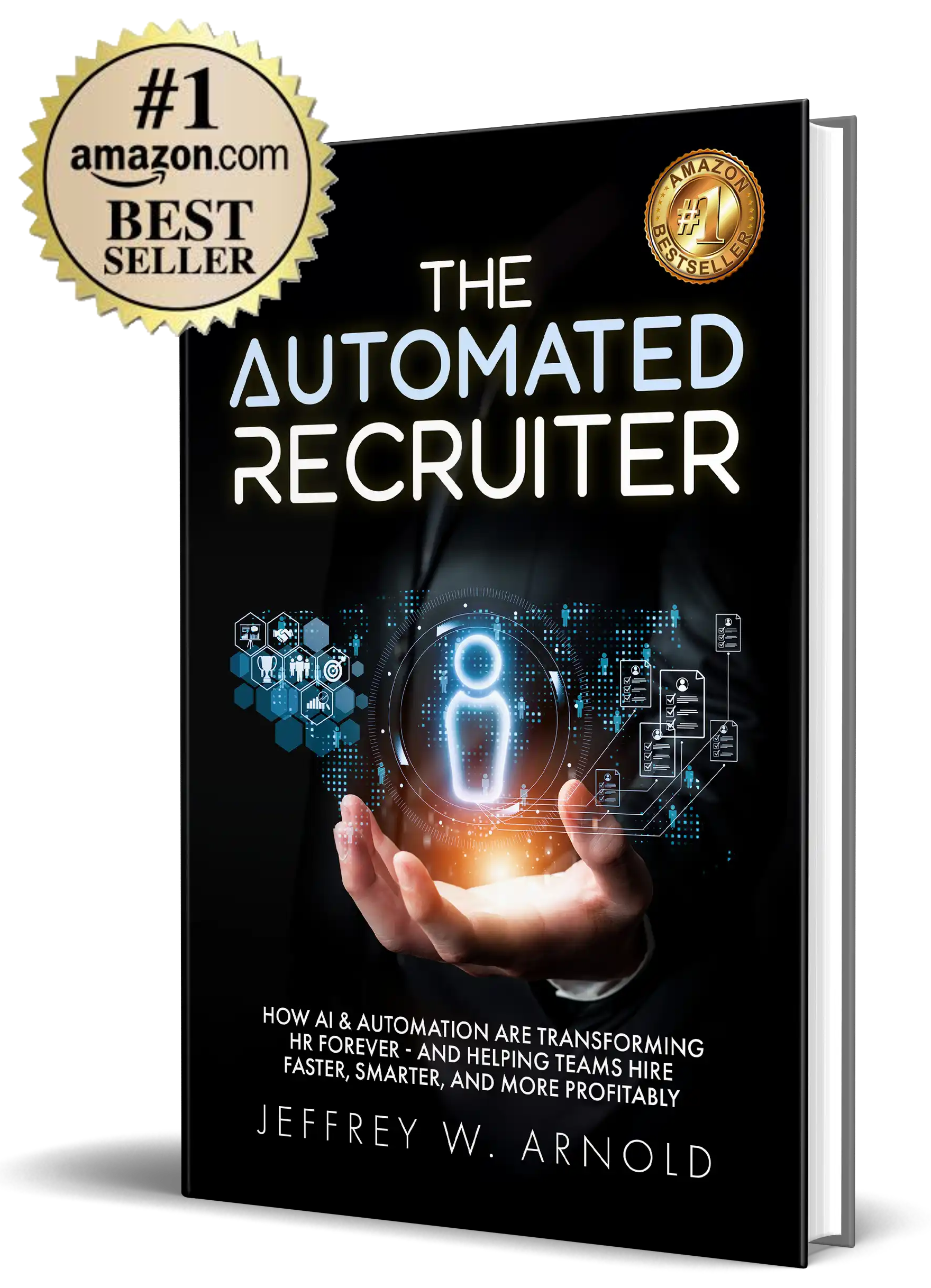
As discussed in my most recent book The Automated Recruiter, employers should treat candidate-provided media as structured evidence, not free-form influence material. That approach preserves fairness and defensibility.
Implementation Playbook (OpsMesh™)
OpsMap™ (30 days)
- Inventory all points where video enters the recruiting funnel (ads, job posts, candidate submissions, social referrals).
- Define acceptance criteria: when is a video optional vs required? What metadata must accompany it (timestamp, original file hash, consent checkbox)?
OpsBuild™ (60–90 days)
- Create a low-friction consent and provenance capture: a short form where candidates attest to being the person in the video and confirm permission to process their likeness.
- Integrate lightweight verification (photo ID match, live selfie check) for any video that will influence hiring decisions.
- Automate tagging and routing: agentic AI can tag videos for role fit and surface high-confidence matches to recruiters while sending low-confidence items for human review.
OpsCare™ (Ongoing)
- Monitor for misuse and deepfake signals; score content with a risk flag and route flagged items into a manual review queue.
- Train recruiters on interpreting AI-generated content and on maintaining equitable assessments across video and text submissions.
- Keep a documented audit trail for any decision made or altered due to video evidence.
ROI Snapshot
Example conservative calculation for a single recruiter automating candidate triage from video submissions:
- 3 hours/week recovered from manual triage and scheduling × 52 weeks = 156 hours/year saved.
- 156 / 2,000 ≈ 0.078 FTE equivalent; at $50,000/year FTE, that’s ≈ $3,900 saved per year per recruiter.
Apply the 1-10-100 Rule here: a $1 investment in clear consent and verification (e.g., a simple ID selfie step) may prevent roughly $10 of manual review rework and avoid up to $100 of reputational or legal cost if a deepfake passes unchecked into hiring decisions. That strongly favors instrumented pilots with verification layers before scaling creative use of Sora-generated material.
Original Reporting: The Sora model and the paired social video app were described in the newsletter’s referenced piece: https://u33312638.ct.sendgrid.net/ss/c/u001.dwlXI0Ml-aslcJUOJAUFAC74NdHkjgUJmgA2D68f3IxWxr7HT0zeQnWRUV9lWdPdX1JaYGyTeZHC4hpXQVpR86Y43unZoy4aD9cTm1Jef9NQOENoAxaBcXtMo5uRWodnxOT_NrdrqEKT8WdaM_jGfEf1DefAtIlXFPIiclIgM-ejhkv0Xf5dFu4XUYxHs-E7EqadhVyPZ1DIMJTMqaUcvttIA9gkHLy7dVCbU411LV-BvoqGo5uHbU1QY46I6jPHR5p3a4d8E-XQvJqH6F-big/4kd/vEk8d8l_RBmCHtvXF3mfVQ/h11/h001.OSgl64hG3JUjyMZpbCBdjq2jEnYTUIovLYM_uGHspa0
Sources:


RELATED POST