
Post: Reactive vs. Predictive Talent Acquisition (2026): Which Pipeline Strategy Wins?
Reactive vs. Predictive Talent Acquisition (2026): Which Pipeline Strategy Wins?
Reactive hiring and predictive pipeline management are not two points on the same spectrum — they are structurally different operating models with measurably different outcomes. The question is not whether predictive is better in theory. The question is what it actually takes to get there, and whether the operational gap is as wide as most recruiting leaders fear. This satellite drills into that comparison directly, using dynamic tagging as the mechanism that makes predictive talent acquisition achievable without a six-figure technology overhaul. For the full strategic framework behind tag architecture and AI integration, see the parent pillar: Dynamic Tagging: 9 AI-Powered Ways to Master Automated CRM Organization for Recruiters.
At a Glance: Reactive vs. Predictive Talent Acquisition
Before unpacking each decision factor, the head-to-head comparison table below shows where the two models diverge across the dimensions recruiting leaders actually report on.
| Dimension | Reactive Hiring | Predictive (Dynamic Tagging) |
|---|---|---|
| Pipeline trigger | Vacancy opens | Continuous — role-agnostic |
| Candidate data freshness | Manual, episodic updates | Automated, real-time tag writes |
| Time-to-fill | Full sourcing cycle every time | Shortlist from existing pipeline |
| Sourcing spend | High — new sourcing per req | Lower — warm candidates reactivated |
| Recruiter time on admin | High — manual profile review | Reduced — automation handles tagging |
| Niche role coverage | Weak — cold market every time | Strong — pre-tagged passive candidates |
| Pipeline forecasting | None — backward-looking only | Segment counts as leading indicators |
| AI/ML readiness | Blocked — inconsistent data | Enabled — clean tag structure feeds models |
| Compliance auditability | Manual, error-prone | Automated tag logs — auditable trail |
| Setup investment | Near zero — no system change | Moderate — tag taxonomy + automation rules |
Verdict: Predictive wins on every operational metric except upfront setup effort. The setup cost is a one-time structural investment; the reactive cost compounds with every new requisition.
Pipeline Trigger: When Does Hiring Actually Start?
Reactive hiring starts when someone sends a Slack message that a role needs to be filled. Predictive hiring starts the day a candidate first touches your ecosystem — and never fully stops.
The structural difference matters more than it sounds. In a reactive model, every open requisition is treated as a new sourcing event, regardless of how many times that role profile has been hired before. Recruiters rebuild searches, re-qualify candidates who have applied previously, and re-engage passive talent who went cold because no one maintained the relationship. APQC benchmarking data consistently shows that organizations with mature talent pipeline practices fill critical roles faster and at lower cost than peers operating req-by-req.
Dynamic tagging converts every candidate interaction — a content download, an email reply, a skills update, a previous interview — into a persistent, searchable signal stored on the candidate record. When the requisition opens, the pipeline is already populated. The sourcing event becomes a filter operation, not a cold-start search.
Choose reactive if: You hire fewer than five roles per year and roles never repeat. At that volume, a standing pipeline provides limited marginal return.
Choose predictive if: You fill recurring role families, operate at any meaningful volume, or compete for candidates in thin talent markets.
Candidate Data Freshness: Manual Updates vs. Automated Tag Writes
Stale data is the primary failure mode of every reactive pipeline — not bad intent and not insufficient candidate supply.
Parseur’s Manual Data Entry Report documents that manual data processes carry error rates that compound over time, with each manual step introducing delay and inconsistency. In recruiting CRMs, this plays out as candidate records that reflect a 2021 job title, a skills set that predates two years of career development, and an engagement score of zero because no one logged the three emails the candidate replied to in 2023.
Dynamic tagging replaces the manual update cycle with rule-governed automation. When a candidate completes a skills assessment, the platform reads the result and writes a tag to the CRM record. When a candidate opens three consecutive nurture emails, an engagement score tag increments automatically. When a candidate’s previous application reached the final-round stage, a tag marks them as a warm, pre-vetted contact for that role family — persisting across requisition cycles without any recruiter action.
Forrester research on automation ROI in knowledge-worker environments consistently finds that eliminating manual data maintenance from high-frequency processes produces disproportionate productivity gains — because the time saved is reclaimed for candidate-facing work that actually moves requisitions forward.
For a deeper look at automating the tagging layer itself, see Automate Tagging in Talent CRM.
Choose reactive if: Your team has the discipline and bandwidth to manually update every candidate record after every interaction. In practice, no team does.
Choose predictive if: You want your CRM data to reflect reality — automatically, continuously, without relying on recruiter memory.
Time-to-Fill: Full Sourcing Cycle vs. Shortlist from Existing Pipeline
Time-to-fill is the metric hiring managers complain about most and CFOs use to assess recruiting efficiency. It is also the metric where the reactive-vs-predictive gap is most directly measurable.
SHRM benchmarking places average time-to-fill across industries in the range of several weeks for professional roles, with specialized and senior positions extending significantly longer. Every day that position sits open carries a real productivity cost — Forbes and HR Lineup composite analysis estimates unfilled position drag at approximately $4,129 per month in lost output and coverage overhead, and that figure scales with role seniority.
Reactive hiring adds to this timeline at the front end: sourcing setup, job board posting, resume review, and initial outreach all happen after the vacancy is confirmed. Predictive pipeline management compresses the front end by eliminating it. When a role opens against a tag segment that already exists in your CRM — say, “Senior DevOps Engineer | 3+ Years Kubernetes | Engaged Last 90 Days” — the shortlist is a filter, not a search. The first outreach goes to candidates who are already warm.
For a detailed breakdown of how intelligent tagging drives time-to-hire reductions, see Reduce Time-to-Hire with Intelligent CRM Tagging.
Choose reactive if: Every role you fill is unique, your candidate population never overlaps, and speed is not a business priority.
Choose predictive if: Any delay in filling open roles has a measurable business cost — which is true for virtually every organization above a handful of employees.
Sourcing Spend: New Budget Every Req vs. Reactivating Warm Candidates
Reactive hiring treats the existing CRM as a compliance archive and the sourcing budget as the primary pipeline tool. Every new requisition triggers new job board spend, new advertising, and often new agency fees — even when the role profile is identical to one filled six months ago.
Predictive pipeline management inverts this. Sourcing spend is front-loaded into relationship-building and content engagement that applies across all future requisitions for that talent segment. When the req opens, the warm outreach to pre-tagged candidates costs a recruiter’s time, not a job board budget line.
McKinsey Global Institute analysis of talent strategy maturity consistently identifies reactivation of existing talent relationships as among the highest-ROI sourcing activities available — particularly for organizations with established candidate databases that remain untapped because no one built the tagging and segmentation logic to surface them.
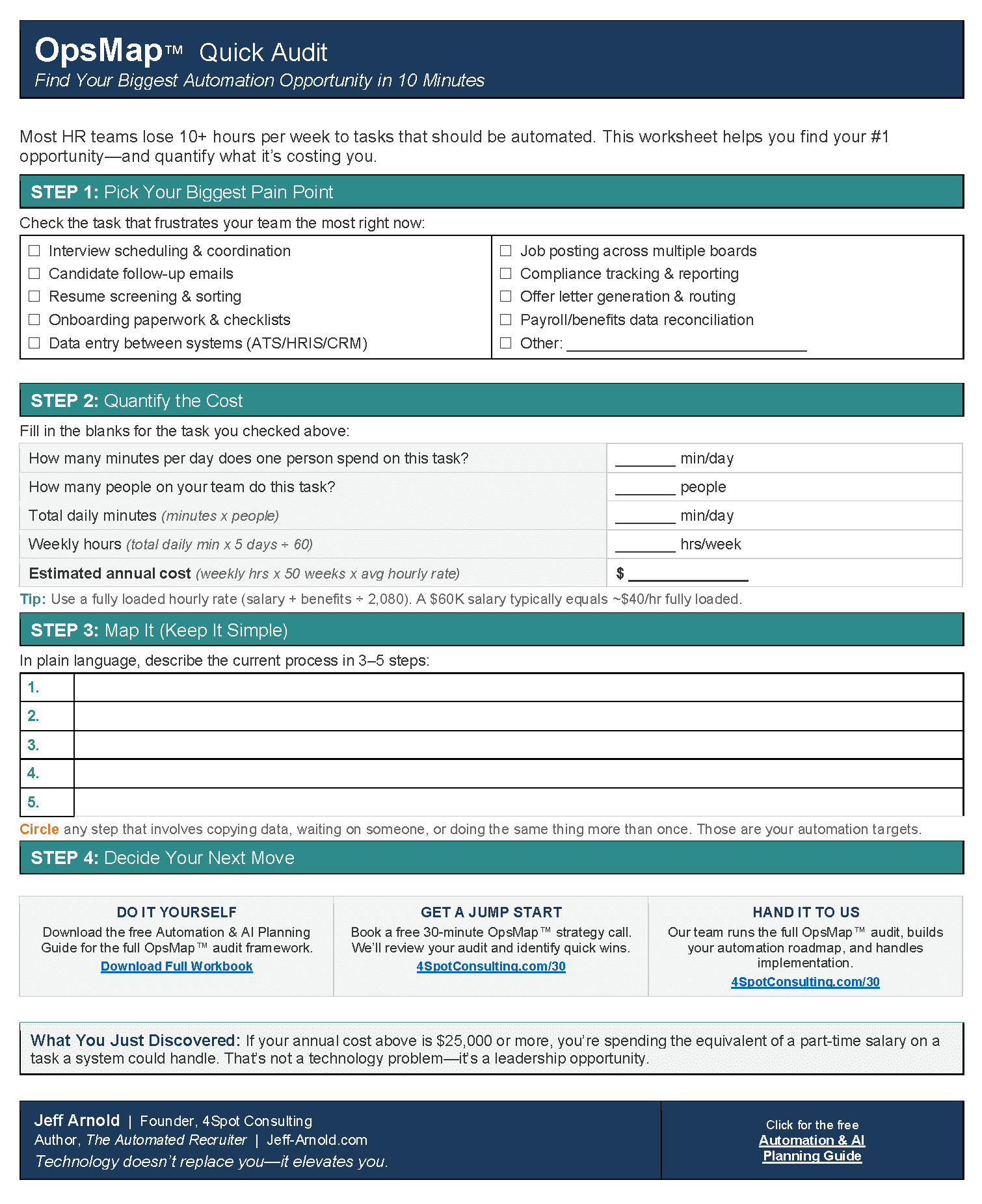
TalentEdge, a 45-person recruiting firm, identified nine automation opportunities through our OpsMap™ process, including pipeline reactivation workflows built on dynamic tagging. The result was $312,000 in annual savings and a 207% ROI in 12 months — driven primarily by sourcing cost reduction and recruiter time reclaimed from manual CRM maintenance.
Choose reactive if: You have unlimited sourcing budget and no interest in measuring cost-per-hire efficiency.
Choose predictive if: Sourcing spend is scrutinized, your CRM holds thousands of previously engaged candidates, or your CFO wants to see recruiting ROI numbers.
Recruiter Productivity: Manual Review vs. Automation-Handled Tagging
Asana’s Anatomy of Work research documents that knowledge workers — including recruiters — lose a significant portion of their available work hours to repetitive coordination tasks that do not require their expertise. In recruiting, that overhead looks like manually reviewing profiles to recall past interactions, re-reading application notes to reconstruct a candidate’s skill level, and cross-referencing spreadsheets to determine who has been contacted recently.
Dynamic tagging eliminates most of this overhead at the source. When every interaction writes a tag automatically, the recruiter opens a candidate record and immediately sees: last engagement date, current pipeline stage, skills confirmed, roles considered, and fit signals — without reading four years of recruiter notes to reconstruct the picture.
Nick, a recruiter at a small staffing firm processing 30-50 PDF resumes per week, illustrates the compounding effect of manual overhead: 15 hours per week on file processing alone, before any substantive recruiting work begins. For a team of three, the automation of profile tagging and data enrichment reclaimed 150+ hours per month — redirected entirely to candidate-facing activity.
For a structured approach to reducing CRM overload through intelligent tagging, see Intelligent Tagging Solves Recruiting CRM Overload.
Choose reactive if: Your team has unlimited capacity for manual data maintenance and enjoys cross-referencing spreadsheets.
Choose predictive if: Recruiter time is your most constrained resource — which it is, for every team we have ever worked with.
Niche Role Coverage: Cold Market vs. Pre-Tagged Passive Candidates
Niche and specialized roles expose the reactive model’s structural weakness most visibly. When a rare skill combination is required, the reactive approach starts from zero: cold outreach to passive candidates who have no relationship with the organization, no existing trust, and no reason to respond quickly.
The predictive model solves niche hiring before the requisition exists. Passive candidates with rare skill combinations are tagged and nurtured continuously — not because a role is open, but because the organization knows it will eventually need those profiles. When the role opens, the team reaches out to candidates who have already engaged with the organization’s content, attended a webinar, or applied for a related position in the past. Response rates are categorically different.
Harvard Business Review analysis of passive candidate engagement strategies consistently identifies relationship tenure as the primary driver of passive candidate response rates — a variable that reactive hiring cannot manufacture quickly and predictive hiring builds structurally over time.
For organizations competing for niche talent specifically, see Hire Niche Talent Faster with Dynamic Tagging & AI Matching.
Choose reactive if: Every role you fill is generalist and your talent market has abundant supply.
Choose predictive if: Any of your recurring roles require specialized skills, clearances, certifications, or experience combinations that narrow the candidate pool significantly.
Pipeline Forecasting: No Visibility vs. Segment Counts as Leading Indicators
Reactive pipelines are backward-looking by design. They tell you who was considered for roles that already closed. They offer no visibility into how many qualified candidates currently exist for roles that have not yet opened.
Dynamic tagging converts the CRM into a forward-looking instrument. Each tag segment has a count: how many candidates are tagged “Senior Data Engineer | Available Q2 | Warm Engaged.” When workforce planning projects a hiring need six months out, recruiting leadership can assess whether the pipeline segment is sufficient to meet it — or whether nurturing activity needs to accelerate now to build the segment before the req opens.
Gartner research on talent acquisition maturity identifies pipeline visibility as a top differentiator between high-performing and average recruiting functions. The organizations at the top of that maturity curve are not necessarily using more sophisticated AI — they are using better-structured data that surfaces leading indicators instead of lagging ones.
For the metrics that make this forecasting measurable, see 5 Key Metrics to Measure CRM Tagging Effectiveness.
Choose reactive if: Your organization has no workforce planning function and no interest in connecting recruiting to business capacity planning.
Choose predictive if: You are accountable to a CHRO or CFO who wants forward-looking hiring capacity data — not post-hoc fill-time reports.
AI and ML Readiness: Blocked vs. Enabled
This is the dimension most recruiting technology vendors avoid discussing directly, because it exposes a hard truth: AI matching and predictive scoring tools do not fix bad data. They inherit it.
A reactive CRM with inconsistent manual tags, half-populated skills fields, and no engagement history produces unreliable AI match scores — because the model has nothing reliable to score against. Organizations that deploy AI on top of reactive data infrastructure routinely report that the AI shortlists do not reflect actual candidate quality, and recruiter trust in the tool collapses within months of deployment.
Dynamic tagging resolves this at the foundation. When tags are applied by consistent, rule-governed automation — not by twelve recruiters with twelve different conventions — the underlying data structure is clean enough for AI to operate on reliably. Predictive scoring, engagement prediction, and attrition risk modeling all require that clean input. Tag governance is the prerequisite, not a nice-to-have.
The International Journal of Information Management documents that data quality at the point of collection is the strongest predictor of downstream AI output reliability — a finding that applies directly to recruiting CRM environments where tag consistency determines model input quality.
For a structured look at how predictive tagging specifically enables smarter candidate management, see Predictive Tagging: Smarter Candidate Management in Your Recruiting CRM.
Choose reactive if: You have no plans to use AI matching or predictive analytics in recruiting — ever.
Choose predictive if: AI is on your recruiting technology roadmap at any point in the next three years. The tag structure you build now is the data foundation that makes that investment viable.
Final Decision Matrix
Choose reactive hiring if:
- You fill fewer than five roles per year and role profiles never repeat
- Every hire is genuinely unique — no recurring role families
- Sourcing budget is unlimited and speed is not a business priority
- Your organization has no workforce planning function and no AI roadmap
Choose predictive talent acquisition (dynamic tagging) if:
- You fill recurring role families at any volume — even low volume
- Any of your roles are specialized, niche, or in competitive talent markets
- Time-to-fill delays have measurable business cost — they almost always do
- Your recruiting team’s time is constrained and manual CRM maintenance is consuming it
- AI matching or predictive analytics are on your technology roadmap
- Your CHRO or CFO wants forward-looking pipeline data, not backward-looking fill reports
The setup investment for dynamic tagging is real but bounded: a consistent tag taxonomy, automation rules that write tags based on candidate actions and CRM field triggers, and a governance process that prevents tag proliferation over time. That investment is made once. The efficiency gains compound across every requisition that follows.
For the ROI measurement framework that quantifies those gains in terms a CFO will act on, see Prove Recruitment ROI: Dynamic Tagging Drives Efficiency. For the complete strategic architecture — including nine specific AI-powered applications of dynamic tagging — return to the full dynamic tagging framework.




RELATED POST