Post: AI Bias in Hiring: Strategies for Ethical Talent Acquisition
Will AI Level the Playing Field or Create New Biases in Hiring?
The promise of Artificial Intelligence in talent acquisition has been a beacon for many organizations striving for efficiency, objectivity, and broader talent pools. At 4Spot Consulting, we regularly engage with HR leaders and business owners wrestling with how to leverage AI without compromising their core values. The core question isn’t whether AI will transform hiring, but how responsibly and ethically that transformation will unfold. Will it truly democratize opportunity, or will it inadvertently embed and amplify existing biases, creating new hurdles for diverse candidates?
The Double-Edged Sword of AI in Talent Acquisition
The allure of AI in hiring is undeniable. Imagine a world where every resume is screened impartially, where unconscious human biases regarding names, backgrounds, or universities are eliminated, and where candidates are evaluated solely on their skills and potential. This vision of a leveled playing field is a powerful driver for adopting AI tools, promising not just faster processes but fairer outcomes.
Unpacking the “Level Playing Field”: Where AI Could Shine
AI’s potential to enhance fairness stems from its capacity for data processing and pattern recognition at scale. For instance, AI can analyze vast datasets of past successful employees to identify skills, experiences, and aptitudes that correlate with high performance, moving beyond superficial indicators. This can lead to:
- **Wider Candidate Reach:** AI can help source candidates from non-traditional backgrounds or underrepresented groups that might be overlooked by human recruiters using conventional methods.
- **Reduced Screening Time:** Automated initial screening can free up recruiters to focus on deeper engagement with qualified candidates, potentially reducing the impact of rushed decisions.
- **Skills-Based Matching:** Advanced AI can move beyond keyword matching to understand the nuances of a candidate’s skills and how they apply to specific job requirements, rather than relying solely on job titles or prestige.
In theory, by focusing on measurable criteria and minimizing human intervention in early stages, AI could become a powerful tool for diversity and inclusion, uncovering hidden gems and challenging established hiring norms. Our experience at 4Spot Consulting shows that when AI is implemented strategically and consciously, it *can* contribute to more equitable processes, provided the underlying data and algorithms are robust and unbiased.
The Shadow of Bias: Where AI Can Go Wrong
Despite its potential, AI is not inherently neutral. It learns from the data it’s fed, and if that data reflects historical human biases, the AI will internalize and perpetuate them. This is the critical challenge we often discuss with our clients: garbage in, garbage out. The ambition to level the playing field can quickly backfire if not managed with extreme care.
Data Dependency and Algorithmic Blind Spots: The Root Causes of AI Bias
The primary source of AI bias in hiring is the training data. If an AI system is trained on historical hiring data where certain demographics were underrepresented or unfairly evaluated, the AI will learn to associate those biases with “optimal” candidates. For example, if a company historically hired more men than women for leadership roles, an AI system trained on this data might inadvertently downrank female candidates for similar positions, even if they are equally or more qualified.
Other pitfalls include:
- **Proxy Attributes:** AI might identify seemingly neutral data points (like postal codes or specific hobbies) as predictive, when these are actually proxies for protected characteristics like race or socio-economic status.
- **Lack of Transparency:** Many AI algorithms are “black boxes,” making it difficult to understand *why* a particular candidate was recommended or rejected. This lack of transparency hinders auditability and accountability.
- **Overfitting to Past Success:** By solely optimizing for past success, AI can prevent innovation and diversity of thought. If all past successful employees share similar profiles, the AI will perpetuate that homogeneity, hindering an organization’s ability to adapt and grow.
The risk isn’t just maintaining existing biases; it’s scaling them at an unprecedented rate, making them harder to detect and rectify. Without careful oversight, AI could create an impenetrable wall for deserving candidates who don’t fit the algorithm’s biased mold.
Navigating the Ethical AI Landscape: Solutions and Best Practices
The path to ethical AI in hiring requires a proactive and multidisciplinary approach. It’s not enough to simply deploy a tool; it requires continuous monitoring, auditing, and a deep understanding of both the technology and its human implications.
Key strategies for mitigating bias include:
- **Diverse Data Sets:** Actively seek out and train AI on diverse, bias-free data sets. This may involve synthetically balancing data or using external, verified benchmarks.
- **Bias Auditing and Monitoring:** Implement regular audits of AI systems to detect and measure bias. This requires both technical expertise and domain knowledge to interpret results accurately.
- **Human Oversight:** Maintain significant human involvement in critical decision-making points. AI should assist, not replace, human judgment, especially in the final stages of hiring.
- **Explainable AI (XAI):** Prioritize AI solutions that offer transparency and explainability, allowing HR professionals to understand the rationale behind recommendations.
- **Iterative Refinement:** Treat AI implementation as an ongoing process of learning and refinement. As new data emerges and biases are identified, the algorithms must be adapted.
4Spot Consulting’s Approach to Ethical AI Implementation
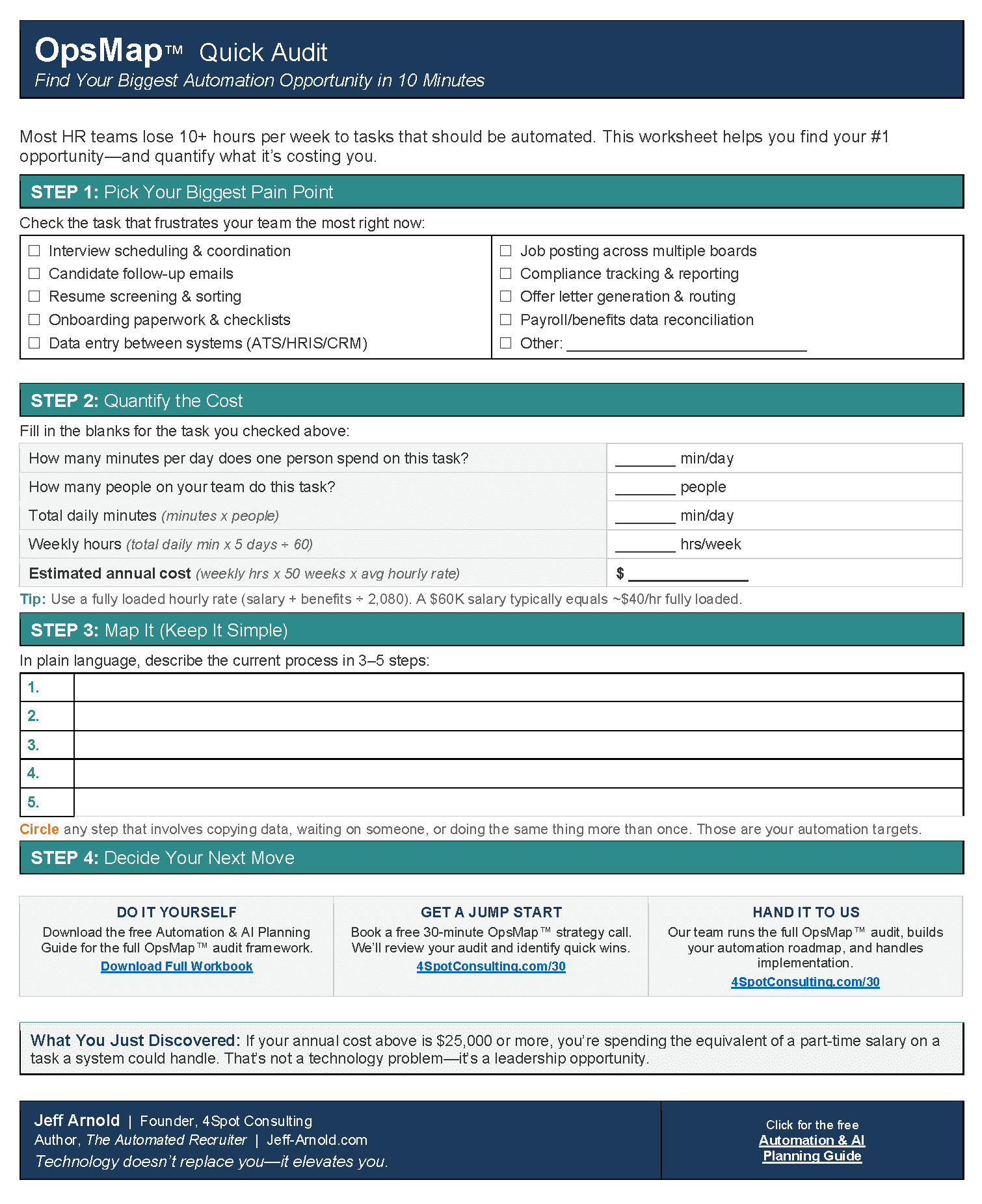
At 4Spot Consulting, our OpsMesh framework emphasizes a strategic, outcomes-driven approach to AI and automation. When it comes to hiring, this means starting with an OpsMap™—a strategic audit that uncovers not just operational inefficiencies but also potential sources of bias in current processes and data. We then design and implement AI solutions (OpsBuild) that are specifically architected for fairness and transparency, building in mechanisms for continuous monitoring (OpsCare).
Our goal is not just to save you 25% of your day through automation, but to ensure that the automations you implement uphold your company’s values and contribute to a more equitable future. We work with clients to ensure their AI solutions are not only efficient but also ethically sound, safeguarding against unintended consequences and building trust in their hiring processes.
Conclusion: Balancing Innovation with Integrity
AI holds immense potential to revolutionize hiring, making it faster, more efficient, and, yes, potentially fairer. However, this future is not guaranteed. Without diligent effort, awareness, and a commitment to ethical implementation, AI could easily entrench and amplify existing societal biases, creating an even less equitable landscape for job seekers. The responsibility lies with organizations to approach AI not as a magic bullet, but as a powerful tool that demands careful stewardship. By prioritizing transparency, continuous auditing, and human oversight, we can steer AI towards leveling the playing field, ensuring that innovation serves integrity rather than undermining it.
If you would like to read more, we recommend this article: The Ultimate Keap Data Protection Guide for HR & Recruiting Firms
RELATED POST