
Post: Audit Your AI Resume Parser for Accuracy and Fairness
Auditing Your AI Resume Parser for Accuracy and Fairness: A Strategic Imperative for Modern HR
The promise of AI in recruitment is undeniable: efficiency, speed, and the ability to sift through vast candidate pools with unprecedented scale. AI resume parsers, in particular, have become a cornerstone for many HR and recruiting operations, streamlining the initial candidate assessment. Yet, beneath the veneer of technological marvel lies a critical responsibility: ensuring these tools are not just fast, but also accurate and, crucially, fair. Without rigorous auditing, your sophisticated AI parser could be inadvertently sabotaging your talent acquisition efforts, leading to missed opportunities, poor hires, and even compliance risks. This isn’t merely a technical check-up; it’s a strategic imperative for any organization committed to equitable and effective hiring.
The Imperative for AI Resume Parser Auditing
In a competitive talent landscape, relying on AI without understanding its nuances is like navigating uncharted waters without a compass. AI resume parsers are trained on data, and that data inherently carries biases, historical patterns, and limitations. Unchecked, these biases can manifest as skewed candidate shortlists, inadvertently filtering out qualified individuals based on non-job-related attributes. Beyond fairness, there’s the equally vital aspect of accuracy – does the parser truly extract and interpret information correctly? Is it categorizing skills, experience, and education with precision, or is it misrepresenting candidates, leading to inefficient human review or even overlooked top talent? A comprehensive audit is not just about compliance; it’s about optimizing your investment in AI and upholding your commitment to meritocratic hiring.
Unpacking Accuracy: What to Look For
Accuracy in AI resume parsing extends far beyond simply pulling text from a document. It involves a deep understanding of data, context, and the subtle nuances of human language. A superficial parser might extract keywords, but a truly effective one interprets the underlying meaning and relevance to a job role.
Data Ingestion and Interpretation
The first layer of accuracy lies in how well the parser ingests various resume formats (PDF, DOCX, TXT) and consistently extracts structured data. Does it correctly identify names, contact information, job titles, companies, dates of employment, and educational institutions every single time, regardless of resume layout or design? Inconsistencies here create a faulty foundation for all subsequent analyses. Errors in parsing dates, for example, could misrepresent tenure, while misidentifying a company could obscure valuable industry experience.
Semantic Understanding and Context
Beyond mere extraction, an accurate parser demonstrates semantic understanding. Does it understand that “leading a team of 10 engineers” signifies management experience, or that “full-stack development” implies proficiency in multiple programming languages? Does it distinguish between relevant skills and incidental mentions? Context is king; a parser that blindly matches keywords without comprehending their application within a candidate’s overall profile will generate misleading results, potentially elevating less qualified candidates or dismissing highly relevant ones.
Performance Metrics and False Negatives/Positives
To quantify accuracy, organizations must establish clear performance metrics. This involves evaluating the parser’s precision (how many identified items are correct), recall (how many correct items were identified), and F1-score. More importantly, focus on the impact of false negatives (qualified candidates incorrectly rejected) and false positives (unqualified candidates incorrectly advanced). A high rate of false negatives means you’re missing out on top talent, while excessive false positives burden your recruiters with irrelevant profiles. A robust audit identifies these rates and their implications for your recruitment funnel.
Addressing Fairness: Identifying and Mitigating Bias
Bias is an inherent risk in any data-driven system, and AI resume parsers are no exception. Addressing fairness is not about achieving a perfectly neutral system—which may be impossible—but about understanding, measuring, and actively mitigating algorithmic bias to ensure equitable opportunities for all candidates.
The Sources of Bias
Bias in AI parsers typically originates from three main areas: the training data, the algorithm itself, and the reflection of historical societal biases. If the parser is trained predominantly on resumes from a specific demographic group that historically held certain roles, it might implicitly learn to favor similar profiles, even if job-irrelevant attributes are not explicitly coded. Gendered language, educational institution prestige, or even gaps in employment (which might affect women disproportionately) can become unintended signals for the AI, leading to biased outcomes.
Measuring and Detecting Bias
Detecting bias requires a multi-faceted approach. This includes statistical analysis to identify disparate impact across various demographic groups for key metrics (e.g., progression rates, scores). Testing with synthetic or anonymized datasets can help isolate biases related to specific attributes like gender, age, or ethnicity. Qualitative reviews by human experts, analyzing a sample of rejected and accepted resumes, can also uncover subtle biases that quantitative methods might miss. The goal is to identify patterns where certain groups are systematically disadvantaged or over-advantaged without legitimate, job-related reasons.
Strategies for Bias Mitigation
Mitigating bias is an ongoing process. Strategies include diversifying training data to ensure it represents the true diversity of the talent pool, employing fairness-aware algorithms designed to reduce discriminatory outcomes, and incorporating a “human-in-the-loop” approach where human oversight and judgment are integrated at critical decision points. Regular recalibration and re-training of models, alongside continuous monitoring, are essential. It’s also vital to ensure that your parser isn’t over-indexing on proxies for protected characteristics (e.g., zip codes as proxies for socioeconomic status).
The 4Spot Consulting Approach to Responsible AI Auditing
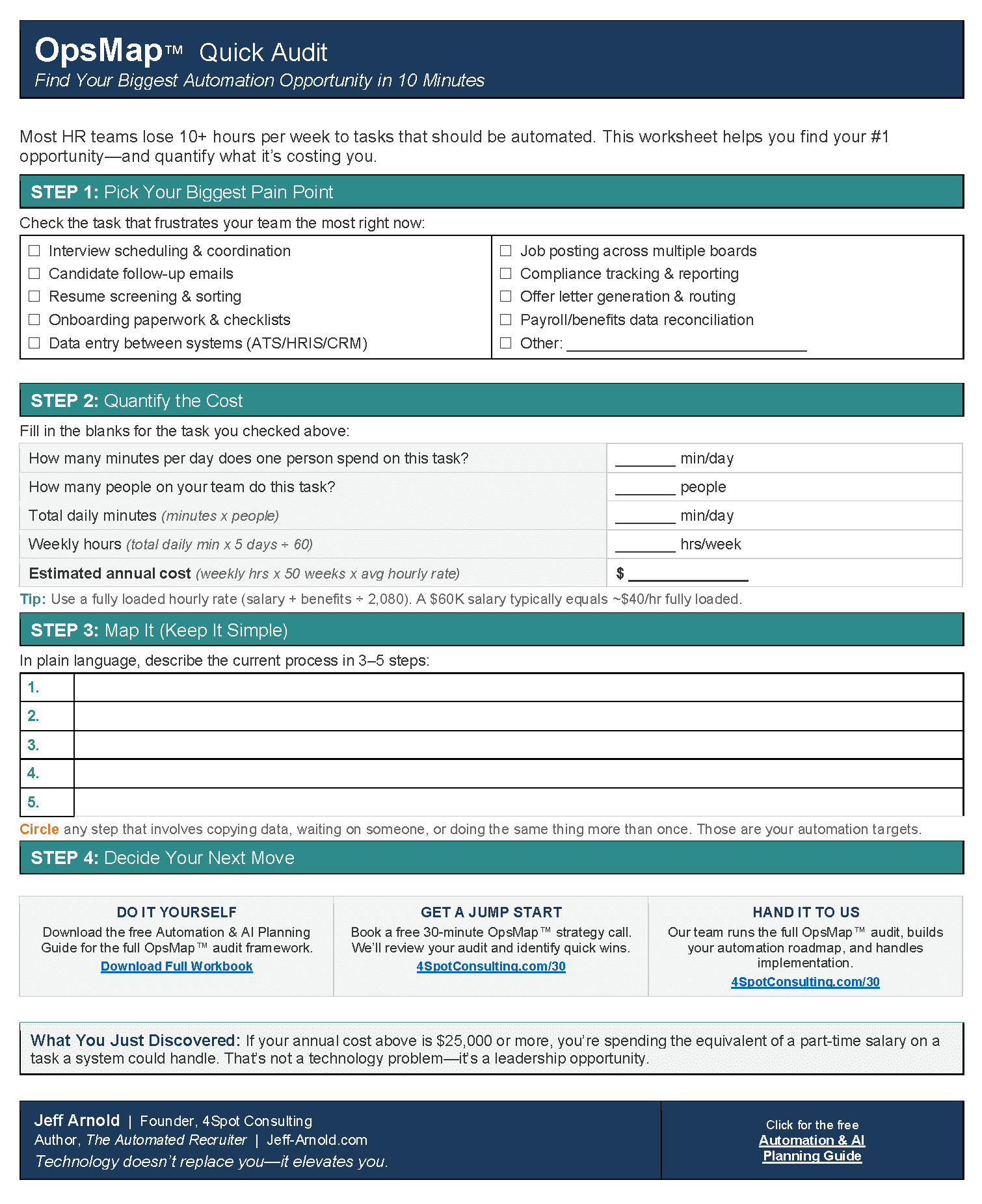
At 4Spot Consulting, we understand that leveraging AI effectively in HR isn’t just about implementing the latest tech; it’s about integrating it strategically and responsibly. Our OpsMap™ framework begins with a thorough diagnostic audit of your existing and planned systems, including AI resume parsers. We don’t just point out flaws; we provide a clear roadmap to address them.
We work with you to define what accuracy and fairness mean for your organization, identifying the specific metrics and ethical considerations that align with your values and business goals. Leveraging our expertise in automation and AI integration, we help you identify the root causes of parser inaccuracies or biases, whether it’s poor data quality, suboptimal model training, or misaligned configuration. Our OpsBuild™ phase then helps you implement targeted solutions—refining data pipelines, optimizing parsing logic, or integrating complementary AI and automation tools to create a more robust and equitable recruitment workflow. We ensure your AI doesn’t just work, but works for everyone.
Moving Beyond the Hype: Practical Steps for Your Organization
The era of simply deploying AI and hoping for the best is over. Responsible AI integration demands continuous vigilance and a proactive approach to auditing. Begin by clearly defining the success metrics for your AI parser, both in terms of efficiency and equity. Dedicate resources to regular, strategic audits, leveraging both technical analysis and human review. Foster a culture of continuous improvement, where feedback from recruiters and candidates alike informs iterative enhancements to your AI systems. Your investment in AI should empower, not hinder, your ability to build a diverse, skilled, and effective workforce. Failing to audit your AI parser is not just a technical oversight; it’s a strategic misstep that can profoundly impact your organization’s future talent and reputation.
Ready to uncover automation opportunities that could save you 25% of your day, including optimizing your AI-powered HR systems? Book your OpsMap™ call today.
If you would like to read more, we recommend this article: The Essential Guide to CRM Data Protection for HR & Recruiting with CRM-Backup
RELATED POST