Post: Optimize Job Descriptions for AI Parsing and ATS
The Future of Job Descriptions: Optimized for AI Parsing
The landscape of recruitment is undergoing a monumental shift, driven by the relentless advancement of artificial intelligence. For decades, the job description has stood as the bedrock of talent acquisition – a static document, often a relic of previous hires, crafted primarily for human eyes. Today, however, these traditional descriptions are becoming bottlenecks, hindering organizations from effectively leveraging the very AI tools designed to streamline their talent pipeline. At 4Spot Consulting, we see this not as a challenge, but as a critical inflection point: the dawn of job descriptions optimized not just for candidates, but for AI parsing.
The AI Imperative: Why Traditional JDs Are Failing
Consider the sheer volume of applications that high-growth companies receive. Manual review is not merely inefficient; it’s impossible. This is where AI-powered applicant tracking systems (ATS) and parsing engines step in, designed to rapidly filter, score, and present candidates. The problem arises when these sophisticated systems encounter ambiguous, unstructured, or overly verbose job descriptions. They struggle to extract precise requirements, often misinterpreting nuances or, worse, overlooking perfectly qualified candidates because the data isn’t presented in a machine-readable format.
This disconnect leads to several critical issues: increased time-to-hire, a higher probability of human error in candidate selection, and significant operational costs. Ultimately, it means high-value employees are still sifting through low-value work, undermining the promise of efficiency that AI is supposed to deliver. We know businesses thrive on precision and speed, and vague job descriptions are antithetical to both.
Understanding How AI ‘Reads’ a Job Description
Unlike a human recruiter who can infer, deduce, and understand context beyond explicit words, AI systems operate on data patterns, keywords, and semantic structures. When an AI parses a job description, it’s looking for clearly defined, unambiguous information. It’s evaluating skills, experience levels, qualifications, and even cultural fit indicators based on the text it processes. If your job description is a dense block of text, laden with industry jargon without proper categorization, or uses inconsistent terminology, the AI’s ability to accurately match it against candidate profiles is severely diminished.
The goal is to create a symbiotic relationship between the job description and the AI. This means moving beyond simple keyword stuffing to a more structured, semantic approach. Think of it as creating a “source of truth” for the AI, where every requirement is expressed with clarity and consistency, allowing the AI to perform its function with optimal accuracy.
Crafting the AI-Optimized Job Description: A Strategic Approach
Optimizing job descriptions for AI parsing isn’t about stripping away humanity; it’s about adding clarity and structure. This involves a strategic re-evaluation of how job requirements are articulated. Instead of broad statements, we need granular, data-rich attributes. For example, instead of “strong communication skills,” an AI-optimized JD might specify “demonstrated experience presenting project updates to executive stakeholders” or “proficiency in crafting concise, data-driven reports for cross-functional teams.”
Furthermore, it involves standardizing terminology for skills and experience across the organization. Imagine a scenario where one department lists a requirement as “CRM expertise” while another lists “Keap CRM proficiency.” A human might understand the overlap, but an AI needs explicit connections. This standardization, often a component of our OpsMesh™ framework, ensures consistency and enhances the AI’s matching capabilities.
Benefits Beyond Efficiency: Precision and Equity
The advantages of AI-optimized job descriptions extend far beyond merely speeding up the hiring process. When job requirements are clearly defined and structured for AI, it leads to a more precise matching process. This reduces the likelihood of subjective human bias creeping into the initial screening phases, promoting a more equitable and diverse talent pipeline. AI, when properly configured and fed clean data, is indifferent to names, backgrounds, or unconscious biases that can subtly influence human decision-making.
Moreover, precision in matching means candidates are presented with roles that genuinely align with their skills and aspirations, improving the candidate experience and reducing churn rates. This is about working smarter, not harder, enabling your high-value HR and recruiting teams to focus on the human elements of hiring – interviewing, onboarding, and culture integration – while the AI handles the heavy lifting of initial data processing.
Navigating the Transformation with 4Spot Consulting
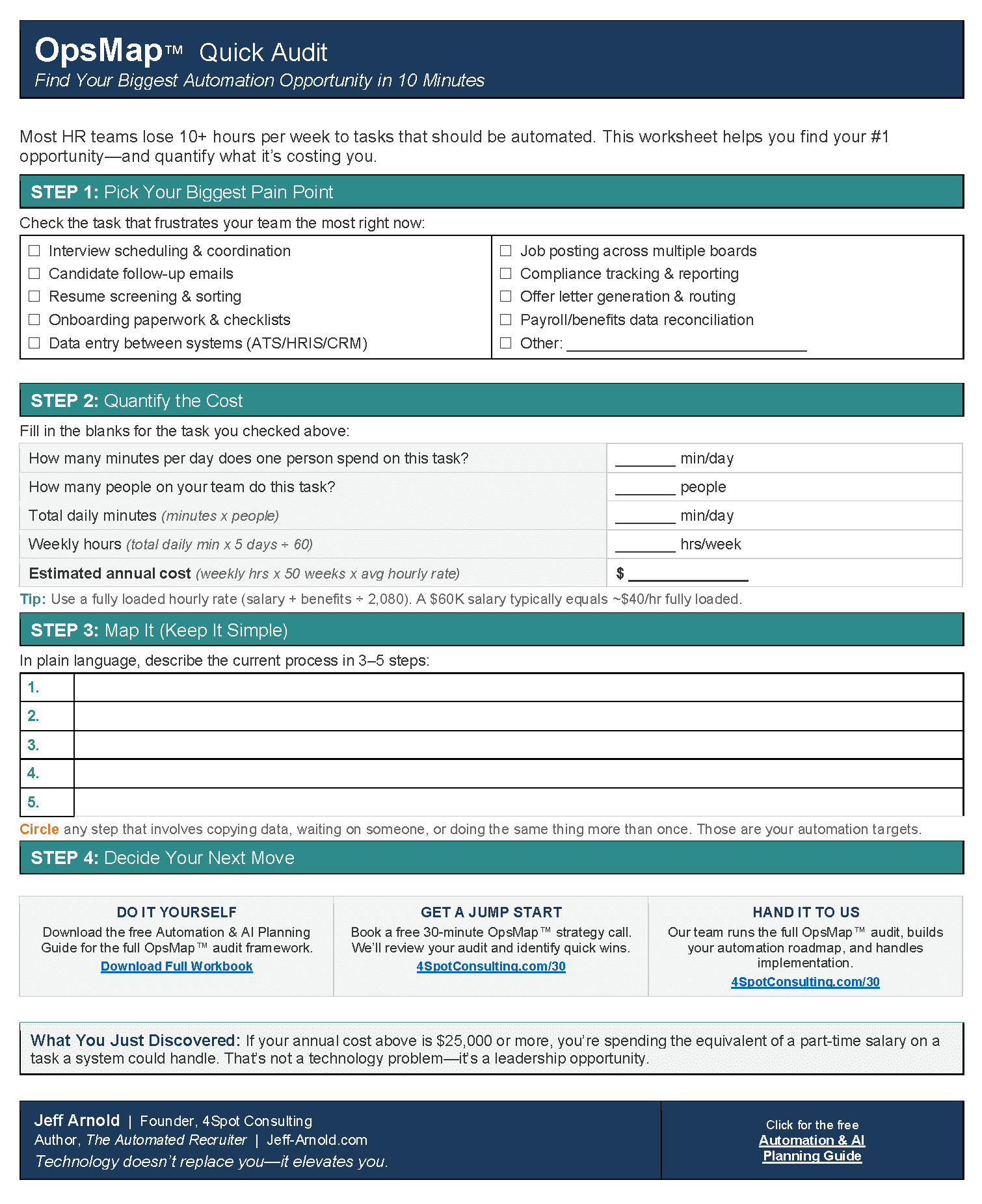
The transition to AI-optimized job descriptions requires more than just new templates; it demands a strategic overhaul of your talent acquisition processes and data management. This is precisely where 4Spot Consulting excels. Through our OpsMap™ diagnostic, we help organizations identify bottlenecks in their existing HR and recruiting workflows, uncovering where traditional job descriptions are impeding AI effectiveness. We then move to OpsBuild™, implementing tailored automation and AI integrations using platforms like Make.com, ensuring your job descriptions are not only AI-ready but also seamlessly integrated into your broader HR tech stack.
Our approach saves clients significant time and resources – often upwards of 25% of their day – by eliminating human error and optimizing operational costs. We transform your job descriptions from static documents into dynamic, intelligent assets that fuel your AI-powered recruitment engine, ensuring you attract, identify, and secure the best talent in a rapidly evolving market. It’s about building a scalable, future-proof recruitment infrastructure, where every piece of data, starting with the job description, serves a strategic purpose.
If you would like to read more, we recommend this article: Protecting Your Talent Pipeline: The HR & Recruiting CRM Data Backup Guide
RELATED POST