Post: Use AI to Screen Candidates: Boost Efficiency and Quality
AI in Recruiting: A Deep Dive into Candidate Screening Efficiency
The quest for top talent has never been more competitive, yet the foundational processes for identifying the right candidates often remain stubbornly manual and inefficient. Recruiters and HR leaders grapple with an ever-increasing volume of applications, the inherent biases of human review, and the sheer time investment required to sift through thousands of resumes. This is where artificial intelligence emerges not as a futuristic fantasy, but as a critical tool for modernizing and optimizing candidate screening, fundamentally reshaping how organizations identify and engage with prospective employees.
At 4Spot Consulting, we observe firsthand how businesses lose significant operational time and financial resources due to bottlenecks in their talent pipelines. The promise of AI in recruiting isn’t merely about automating tasks; it’s about elevating the entire screening process, making it more accurate, equitable, and ultimately, far more efficient. This deep dive will explore how AI is moving beyond simple keyword matching to deliver unprecedented clarity and speed to a traditionally cumbersome function.
The Shifting Landscape of Talent Acquisition
For decades, candidate screening relied heavily on human judgment, often leading to inconsistencies, unconscious biases, and a slow time-to-hire. As businesses grow, the volume of applications can quickly overwhelm even the most dedicated HR teams, leading to missed opportunities and a diluted candidate experience. The challenge isn’t just about finding candidates; it’s about efficiently identifying the best-fit individuals from a vast pool, consistently and fairly.
Traditional methods struggle to keep pace with the demands of today’s dynamic job market. Recruiters spend countless hours manually reviewing resumes, verifying qualifications, and often overlooking highly qualified candidates due to fatigue or rigid keyword filters. This antiquated approach not only drains valuable resources but also limits an organization’s ability to scale its hiring efforts in alignment with strategic growth objectives.
Beyond Keywords: AI’s Nuanced Approach
Early iterations of automation in recruiting were often criticized for their rigid, keyword-centric matching, which could inadvertently filter out perfectly suitable candidates who didn’t use the ‘right’ terminology. Modern AI, however, has evolved significantly. Today’s AI models can analyze context, identify transferable skills, assess cultural fit indicators through language patterns, and even predict job performance based on a broader set of data points.
This nuanced approach allows AI to ‘read between the lines’ of a resume or application, understanding the underlying capabilities and potential rather than just surface-level keywords. For instance, an AI system powered by natural language processing (NLP) can understand that experience managing a “project pipeline” is analogous to managing a “sales funnel,” where a basic keyword search might miss the connection. This deeper contextual understanding is a game-changer for identifying a more diverse and truly qualified talent pool, significantly reducing the burden on human screeners while improving the quality of candidates advanced.
Practical Applications of AI in Candidate Screening
The integration of AI into candidate screening manifests in several powerful ways, each contributing to a more streamlined and effective talent acquisition strategy. These applications are not theoretical; they are being implemented today by forward-thinking organizations seeking to gain a competitive edge in hiring.
Automating Resume and Application Review
Perhaps the most immediate and impactful application of AI is in the automation of initial resume and application review. AI-powered parsing tools can rapidly extract, categorize, and prioritize relevant information from thousands of submissions in minutes, not days. This includes identifying key skills, experience levels, educational backgrounds, and even soft skills inferred from professional descriptions. For an HR firm, as we’ve seen, this capability can translate into saving over 150 hours per month, enabling recruiters to focus on engagement rather than data entry and initial vetting.
By automating this initial screening, organizations can ensure that every application receives a thorough, objective review against defined criteria, eliminating human fatigue and the potential for unconscious bias in the early stages. The AI system acts as a highly efficient, tireless first pass, presenting human recruiters with a refined list of top-tier candidates.
Predictive Analytics for Candidate Success
Beyond simply matching qualifications, AI can leverage historical data to build predictive models for candidate success. By analyzing patterns from past successful hires—considering factors like career progression, tenure, performance metrics, and even company culture fit—AI can provide insights into which current applicants are most likely to thrive in a given role and within the organization. This capability moves candidate screening from reactive assessment to proactive prediction.
These predictive insights empower hiring managers to make more data-informed decisions, reducing turnover rates and improving the overall quality of hires. It transforms the hiring process from an educated guess into a strategic, analytically-driven exercise, ultimately contributing to a stronger, more stable workforce.
Bias Mitigation and Enhanced Fairness
While often a concern, AI, when developed and implemented ethically, can be a powerful tool for mitigating bias in candidate screening. By establishing objective evaluation criteria and consistently applying them across all applicants, AI can help standardize the assessment process. Algorithms can be designed to identify and flag language or patterns that might inadvertently introduce bias, allowing organizations to audit and refine their screening methodologies for greater fairness.
This doesn’t mean AI is inherently bias-free; it’s only as unbiased as the data it’s trained on. However, with careful design and continuous monitoring, AI systems can significantly reduce the impact of human subjective biases, leading to a more diverse and inclusive talent pool that accurately reflects the full breadth of available talent.
The 4Spot Consulting Advantage: Strategic AI Implementation
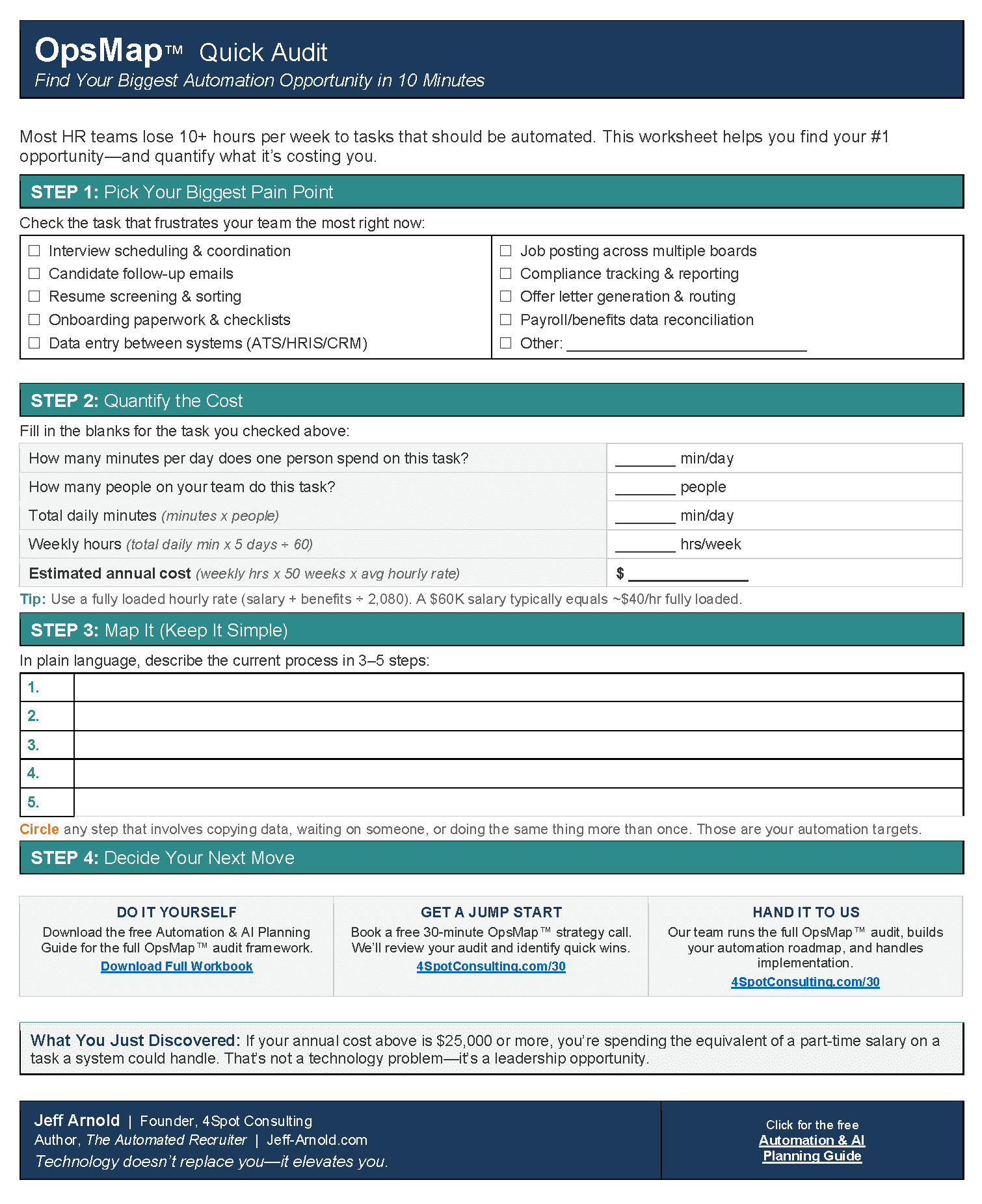
Implementing AI in recruiting is not just about adopting new software; it’s about a strategic overhaul of existing processes. At 4Spot Consulting, we approach AI integration with our OpsMesh framework, understanding that technology must serve a clear business objective. We begin with an OpsMap™ diagnostic to uncover inefficiencies and identify precisely where AI can deliver the most significant ROI – whether it’s saving 25% of your team’s day or enabling smarter, faster hires.
Our expertise in low-code automation tools like Make.com allows us to seamlessly integrate AI capabilities with your existing HR tech stack, from CRM systems like Keap to applicant tracking systems. We don’t just build; we strategize, ensuring that every AI solution is tied to tangible outcomes: reduced operational costs, elimination of human error, and enhanced scalability for your talent acquisition efforts. Our goal is to transform your recruiting from a bottleneck into a competitive advantage.
AI in candidate screening is no longer a luxury but a necessity for organizations committed to efficiency, fairness, and securing the best talent. By strategically adopting and integrating these intelligent systems, businesses can free up high-value employees from low-value work, accelerate their hiring cycles, and make more informed decisions that drive long-term success.
If you would like to read more, we recommend this article: CRM Data Protection and Recovery for Keap and High Level


RELATED POST