Post: Make.com’s Pricing Model: Why It Renders Zapier Obsolete for Growing Startups
Why Make.com’s Pricing Model Makes Zapier Obsolete for Growing Startups
In the relentless pursuit of growth, startups often find themselves at a critical juncture: the very tools designed to automate their processes begin to stifle their scalability. While platforms like Zapier have long been the go-to for quick integrations, their underlying pricing models can become a significant bottleneck as a company matures. For growing startups, where every dollar spent on infrastructure must directly fuel expansion, the efficiency and cost-effectiveness of automation are paramount. This isn’t just about connecting apps; it’s about building a resilient, scalable operational backbone without incurring prohibitive costs. The fundamental differences in how Make.com and Zapier structure their pricing reveal a stark truth: for businesses truly committed to sustained growth and cost optimization, Make.com presents a superior, more strategic choice.
The Hidden Costs of Zapier’s Task-Based Model
Zapier operates on a task-based pricing model, where each action performed by an automation is counted as a “task.” While simple to understand initially, this model quickly unravels into a complex and often unpredictable expense as a startup scales. Consider a scenario where a single automation moves data from a form submission, enriches it, and then adds it to a CRM and an email sequence. What might seem like one process can easily count as multiple tasks, escalating costs rapidly. This unpredictable cost structure makes budgeting challenging and often forces growing companies to compromise on the extent of their automation, leaving valuable efficiency gains on the table.
Furthermore, Zapier’s model can disincentivize robust, end-to-end automation. Businesses become wary of creating comprehensive workflows for fear of racking up task counts, leading to fragmented systems and a return to manual interventions for parts of a process. This defeats the very purpose of automation – to eliminate human error and reduce operational costs. For a startup striving for hyper-efficiency and scalability, such limitations are not merely inconveniences; they are direct impediments to growth and profitability, turning an enabler into a cost center.
Make.com: Building Scalable Automation with Predictable Costs
Make.com (formerly Integromat) offers a fundamentally different and, frankly, superior approach to automation pricing and execution. Instead of individual tasks, Make.com prices based on “operations,” which are bundled actions within a single scenario. This means that a complex workflow, involving multiple steps and data transformations, can often be counted as just one or a few operations, providing significantly more value for each dollar spent. This predictable, bundle-based model gives growing startups the financial clarity they need to scale their automation initiatives without fear of surprise bills.
Beyond pricing, Make.com’s visual builder is a game-changer. It allows for highly intricate and flexible workflow design, enabling businesses to create sophisticated automations that precisely match their unique operational requirements. Unlike Zapier’s simpler, linear “if this, then that” logic, Make.com empowers users to build multi-path scenarios, integrate conditional logic, handle error pathways, and perform advanced data manipulation directly within the platform. This level of control and customization means that almost any business process, no matter how complex, can be fully automated and optimized, reducing the need for costly custom development or manual workarounds.
For startups, this translates into direct ROI. By leveraging Make.com, organizations can automate more extensively, from HR and recruiting workflows to CRM management and internal data synchronization, all while keeping a firm grip on their operational expenditures. This predictability and power are not just features; they are strategic assets that allow businesses to invest confidently in their automation infrastructure, knowing it will support their growth rather than drain their resources.
Why Zapier Can’t Keep Up with Growth
For early-stage startups with minimal automation needs, Zapier offers a quick entry point. However, as soon as a business begins to experience meaningful transaction volume, expand its service offerings, or integrate more sophisticated backend systems, Zapier’s limitations become glaring. The inflexibility of its task-based model and its less robust visual programming environment mean that scaling automation rapidly becomes an exercise in cost management rather than efficiency gains. It forces a choice between critical business processes and budget constraints.
Make.com, on the other hand, is built for scale and complexity from the ground up. It aligns perfectly with the needs of a growing startup that requires deep, interconnected systems without the exponential cost curve. The strategic choice is clear: building an automation infrastructure on Make.com means future-proofing your operations, gaining unparalleled flexibility, and ensuring that automation truly serves as a catalyst for growth, rather than a cost burden that eventually renders your initial choice obsolete.
Optimizing Your Automation Strategy with 4Spot Consulting
At 4Spot Consulting, we specialize in helping high-growth B2B companies leverage the full power of platforms like Make.com to eliminate human error, reduce operational costs, and increase scalability. Our OpsMesh framework is designed to identify and implement strategic automations that truly save you 25% of your day. We understand the nuances of complex business processes and how to translate them into robust, cost-effective Make.com scenarios. We don’t just build; we strategize, ensuring every automation delivers measurable ROI.
Our expertise with Make.com allows us to unlock efficiencies that Zapier’s model simply cannot sustain for growing operations. From HR and recruiting automation to seamless CRM and data management, we build systems that are designed to evolve with your business, ensuring your automation infrastructure is an asset, not a liability.
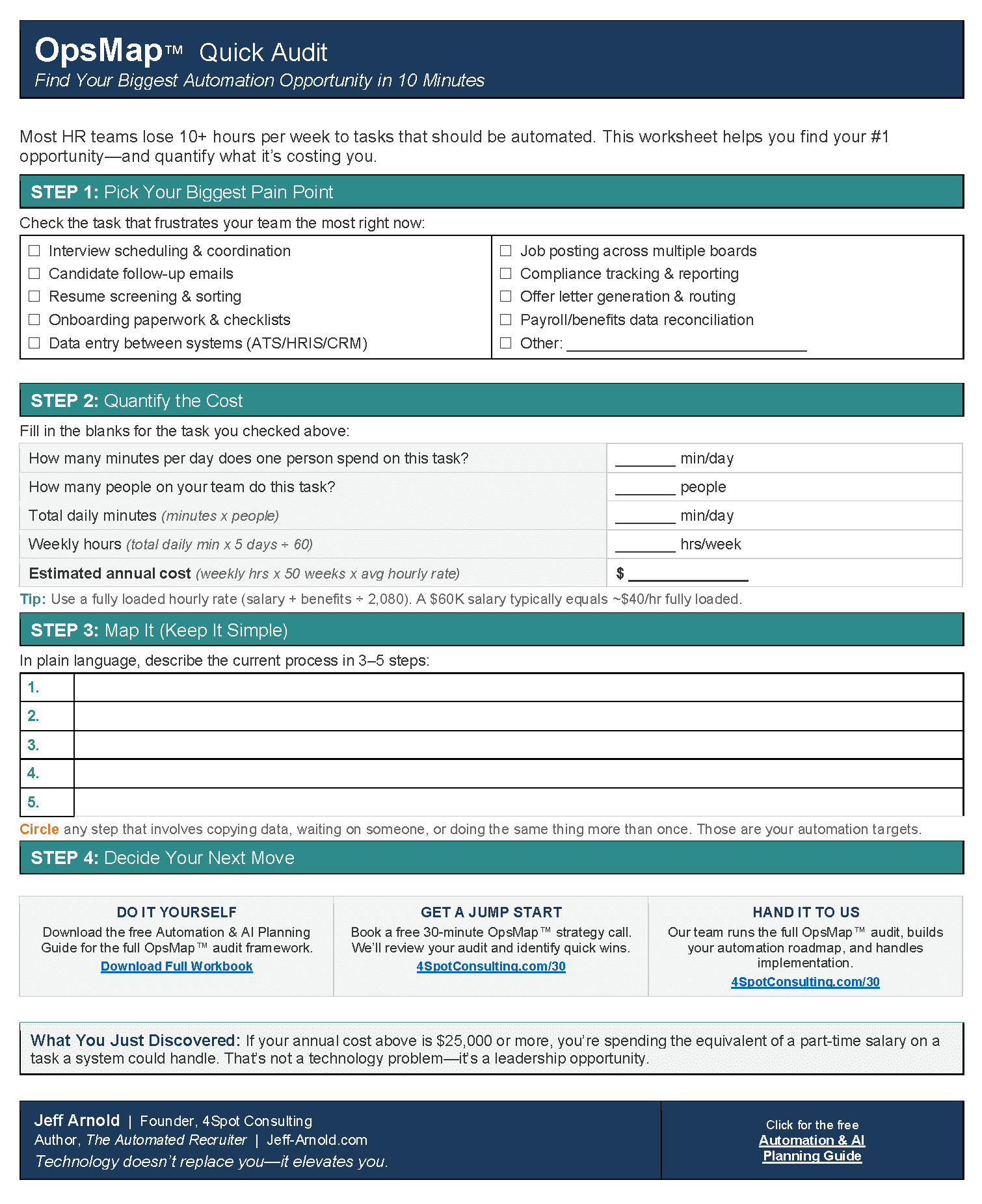
Ready to uncover automation opportunities that could save you 25% of your day and position your startup for sustainable growth? Book your OpsMap™ call today.
If you would like to read more, we recommend this article: Choosing the Right Automation Platform for Your Business


RELATED POST