Post: From Admin to Advantage: 9 Ways AI is Revolutionizing HR & Recruiting
AI transforms HR and recruiting by eliminating manual bottlenecks, automating candidate screening, personalizing the hiring journey, and converting compliance risk into a managed process. For high-growth B2B organizations, these nine applications deliver measurable ROI—including the 25% daily time reclamation 4Spot Consulting documents across every client engagement.
Why AI in HR Is No Longer Optional
HR and recruiting teams at scaling companies face a compounding problem: headcount grows, process complexity multiplies, and the administrative burden consumes the strategic bandwidth leaders were hired to exercise. AI does not replace human judgment—it removes the friction that keeps your best people buried in repetitive work. The organizations winning the talent war right now are the ones that treat AI as operational infrastructure, not an experiment. This guide covers nine practical applications already producing results in production environments, not theoretical pilots.
Expert Take
The single most common finding in our diagnostic work is that HR leaders underestimate how much time their team spends on tasks AI can handle in seconds. Resume triage, follow-up sequencing, compliance document tracking—these are not strategic activities. Every hour reclaimed from admin is an hour that goes back into candidate relationships and culture-building, which are the actual levers of retention.
1. Intelligent Candidate Sourcing and Automated Screening
AI-powered sourcing platforms scan job boards, professional networks, and proprietary databases simultaneously, identifying candidates whose skills, experience, and work history align with specific role requirements—going well beyond keyword matching. Natural language processing (NLP) reads context and intent within resumes and project descriptions, surfacing qualified applicants a keyword filter would miss entirely.
Automated screening layers on top of sourcing to filter unqualified applicants against predefined criteria, run initial conversational assessments, and flag potential bias patterns before they reach a human reviewer. The result is a recruitment funnel that narrows to quality faster, reduces time-to-hire, and lets recruiters invest their hours in the candidates who genuinely warrant a conversation.
For a detailed look at how this plays out in a real engagement, see our case study: 105,000 Hours Saved: How 4Spot Consulting Revolutionized GTS Talent Acquisition with AI Automation.
2. Personalized Candidate Experience and Engagement
A generic hiring process signals to top talent that the organization treats people as interchangeable. AI eliminates that signal by enabling personalization at every touchpoint without adding headcount. Conversational chatbots answer role-specific and culture-related questions around the clock, removing the 24–48 hour lag that causes candidates to disengage.
Beyond immediate query resolution, AI personalizes follow-up communications using data from the candidate’s own application and prior interactions. Relevant company content, role-specific testimonials, and tailored status updates make candidates feel seen and valued. That perception directly improves offer acceptance rates and strengthens the employer brand with every interaction—including interactions that end in a rejection.
3. Predictive Analytics for Talent Acquisition and Retention
Predictive analytics give HR leaders the ability to act on leading indicators rather than react to lagging ones. By analyzing historical performance data, tenure patterns, engagement survey results, and external labor market signals, AI models forecast which candidates are most likely to succeed in a given role and which current employees carry the highest attrition risk.
When data shows a consistent 18-month attrition spike in a specific department, AI pinpoints the contributing variables—management patterns, compensation positioning, development velocity—so HR can address root causes before the next departure. Our OpsMap™ diagnostic surfaces exactly these hidden data points, creating the foundation for AI-driven retention strategy rather than reactive damage control.
Expert Take
Predictive retention work produces the fastest ROI we see in HR engagements. The cost of replacing a mid-level employee typically runs 60% to 200% of annual salary when you account for recruiting, onboarding, and productivity ramp. Identifying three or four flight risks per quarter and intervening successfully pays for an entire automation program within a single fiscal year.
4. AI-Powered Interview Assistance and Skills Assessment
Human interviewers introduce variance—different questions, different scoring thresholds, different tolerance for ambiguity—that makes comparison across candidates unreliable. AI interview tools standardize the process by presenting every candidate with the same scenario-based questions or technical challenges and scoring responses against consistent criteria.
Video interview analysis layers on behavioral signals—communication clarity, structural reasoning in verbal responses, engagement indicators—providing interviewers with data-rich summaries before the debrief conversation. This is not a replacement for human judgment; it is additional signal that reduces the likelihood of a strong candidate being eliminated for the wrong reasons or a weak candidate advancing due to social fluency alone.
5. AI-Enhanced Onboarding and Continuous Training
Onboarding failure is expensive and preventable. AI addresses the two primary causes: information overload in the first weeks and inconsistent delivery across managers and locations. Virtual onboarding assistants answer policy questions, IT setup queries, and team structure questions on demand, without requiring a manager or HR generalist to field the same questions repeatedly.
Beyond onboarding, AI identifies individual skill gaps by analyzing performance data and role requirements, then delivers personalized learning paths rather than one-size-fits-all training curricula. Progress tracking allows the system to adapt pacing and content in real time, ensuring employees develop the capabilities the business actually needs. The administrative coordination that previously consumed HR training staff—scheduling, completion tracking, compliance certification—runs automatically in the background.
For a practical breakdown of automated onboarding architecture, see: 12 Essential Steps to Building a Future-Proof AI-Driven Onboarding Strategy.
6. HR Workflow Automation with AI Integration
Fragmented HR tech stacks are one of the most common sources of wasted labor in scaling organizations. Data entered manually into an ATS gets re-entered into an HRIS, then copied again into a payroll system, then referenced manually to trigger a background check. Every handoff is a failure point—for data integrity, compliance, and staff time.
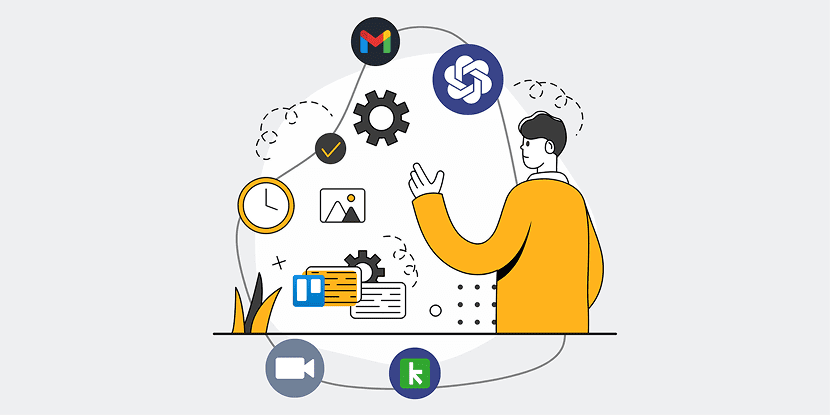
AI integration via platforms like Make.com eliminates those handoffs. An applicant’s data flows automatically from ATS to HRIS, triggers background check initiation, generates an offer letter through PandaDoc, and provisions software access—all without manual intervention. AI handles exceptions by flagging anomalies rather than silently passing errors downstream. This is the core function of our OpsMesh™ framework: building interconnected, intelligent systems that make the existing tech stack work as a single coherent operation rather than a collection of disconnected tools. The documented result across our engagements is a 25% reclamation of daily operational time.
See a live example of this in practice: $103K Annual Labor Hours: Make Automation Case Study.
Expert Take
Most HR leaders we work with initially underestimate how much of their team’s time disappears into inter-system data movement. When we map the actual workflow in an OpsMap™ diagnostic, the number is almost always shocking. Eliminating those handoffs through AI-connected automation is the highest-leverage intervention we execute—because the time savings compound across every hire, every offboard, and every compliance cycle.
7. AI for Employee Engagement and Retention
Retention strategy built on annual engagement surveys is structurally reactive—by the time the data is collected, analyzed, and presented, the disengaged employees have already updated their LinkedIn profiles. AI enables continuous sentiment monitoring by analyzing anonymized signals from pulse surveys, internal communications, and performance data to detect dissatisfaction trends before they become departure decisions.
Predictive models flag employees showing behavioral patterns correlated with attrition—changes in work pace, reduced collaboration activity, declining feedback sentiment—so HR can intervene with targeted support, development conversations, or compensation reviews at the moment when intervention still works. AI also personalizes benefits recommendations and career pathing suggestions, making the organization’s investment in each employee visible and specific rather than generic.
For additional strategies on building this kind of proactive engagement infrastructure, see: 10 Employee Advocacy Mistakes to Avoid for a Thriving Program.
8. AI-Driven Compliance and Risk Management
Labor law changes, privacy regulation updates, and industry-specific compliance requirements arrive on an unpredictable schedule and carry significant financial and reputational consequences when missed. AI compliance systems monitor regulatory changes continuously, automatically updating relevant policies, forms, and procedures without waiting for a quarterly legal review cycle.
AI audits HR data for completeness and accuracy, flagging missing documentation, incomplete training certifications, and discrepancies that could trigger non-compliance findings. In compensation equity analysis, AI scans salary data across demographic segments to identify pay gaps before they become legal liability. The practical effect is an always-active compliance function that converts a historically reactive, high-risk process into a managed, low-friction operational baseline.
9. Data-Driven HR Strategy and ROI Measurement
The strategic value of AI in HR culminates in its capacity to reposition HR from a cost center into a business driver with measurable impact on revenue outcomes. Real-time dashboards surface KPIs—time-to-hire, cost-per-hire, turnover rate by department, training ROI, diversity program effectiveness—that allow HR leaders to make investment decisions with the same analytical rigor applied to marketing or product development.
This data infrastructure is what allows HR to justify budget allocations, demonstrate contribution to business performance, and forecast talent requirements ahead of growth initiatives rather than scrambling to hire after growth has already stalled. Our OpsBuild™ and OpsCare™ services are specifically designed to build and maintain this kind of strategic data capability—ensuring the intelligence HR generates stays current, accurate, and connected to the decisions that shape the workforce of the next growth phase.
For a framework on measuring these outcomes, see: 10 Essential Metrics for AI Talent Acquisition ROI.
Frequently Asked Questions
Does AI in HR replace human recruiters?
AI handles the high-volume, repetitive work—screening, scheduling, data movement, compliance monitoring—so human recruiters focus entirely on relationship-building, candidate evaluation, and strategic talent planning. The result is a smaller team operating at higher output and strategic impact, not a headcount reduction that degrades quality.
How long does it take to see ROI from HR automation?
Our engagements consistently show measurable time reclamation within the first 30 to 60 days of deploying targeted automation. Full strategic ROI—including retention improvements and reduced cost-per-hire—builds over two to three quarters as predictive models accumulate sufficient data to produce reliable signals.
What is the first step for an HR team considering AI implementation?
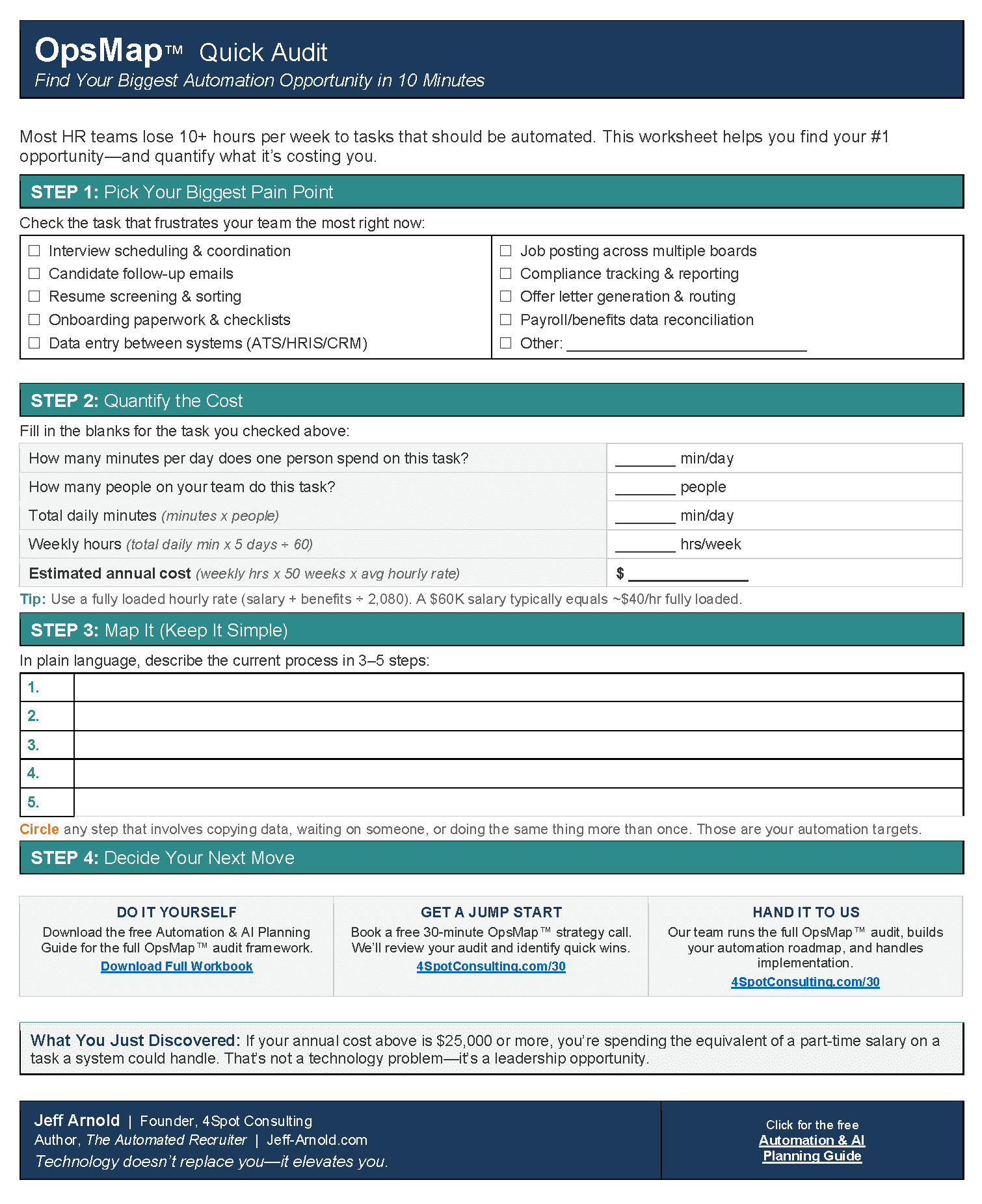
The first step is a structured workflow diagnostic that maps where time is currently being spent and identifies the highest-impact automation opportunities. Without that baseline, organizations invest in tools that solve the wrong problems. Our OpsMap™ diagnostic delivers that clarity in a defined engagement before any build begins.
Is AI-powered HR compliance suitable for small HR teams?
AI compliance tools deliver the greatest proportional benefit to lean HR teams, where a single missed regulatory update carries more risk because there is no redundant review layer. Automated monitoring and alerting functions as a permanent compliance resource that a two- or three-person HR team cannot otherwise afford to staff.
How does OpsMesh connect HR tools that don’t natively integrate?
OpsMesh™ uses middleware platforms like Make.com to build automated workflows between systems that lack native API connections, mapping data fields, handling transformation logic, and managing error states. The result is a unified operational layer where data moves accurately across the full HR tech stack without manual intervention at any handoff point.