Post: Transforming HR & Recruiting: 5 AI Applications for Strategic Advantage
5 Game-Changing AI Applications Transforming HR and Recruiting Today
The landscape of Human Resources and Recruiting is undergoing a profound transformation, driven largely by the rapid advancement and practical integration of Artificial Intelligence. For too long, HR and recruitment professionals have been bogged down by administrative burdens, repetitive tasks, and inefficient processes that stifle strategic initiatives and hinder effective talent acquisition. From sifting through countless resumes to scheduling interviews, the manual effort involved not only consumes valuable time but also introduces human error and slows down critical operations. This is where AI steps in, not as a replacement for human judgment, but as a powerful co-pilot designed to automate the mundane, enhance decision-making, and liberate your team to focus on high-value, human-centric tasks. At 4Spot Consulting, our mission is to help companies like yours reclaim up to 25% of your day by intelligently automating these very challenges. We’ve seen firsthand how integrating AI can turn bottlenecks into streamlined workflows, allowing HR and recruiting leaders to transition from reactive firefighters to proactive strategic partners. This article will explore five practical, game-changing AI applications that are not just theoretical concepts, but real-world solutions making a tangible impact on the efficiency, accuracy, and overall effectiveness of HR and recruiting functions right now.
Embracing these AI-powered applications is no longer a luxury for forward-thinking organizations; it’s becoming a necessity for staying competitive in the race for top talent and optimizing internal operations. From initial candidate outreach to post-hire development and retention, AI is proving its worth by significantly reducing operational costs, minimizing human error, and creating more scalable systems. We’re not talking about futuristic sci-fi; we’re talking about proven technologies that, when integrated strategically with platforms like Make.com, Keap, and PandaDoc, deliver immediate and measurable ROI. Let’s dive into the specific ways AI is reshaping the HR and recruiting landscape and how your organization can leverage these innovations to build a more efficient, engaged, and effective workforce.
1. Automated Candidate Sourcing and Screening
One of the most time-consuming and labor-intensive phases in recruiting is the initial sourcing and screening of candidates. Recruiters spend countless hours manually sifting through hundreds, if not thousands, of resumes, often looking for specific keywords, experiences, and qualifications. This process is not only prone to human bias and oversight but also incredibly inefficient, diverting valuable resources from more strategic engagement. AI-powered tools are revolutionizing this stage by automating the identification, evaluation, and ranking of potential candidates. Using Natural Language Processing (NLP) and machine learning algorithms, these systems can rapidly parse resumes, job applications, and online profiles, extracting key information far more accurately and consistently than a human can.
AI can match candidates against specific job requirements, desired skills, and even company culture indicators, providing a ranked list of the most suitable applicants. Beyond simple keyword matching, advanced AI can analyze the context and nuances of a candidate’s experience, identifying transferable skills or potential for growth that might be missed in a quick human review. This significantly reduces the volume of unqualified applications reaching a recruiter’s desk, allowing them to focus their attention on genuinely promising prospects. For instance, a system integrated via Make.com could automatically pull resumes from various job boards, parse them with an AI tool, and then create a ranked shortlist within your Keap CRM, saving an HR firm over 150 hours per month, as we’ve seen in real-world applications. This not only speeds up the time-to-hire but also improves the quality of candidates presented to hiring managers, leading to better long-term hires and a stronger talent pipeline.
2. AI-Driven Interview Scheduling and Chatbots
The back-and-forth email chains involved in scheduling interviews can be a significant drain on both recruiter and candidate time, often leading to delays and a frustrating candidate experience. Furthermore, candidates frequently have common questions about the role, company culture, or application process that consume recruiter time with repetitive answers. AI-driven solutions are elegantly solving both these problems. AI-powered scheduling tools can integrate directly with calendars, allowing candidates to select available interview slots without any manual intervention from the recruiter. These systems are smart enough to handle time zone differences, interviewer availability, and even send automated reminders, drastically reducing no-shows and administrative overhead.
Beyond scheduling, AI-powered chatbots have become indispensable for handling initial candidate interactions and answering frequently asked questions. These chatbots, often deployed on careers pages or within messaging platforms, can provide instant, accurate responses 24/7. They can guide candidates through the application process, explain benefits, provide insights into company culture, and even conduct preliminary screening questions to assess basic qualifications. This enhances the candidate experience by offering immediate support and information, while freeing recruiters from repetitive inquiries. Imagine an automated system that screens applicants, handles preliminary FAQs, and then schedules interviews directly into your hiring manager’s calendar—all orchestrated through a robust automation platform. This not only improves efficiency but also ensures that every candidate receives a consistent and professional experience, regardless of when they inquire or apply.
3. Predictive Analytics for Talent Management
Retaining top talent and ensuring your workforce has the skills needed for future growth are critical strategic imperatives for any business. However, identifying employees at risk of leaving, predicting future skill gaps, or understanding which development programs will yield the best results can be incredibly challenging with traditional HR data analysis. AI-driven predictive analytics offer a powerful solution by leveraging vast amounts of internal and external data to forecast future trends and inform strategic talent decisions. By analyzing factors such as employee performance data, engagement survey results, compensation trends, tenure, and even macroeconomic indicators, AI algorithms can identify patterns that predict employee turnover with remarkable accuracy.
This allows HR leaders to proactively intervene with targeted retention strategies for high-risk employees, such as career development opportunities, mentorship programs, or compensation adjustments. Furthermore, predictive analytics can forecast future skill requirements based on business growth projections and industry trends, highlighting potential talent gaps before they become critical. This enables strategic workforce planning, guiding investments in training and development or informing future recruitment drives. For companies seeking a competitive edge, integrating disparate data sources into a single source of truth, a core offering of 4Spot Consulting, is essential for unlocking the full potential of predictive analytics. This strategic insight shifts HR from a reactive function to a proactive, data-driven engine that directly supports business objectives and ensures a resilient, future-ready workforce.
4. Personalized Employee Onboarding and Development
The onboarding experience sets the tone for a new employee’s journey, impacting everything from time-to-productivity to long-term retention. Generic, one-size-fits-all onboarding processes often lead to disengagement and a slower ramp-up time. Similarly, employee development programs can be ineffective if they don’t cater to individual needs and career aspirations. AI is transforming these areas by enabling highly personalized experiences that maximize engagement and accelerate growth. During onboarding, AI can tailor the information, training modules, and resource recommendations based on the new hire’s role, department, and even learning style, ensuring they receive the most relevant support from day one.
For example, an automated workflow built with Make.com could trigger a personalized onboarding sequence: generating role-specific documents via PandaDoc, assigning relevant training courses based on identified skill gaps, and scheduling introductory meetings with key stakeholders. This ensures a smooth, efficient, and welcoming start. In employee development, AI can analyze performance data, career goals, and skill assessments to recommend highly individualized learning paths, courses, and mentorship opportunities. AI-powered platforms can track progress, offer real-time feedback, and suggest micro-learning modules to address specific areas for improvement. This level of personalization not only makes development more effective but also demonstrates a genuine investment in the employee’s growth, fostering loyalty and engagement. By automating these personalized workflows, organizations can ensure every employee feels valued and supported throughout their journey, leading to higher retention rates and a more skilled workforce.
5. AI for Compliance and Risk Management
Navigating the complex and ever-evolving landscape of HR compliance is a constant challenge for organizations. From ensuring fair hiring practices and avoiding discriminatory language in job descriptions to managing intricate contractual agreements and data privacy regulations, the risk of non-compliance is significant and costly. AI tools are emerging as powerful allies in mitigating these risks and streamlining compliance efforts. For instance, AI can be used to automatically scan job descriptions, internal communications, and policy documents for biased language, ensuring adherence to equal opportunity employment laws. These systems can identify subtle linguistic patterns that might unintentionally exclude certain demographic groups, helping organizations maintain fair and inclusive hiring practices.
Furthermore, AI can assist in the meticulous process of contract review and document verification. Tools leveraging NLP can analyze employment contracts, offer letters, and non-disclosure agreements to flag inconsistencies, missing clauses, or potential legal risks, ensuring all documentation is compliant with current regulations. For international organizations, AI can even help navigate different regional laws and cultural nuances. In terms of data privacy, AI can play a crucial role in monitoring access to sensitive employee data and ensuring compliance with regulations like GDPR or CCPA. By automating these rigorous checks and balances, organizations significantly reduce their legal exposure, enhance ethical practices, and free up legal and HR teams from manual audits. Implementing a robust data and document organization system, a specialty of 4Spot Consulting, is foundational to leveraging AI effectively in this critical area, ensuring data integrity and automated oversight for continuous compliance.
The integration of AI into HR and recruiting is not a distant future; it’s a present reality that is fundamentally reshaping how organizations attract, manage, and retain talent. From automating the tedious tasks of sourcing and scheduling to providing predictive insights for talent management and ensuring robust compliance, AI is empowering HR and recruiting professionals to operate with unprecedented efficiency, accuracy, and strategic foresight. These five applications represent just a fraction of AI’s potential, each offering tangible benefits that translate into significant time savings, reduced operational costs, and an enhanced experience for both candidates and employees. By embracing these intelligent automation solutions, organizations can elevate their HR functions from administrative cost centers to strategic powerhouses, capable of driving sustained business growth and fostering a truly engaged workforce.
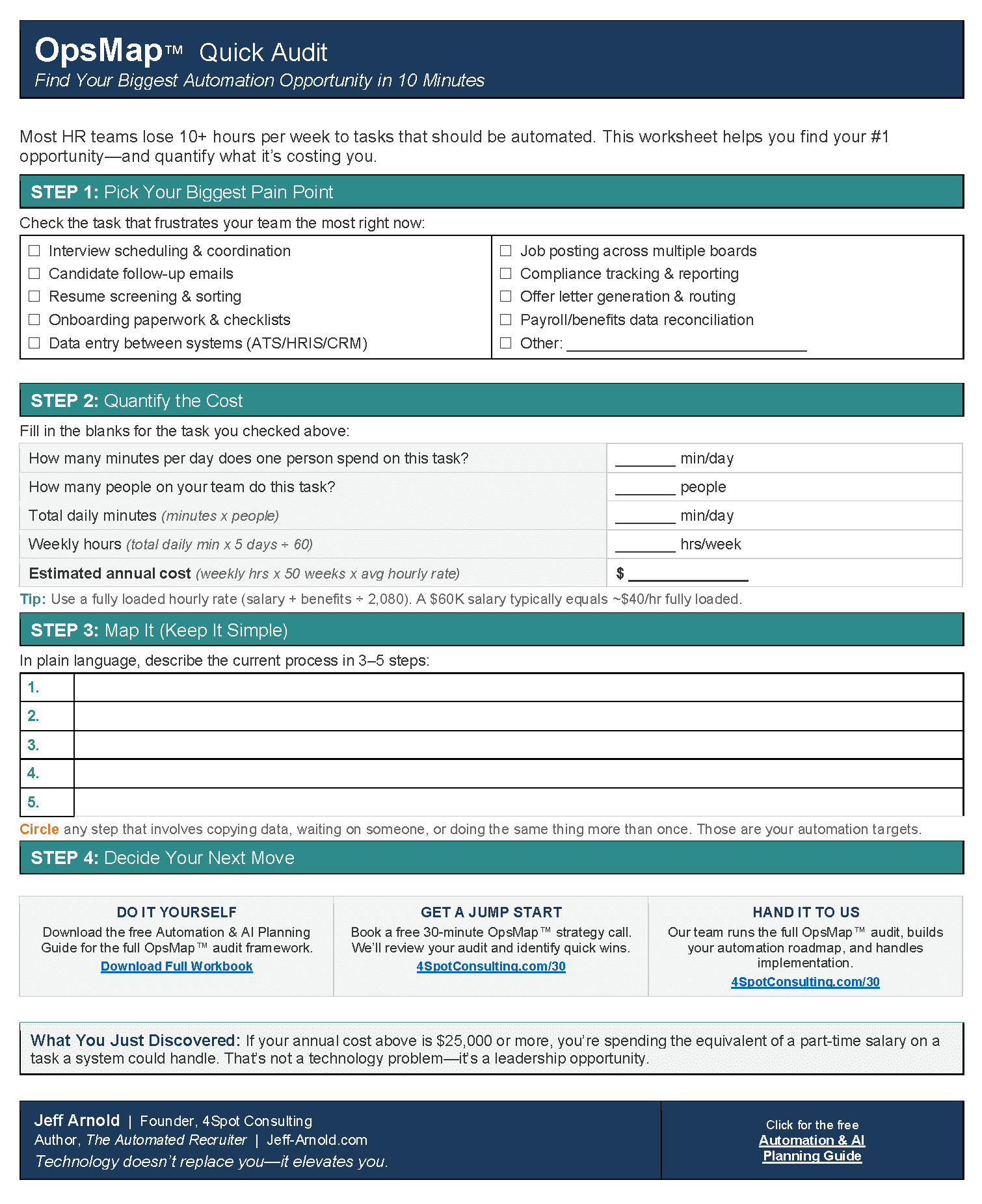
At 4Spot Consulting, we specialize in helping high-growth B2B companies strategically implement these types of AI and automation solutions, saving you 25% of your day and ensuring your systems are not just efficient but future-proof. Our OpsMap™ diagnostic is the first step in identifying these key opportunities within your unique operations. If you’re ready to transform your HR and recruiting processes and unlock new levels of efficiency and strategic impact, the time to act is now.
If you would like to read more, we recommend this article: 5 Game-Changing AI Applications Transforming HR and Recruiting Today
RELATED POST