Post: From Hype to Impact: Practical AI for HR & Recruiting Efficiency
Beyond the Buzzword: Practical AI Integration for HR and Recruiting Efficiency
The promise of Artificial Intelligence often sounds like something out of a science fiction novel, especially when applied to the nuanced, human-centric world of HR and recruiting. Business leaders, accustomed to navigating complex talent landscapes, are right to be skeptical of technology that promises a silver bullet. Yet, beneath the hype and the endless stream of vendor pitches lies a powerful, transformative truth: AI, when strategically integrated, can fundamentally redefine efficiency, accuracy, and scalability within your human resources and talent acquisition functions. The key is moving past the buzzwords to identify practical applications that deliver tangible ROI.
For years, HR and recruiting teams have grappled with a common paradox: the more talent they aim to attract and manage, the more administrative burden they accumulate. From sifting through countless resumes to scheduling interviews, managing onboarding paperwork, and responding to candidate inquiries, high-value employees often find themselves bogged down in low-value, repetitive tasks. This isn’t just inefficient; it’s a direct drain on profitability and a significant obstacle to strategic growth. At 4Spot Consulting, we observe that this operational drag directly impacts a company’s ability to scale, innovate, and retain its top performers who become frustrated by manual workflows.
Unpacking the Real Value of AI in HR Operations
Many organizations perceive AI as a complex, expensive overhaul that requires deep technical expertise. While implementing advanced AI systems can be intricate, the true value for most businesses lies in automating the mundane, data-heavy tasks that consume significant HR and recruiting bandwidth. Imagine a system that intelligently sorts incoming applications, identifies key skills, and even drafts personalized follow-up emails, all while adhering to your specific criteria. This isn’t about replacing human judgment; it’s about augmenting it, freeing your talent professionals to focus on relationship-building, strategic planning, and the human element that truly matters.
Consider the lifecycle of a candidate. Manual resume review is notoriously time-consuming and prone to human bias. AI-powered parsing and screening tools can analyze hundreds of resumes in minutes, extracting relevant experience, skills, and qualifications. This capability dramatically reduces time-to-hire and ensures a more objective initial assessment. Beyond screening, AI can streamline interview scheduling, automate background check initiation, and even personalize onboarding flows, ensuring new hires feel supported and engaged from day one.
From Concept to Concrete: Where AI Makes a Difference
One of the most immediate and impactful areas for AI integration is in data management and retrieval. HR departments are data rich but often insight poor, due to disparate systems and manual data entry. By leveraging AI-driven automation, data from applicant tracking systems (ATS), human resource information systems (HRIS), and other platforms can be seamlessly integrated, creating a “single source of truth.” This not only enhances data accuracy but also provides leadership with real-time analytics for better decision-making regarding workforce planning, retention strategies, and overall operational health.
For example, we’ve implemented solutions where AI-driven tools extract specific information from candidate profiles on platforms like LinkedIn, parse job descriptions from various sources, and then match them against internal talent pools or active requisitions. This process, often powered by platforms like Make.com, creates a robust, automated pipeline that significantly reduces the manual effort involved in sourcing and initial candidate engagement. This isn’t just about speed; it’s about precision, ensuring that the right candidates are surfaced for the right roles, every time.
Driving Efficiency and Reducing Errors with AI-Powered Workflows
The benefits extend beyond mere time savings. Automated, AI-enhanced workflows significantly reduce the potential for human error. From missed deadlines for compliance documents to incorrect data entry in payroll systems, manual processes are inherently vulnerable. AI, operating on predefined rules and learning algorithms, executes tasks with consistent accuracy. This reliability translates directly into reduced operational costs, fewer compliance risks, and a smoother experience for both employees and candidates.
Our OpsMesh framework focuses on strategically integrating these technologies to eliminate bottlenecks and create resilient, scalable operations. For a recruiting firm, this might involve an AI-powered chatbot handling initial candidate FAQs, freeing recruiters to engage with highly qualified leads. For an HR department, it could mean automating the generation of offer letters, NDA agreements, and benefits enrollment forms, all personalized and triggered by specific events in the hiring workflow. The goal is always to remove low-value work from high-value employees, allowing them to engage in truly strategic endeavors.
The Strategic Imperative: Beyond Automation to Augmentation
The shift towards AI in HR isn’t just about doing things faster; it’s about doing fundamentally better work. By offloading routine tasks to AI, HR and recruiting professionals can reallocate their energy towards cultivating company culture, developing talent, and crafting compelling employer branding. They can transform from administrative gatekeepers into strategic partners who actively shape the future workforce. This augmentation allows businesses to be more agile, responsive to market changes, and ultimately, more competitive in the fierce battle for talent.
We’ve seen firsthand how a well-designed AI strategy can lead to dramatic improvements. One of our HR tech clients, burdened by manual resume intake and parsing, was able to save over 150 hours per month by implementing a Make.com and AI-enriched system. This allowed their team to focus on meaningful candidate engagement rather than data entry, leading to faster hires and a more positive candidate experience. It’s a clear testament to the power of strategic automation.
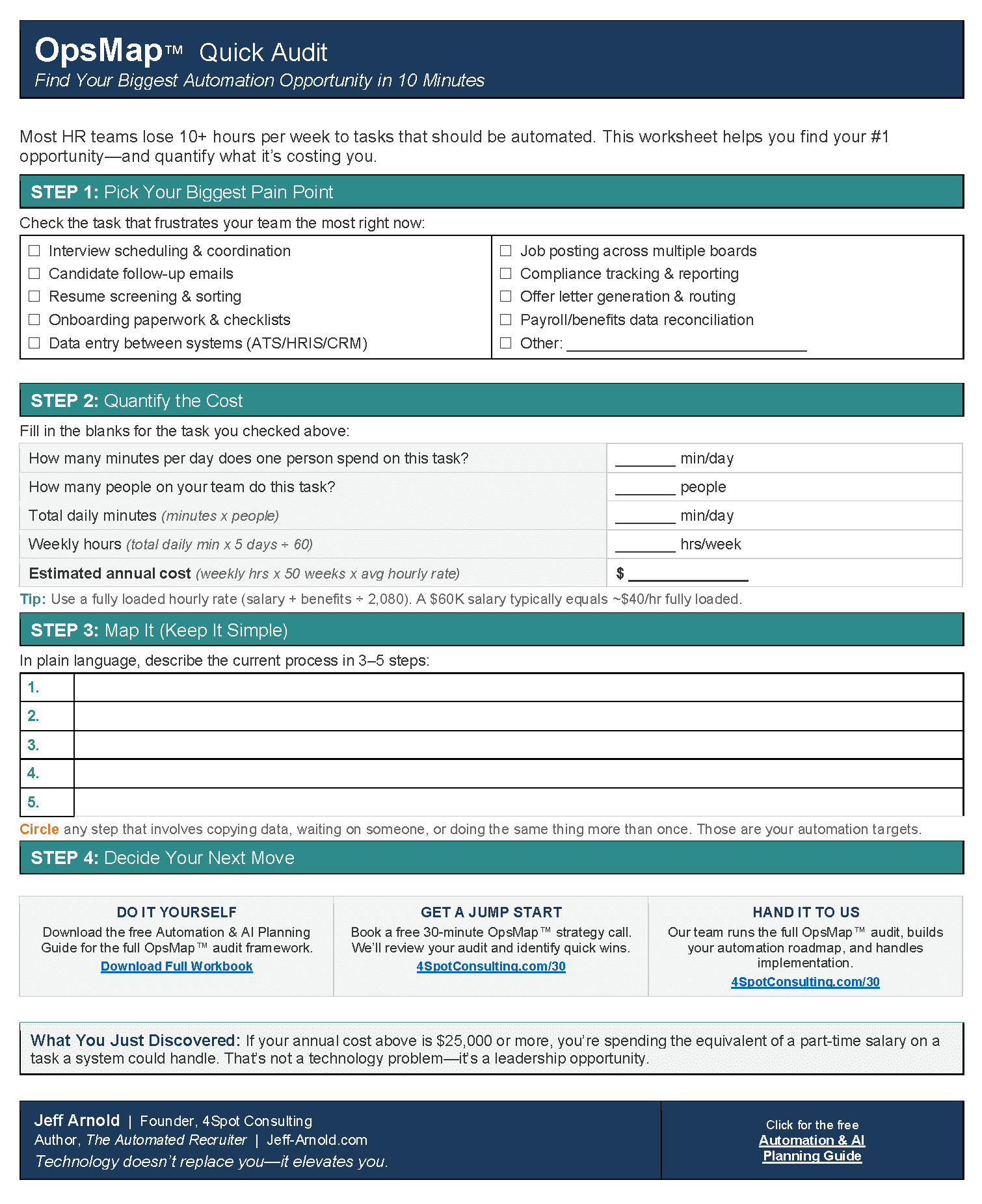
Implementing AI effectively requires a clear understanding of your current operational bottlenecks and a strategic roadmap for integration. It’s not about buying the latest AI tool; it’s about identifying specific pain points and applying targeted AI solutions that deliver measurable outcomes. Our OpsMap™ diagnostic is designed precisely for this—to uncover inefficiencies, surface automation opportunities, and roadmap profitable AI integrations tailored to your unique business needs.
If you’re ready to move beyond the AI buzz and start seeing real operational efficiencies in your HR and recruiting functions, the time to act is now. Don’t let your high-value employees be bogged down by low-value tasks any longer. The path to saving 25% of your day begins with a strategic assessment of where AI can truly make an impact.
If you would like to read more, we recommend this article: The Future of Work: How AI is Reshaping Business Operations