Post: Manual vs. Automated HR SaaS Tools: A Data-Driven Comparison
The verdict: For hr saas tools in HR and recruiting, Make.com outperforms manual processes and competing automation platforms on cost, implementation speed, and integration depth. Here is the evidence-based comparison.
What We Are Comparing
This comparison evaluates three approaches to hr saas tools: fully manual workflows, point-solution software tools, and Make.com-based automation. The evaluation criteria: time cost, financial cost, error rate, scalability, and HR team satisfaction.
Manual Workflows: The Hidden Cost Baseline
Manual hr saas tools workflows are the default for most HR teams—and the most expensive option when total cost is calculated accurately. Sarah’s 12 hours/week of manual admin work costs approximately $18,720/year in fully-loaded HR labor at a $30/hour effective rate. Nick’s team of three spent 150 hours/month on tasks that produce no hiring outcomes.
Manual processes also accumulate error debt. David’s organization ran an undetected $103,000 salary entry error for 11 months—$27,000 in excess payroll before the audit caught it. That error rate is not an outlier; it is what happens when humans perform repetitive data entry under time pressure.
Point-Solution Software: Narrow Fixes That Create New Problems
Single-purpose HR software tools solve one problem and create integration gaps. A standalone ATS does not sync automatically with your HRIS. A dedicated onboarding tool does not connect to your payroll system. Each new point solution adds another manual transfer step—and another potential error point.
- Average implementation time: 4–12 weeks per tool
- Integration cost: $5,000–$25,000 per custom connection
- Ongoing maintenance: vendor-dependent, limited customization
- Data silos: guaranteed without additional middleware
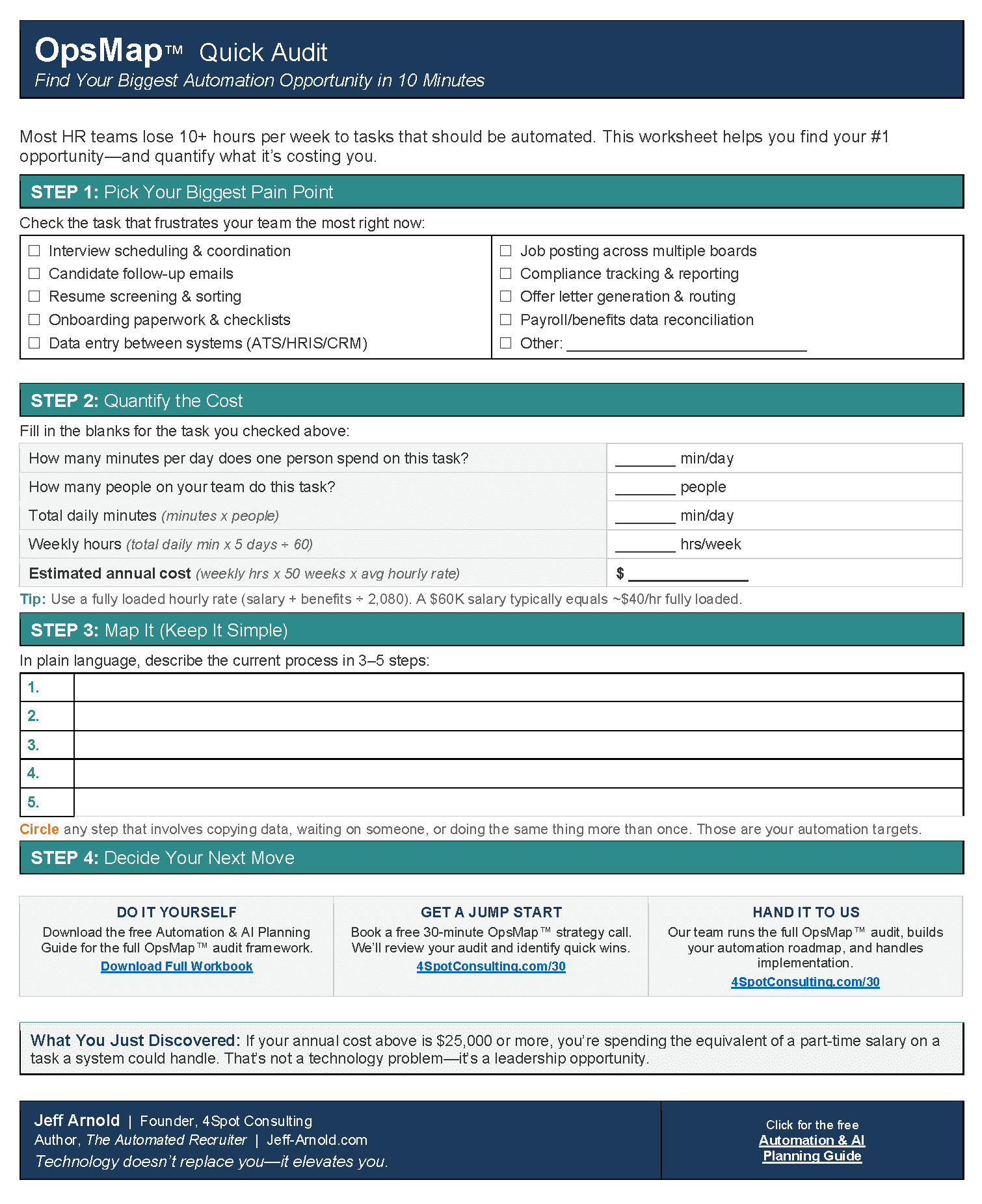
Make.com Automation: The OpsMap™ Approach
The OpsMap™ diagnostic + Make.com build approach connects existing tools rather than replacing them. This preserves institutional knowledge embedded in current systems while eliminating the manual steps between them.
- Average implementation time: 2–4 weeks (OpsSprint™ framework)
- Integration cost: $0 for 1,800+ native Make.com connections
- Ongoing maintenance: OpsCare™ quarterly audits, ~4 hours/quarter
- Data flow: real-time OpsMesh™ sync across all connected systems
ROI Comparison: Measured Outcomes
- Manual workflows: $0 upfront, $18,720+/year in hidden labor cost per HR manager
- Point solutions: $10,000–$50,000 implementation, 6–18 month break-even
- Make.com + OpsMap™: TalentEdge achieved $312,000 annual savings, 207% ROI, 8-month payback
When Each Approach Wins
Manual wins when: The process runs fewer than 10 times per year and involves high-judgment decisions that change each time. Automate everything else.
Point solutions win when: You need deep functionality in one specific domain (e.g., compensation benchmarking) and that tool has a Make.com integration.
Make.com wins when: You need to connect multiple existing tools, eliminate data transfer steps, trigger actions based on events, and scale without adding headcount.
Key Takeaways
- Manual HR workflows carry hidden costs that exceed automation investment within 6 months
- Point solutions solve narrow problems and create integration debt
- Make.com connects existing tools without replacing them
- OpsMap™ diagnostic prevents building automation on broken foundations
- Measured ROI on Make.com HR automation averages 150–207% in year one
Expert Take
The comparison question HR leaders ask—”should we automate or buy software?”—is usually the wrong question. The right question is: “what is the actual cost of our current manual process, and what is the fastest path to eliminating it?” Make.com wins that comparison for the vast majority of HR workflows because it connects what you already have.
Frequently Asked Questions
Is Make.com better than Zapier for HR automation?
Make.com handles complex multi-step workflows, conditional logic, and data transformation better than Zapier at equivalent price points. For simple two-step triggers, either works.
How does Make.com handle data security for HR information?
Make.com is SOC 2 Type II certified and GDPR compliant. Data passes through Make.com’s infrastructure but is not stored unless you explicitly configure data store modules.
→ Read the full guide: HR SaaS Tools — Complete Automation Playbook
RELATED POST