Post: Strategic HR: 7 AI-Powered Transformations in Talent Acquisition & Management
7 Ways AI is Revolutionizing Talent Acquisition and Management
The landscape of human resources and recruiting is undergoing a seismic shift, driven by the rapid advancements in Artificial Intelligence. For HR leaders, COOs, and recruitment directors, this isn’t just about adopting new tech; it’s about fundamentally rethinking how talent is attracted, assessed, hired, and managed. Traditional, manual processes, once the backbone of HR, are now bottlenecks that hinder agility, increase costs, and introduce human error. At 4Spot Consulting, we’ve seen firsthand how high-growth B2B companies struggle with these inefficiencies, losing valuable time and money. The promise of AI isn’t simply automation for automation’s sake; it’s about empowering your team to focus on strategic initiatives, enhance candidate and employee experiences, and drive measurable ROI. This article will explore seven practical applications of AI that are not just theoretical concepts but real-world solutions actively transforming talent acquisition and management for forward-thinking organizations. We’ll delve into how these AI advancements can eliminate low-value work, streamline operations, and ultimately save your business 25% of your day, freeing up your most valuable asset: your people.
1. AI-Powered Resume Screening and Shortlisting
One of the most time-consuming and often biased stages in the recruitment process is the initial screening of resumes. Traditional methods involve human recruiters sifting through hundreds, if not thousands, of applications, a task prone to fatigue, subconscious bias, and missed qualified candidates. AI-powered resume screening tools revolutionize this by automating the parsing and analysis of applications. These systems can quickly identify keywords, evaluate experience against job requirements, and even predict candidate success based on predefined criteria, significantly reducing the initial candidate pool to a highly relevant shortlist. For instance, using platforms like Make.com, we can integrate an AI parser that extracts critical data points from resumes, enriches candidate profiles with publicly available information, and automatically scores them based on custom algorithms tied to your specific hiring needs. This not only saves hundreds of hours of manual review but also promotes objectivity by focusing purely on qualifications rather than subjective interpretations. The result? Recruiters receive a filtered list of top-tier candidates, allowing them to dedicate their valuable time to engaging with prospects who are truly a good fit, rather than sifting through endless stacks of digital paper. We’ve helped clients save over 150 hours per month by automating this very process, directly translating into faster hires and reduced operational costs.
2. Intelligent Chatbots and Virtual Assistants for Candidate Engagement
The candidate experience is paramount in today’s competitive talent market. Slow response times, lack of clarity, and generic communication can quickly deter top talent. AI-driven chatbots and virtual assistants offer a powerful solution to maintain continuous, personalized engagement with candidates throughout their journey. These bots can answer frequently asked questions about job roles, company culture, benefits, and application status 24/7, providing instant support that human recruiters simply cannot. They can also qualify candidates by asking a series of predetermined questions, schedule interviews, and even send automated reminders. Integrating a tool like Bland AI or a custom-built chatbot via Make.com allows for seamless communication across multiple channels, from your career page to social media platforms. Imagine a candidate inquiring about a position at 10 PM; a virtual assistant can immediately provide relevant information or guide them through the initial application steps, preventing them from moving on to a competitor who offers instant gratification. This not only enhances the candidate experience by providing immediate answers and a sense of responsiveness but also frees up recruiters from repetitive administrative tasks, allowing them to focus on high-value interactions and relationship building with promising candidates.
3. Predictive Analytics for Turnover Reduction and Workforce Planning
High employee turnover is a significant drain on resources, impacting productivity, morale, and the bottom line. AI is proving to be an invaluable asset in predicting potential turnover and informing proactive workforce planning strategies. By analyzing vast datasets—including employee performance, engagement survey results, compensation trends, and historical turnover data—AI algorithms can identify patterns and predict which employees are at risk of leaving. This predictive capability allows HR departments to intervene early with targeted retention strategies, such as personalized development plans, mentorship programs, or compensation adjustments, before it’s too late. Furthermore, AI helps in strategic workforce planning by forecasting future talent needs based on business growth projections, market trends, and internal skills gaps. Instead of relying on reactive hiring, organizations can use AI to anticipate demands for specific skills, identify internal talent for upskilling, or initiate proactive recruitment drives. This data-driven approach, often facilitated by robust CRM and data backup systems like those 4Spot Consulting implements with Keap or HighLevel, ensures that your talent pipeline is always aligned with your strategic objectives, reducing the costly cycle of constant reactive hiring and retraining.
4. AI-Enhanced Employee Onboarding and Training Personalization
The first few weeks and months are critical for new hires. A poor onboarding experience can lead to early attrition, while an effective one significantly boosts engagement and long-term retention. AI can personalize and streamline the entire onboarding journey, making it more efficient and impactful. AI-powered platforms can deliver tailored training modules based on the employee’s role, background, and learning style, identifying knowledge gaps and recommending relevant resources. For example, a new sales rep might receive targeted training on CRM usage and sales methodologies, while an engineer gets a deeper dive into specific coding standards or project management tools. Beyond training, AI can automate administrative onboarding tasks, ensuring all necessary documents are completed and submitted, IT access is granted, and initial meet-and-greets are scheduled. This reduces the administrative burden on HR and managers, allowing them to focus on the human aspects of integration. Moreover, AI can monitor new hire progress, identify early signs of disengagement, and trigger interventions, such as a check-in from their manager or a mentor. This proactive, personalized approach, often orchestrated through automation platforms like Make.com, creates a more supportive and efficient start for every employee, accelerating their time to productivity and fostering a stronger sense of belonging from day one.
5. Automated Payroll and Benefits Administration
While often seen as a back-office function, payroll and benefits administration are central to employee satisfaction and compliance. Manual processing in these areas is notoriously error-prone, time-consuming, and carries significant risk. AI and automation, when applied correctly, can virtually eliminate these headaches. AI-powered systems can integrate with time-tracking software, HRIS, and benefits providers to automatically calculate wages, deductions, taxes, and benefits contributions with unparalleled accuracy. They can also flag anomalies or potential compliance issues before they become problems. For example, a system could automatically detect an usual spike in overtime for a particular department and alert management, or ensure that all regulatory reporting requirements are met without manual data entry. Beyond pure calculation, AI can help employees navigate their benefits options by providing interactive guides and personalized recommendations based on their life stage and preferences. At 4Spot Consulting, we specialize in building these types of interconnected systems using tools like Make.com to ensure a single source of truth for all employee data, reducing human error, eliminating duplicate data entry, and freeing up HR teams from mountains of paperwork. This translates directly into improved compliance, significant cost savings, and happier employees who receive accurate and timely compensation and benefits.
6. AI for Performance Management and Employee Development
Performance reviews can often feel subjective, arduous, and backward-looking. AI offers a path to more objective, continuous, and forward-looking performance management. AI tools can analyze various data points, including project contributions, peer feedback, communication patterns, and skill development activities, to provide a more holistic and unbiased view of employee performance. This allows for continuous feedback loops rather than sporadic annual reviews. AI can also identify skill gaps across the organization and recommend personalized learning paths or training programs for individual employees to foster growth and align with future business needs. For high-growth companies, this means cultivating a more agile and skilled workforce. Imagine an AI system identifying that a certain employee consistently excels in cross-functional collaboration but needs development in a specific technical area; the system could then recommend tailored courses or internal mentorship opportunities. This not only empowers employees to take ownership of their development but also provides managers with data-driven insights to coach more effectively. By automating data aggregation and analysis, HR can shift from administrative burden to strategic partner in fostering a culture of continuous improvement and talent optimization, directly contributing to the scalability and success of the organization.
7. Enhancing DEI Initiatives with AI-Powered Insights
Diversity, Equity, and Inclusion (DEI) are no longer just buzzwords but critical components of a successful, innovative, and resilient organization. AI can play a crucial role in advancing DEI initiatives by identifying unconscious biases and providing data-driven insights. From scrutinizing job descriptions for biased language that might deter certain demographic groups to analyzing hiring patterns and promotion rates, AI can uncover systemic biases that might otherwise go unnoticed. For example, an AI tool can analyze the language in job postings to ensure it’s inclusive and appealing to a broad range of candidates, or audit resume screening processes to ensure fairness. Furthermore, AI can help track and report on DEI metrics, providing real-time data on workforce composition, pay equity, and representation at various levels of the organization. This allows HR leaders to move beyond anecdotal evidence and make informed, data-backed decisions to create a truly equitable workplace. At 4Spot Consulting, we emphasize establishing a “single source of truth” for all HR data, which is essential for accurate DEI reporting and analysis. By leveraging AI to continuously monitor and improve DEI efforts, companies can build more diverse teams, foster a more inclusive culture, and ultimately drive better business outcomes, proving that technology can be a powerful ally in creating a fair and equitable environment.
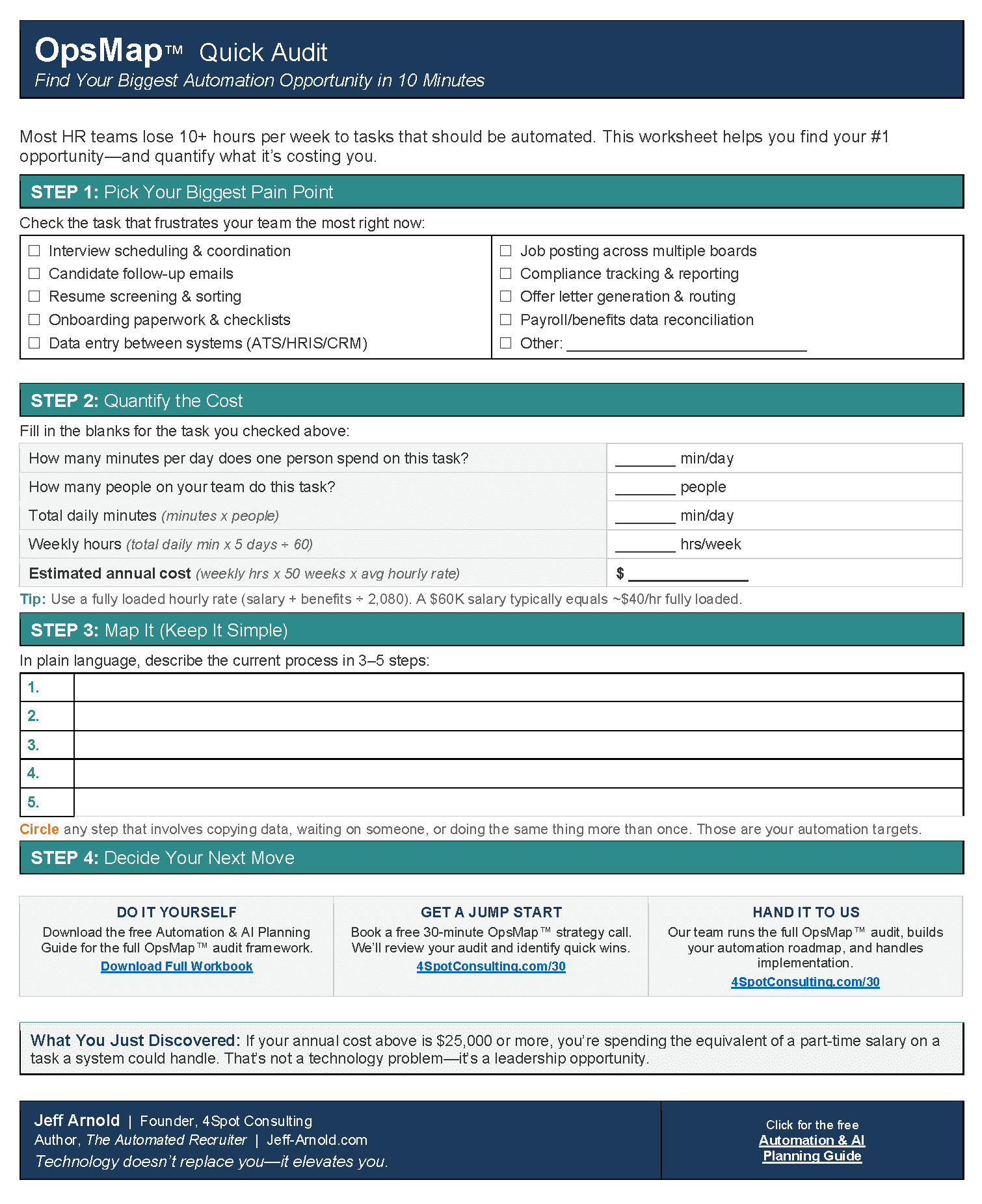
The integration of AI into HR and recruiting is not a futuristic concept; it is a present-day imperative for organizations aiming for sustained growth and efficiency. From automating tedious administrative tasks to providing predictive insights and fostering more equitable workplaces, AI offers unprecedented opportunities to transform how we attract, develop, and retain talent. For HR leaders, COOs, and recruitment directors, embracing these technologies means moving beyond reactive firefighting to becoming strategic architects of their workforce. The benefits are clear: reduced operational costs, elimination of human error, enhanced scalability, and a significant boost in employee and candidate experience. At 4Spot Consulting, we specialize in helping high-growth B2B companies strategically implement these AI and automation solutions, often saving them 25% of their day. Our OpsMap™ framework is designed to identify precisely where AI can deliver the most impactful ROI within your unique HR and recruiting operations. Don’t let your business be bogged down by outdated processes; leverage AI to unlock your team’s full potential and secure your competitive edge in the war for talent.
If you would like to read more, we recommend this article: The OpsMesh Framework: Revolutionizing Your Business Operations

RELATED POST