Post: AI-Powered Recruitment Operations: Scaling Talent Acquisition Beyond ATS
Beyond Applicant Tracking: AI’s Role in Modernizing Recruitment Operations
For decades, the Applicant Tracking System (ATS) has been the cornerstone of recruitment, a necessary evil for managing the deluge of applications and tracking candidate progress. Yet, in today’s fiercely competitive talent landscape, relying solely on an ATS often feels like bringing a knife to a gunfight. Businesses striving for high growth and operational excellence recognize that finding and securing top talent requires more than just tracking; it demands a strategic, agile, and deeply integrated operational approach. This is where AI moves beyond simple applicant tracking to truly modernize and optimize the entire recruitment ecosystem.
Many organizations find themselves trapped in a cycle of manual administrative tasks that bog down their recruitment teams. The sheer volume of applications, the back-and-forth of interview scheduling, the inconsistent candidate communication, and the painful process of data entry across disparate systems collectively drain valuable time and resources. Recruiters, who should be strategic talent advisors, often spend a disproportionate amount of their day on low-value, repetitive work. This not only leads to burnout but also significantly delays time-to-hire, increases costs, and can result in a suboptimal candidate experience, ultimately damaging an employer’s brand.
The Operational Bottlenecks Traditional Recruitment Systems Can’t Solve
While an ATS is effective at centralizing applications, it often falls short in automating the intricate workflows that surround the core tracking function. Consider the lifecycle of a candidate: from initial application and screening, through multiple interview rounds, reference checks, offer generation, and finally, onboarding. Each stage is rife with opportunities for manual error, communication gaps, and delays. Data doesn’t flow seamlessly between the ATS, calendaring tools, CRM, HRIS, and other vital business systems, creating fragmented candidate profiles and requiring endless manual updates.
This operational friction is precisely what prevents businesses from scaling their recruitment efforts efficiently. It’s not just about managing candidates; it’s about managing the entire operational overhead that surrounds the talent acquisition process. Companies spend fortunes on technology, only to find their teams are still mired in administrative quicksand. The challenge isn’t just a lack of candidates, but a lack of systemic efficiency that allows high-value recruiters to focus on what they do best: connecting with people and building relationships.
AI as the Catalyst for Operational Transformation in Talent Acquisition
Artificial intelligence, when strategically integrated, acts as the ultimate force multiplier for recruitment operations. It’s not about replacing human judgment but about augmenting it, automating the mundane, and providing insights previously unattainable. AI frees up recruitment professionals to engage in strategic initiatives, relationship building, and critical decision-making.
Intelligent Sourcing and Screening
Beyond simple keyword matching, AI-powered tools can analyze vast amounts of data from resumes, social profiles, and public databases to identify candidates who not only possess the required skills but also align with company culture and values. AI can intelligently screen applications, pre-qualify candidates based on custom criteria, and even predict potential fit, significantly reducing the manual review burden and surfacing hidden gems that might otherwise be overlooked by traditional methods.
Streamlined Candidate Engagement and Experience
Candidate experience is paramount in today’s market. AI chatbots can provide instant answers to frequently asked questions, guide candidates through the application process, and even conduct initial screening conversations, all available 24/7. Personalized, automated communication ensures candidates feel valued and informed at every stage, from initial application acknowledgment to post-interview follow-ups. This dramatically reduces ghosting, improves brand perception, and ensures no promising candidate falls through the cracks due to slow human response times.
Automating the Interview and Onboarding Workflow
Scheduling interviews is notoriously time-consuming. AI-driven scheduling tools integrate with calendars, automatically finding optimal times, sending invitations, and issuing reminders, eliminating endless email chains. Furthermore, AI can automate the generation of offer letters, contracts, and pre-onboarding documents, pre-populating information and routing for e-signatures. Integrating these workflows with an HRIS ensures a smooth transition from candidate to new hire, setting the stage for a positive employee experience from day one.
Data-Driven Insights and Continuous Improvement
AI’s analytical capabilities provide recruitment leaders with unprecedented insights. From identifying patterns in successful hires to predicting time-to-hire for specific roles or uncovering potential biases in the hiring process, AI transforms raw data into actionable intelligence. This allows for continuous optimization of recruitment strategies, resource allocation, and overall operational efficiency, moving from reactive hiring to proactive talent acquisition.
The 4Spot Consulting Approach: Integrating AI for Tangible ROI
At 4Spot Consulting, we understand that integrating AI into your recruitment operations isn’t just about adopting new tech; it’s about strategic transformation. Our OpsMesh framework ensures that AI solutions are woven seamlessly into your existing systems, eliminating human error, reducing operational costs, and increasing scalability. We don’t just implement tools; we build intelligent operational infrastructures that save you 25% of your day.
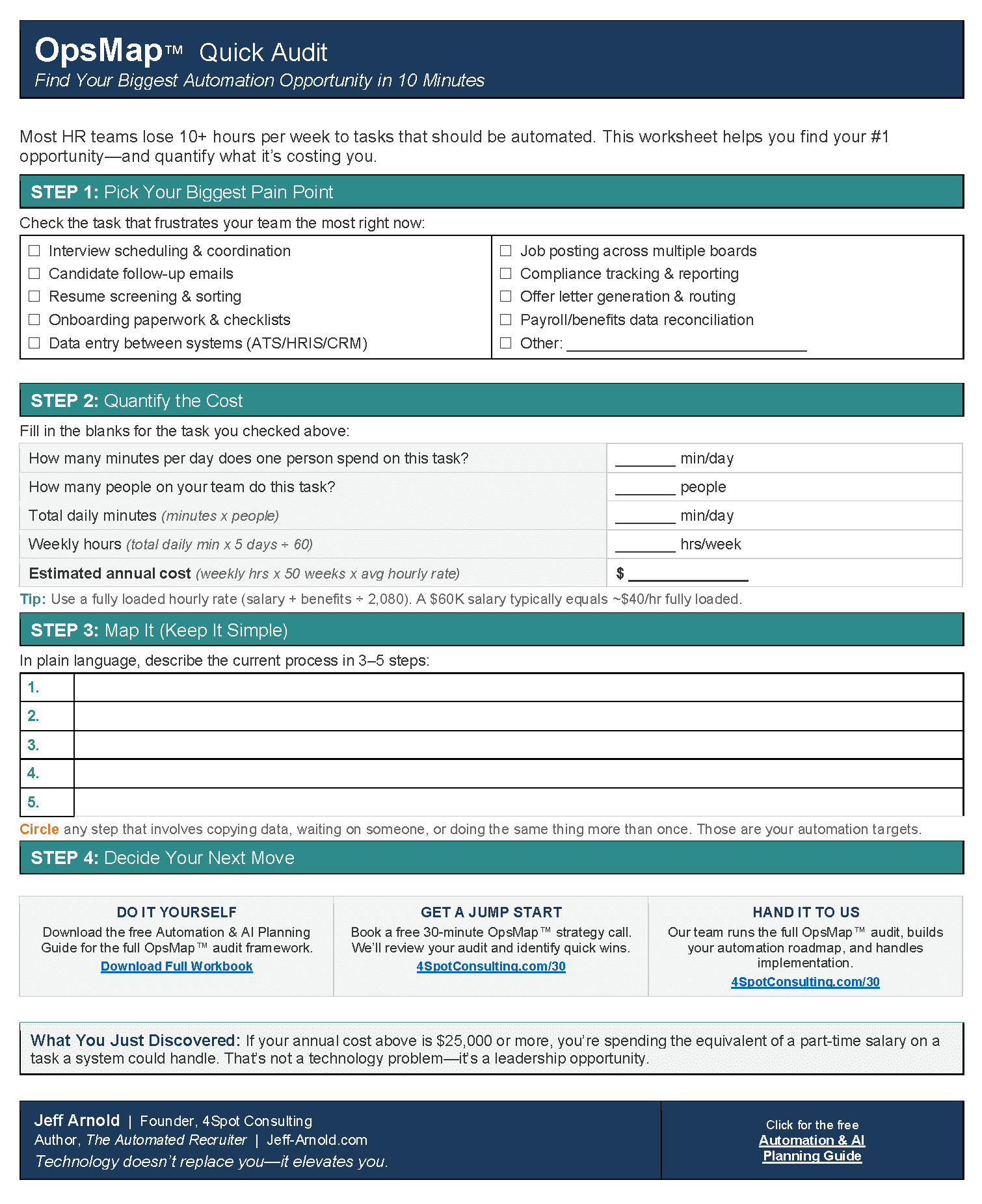
Through our OpsMap™ diagnostic, we meticulously audit your current recruitment processes to uncover inefficiencies and pinpoint the exact opportunities where AI and automation will deliver the highest ROI. Then, with OpsBuild, we implement tailored solutions using leading platforms like Make.com, connecting your ATS, CRM, HRIS, and other systems to create a unified, intelligent workflow. The result is a recruitment operation that is faster, smarter, and more profitable, allowing your high-value employees to focus on strategic talent acquisition rather than administrative overhead. This is about making your recruitment function a true competitive advantage, not just a cost center.
If you would like to read more, we recommend this article: The Automated Enterprise: Unlocking Efficiency with AI & Automation