Post: Unlock Strategic Potential: Automating HR & Operations for High-Value Work
Liberating Strategic Talent: Automating Low-Value Work in HR and Operations
In today’s competitive landscape, every organization faces the relentless pressure to do more with less. Yet, a pervasive inefficiency continues to plague even the most forward-thinking companies: highly compensated, strategic employees routinely dedicating significant portions of their day to mundane, repetitive, and low-value administrative tasks. This isn’t just a minor inconvenience; it’s a profound drag on productivity, innovation, and ultimately, profitability. At 4Spot Consulting, we believe that the true differentiator for scaling businesses lies not just in hiring top talent, but in empowering that talent to focus on the work that genuinely matters.
Consider the HR department, a critical hub of any organization. Recruitment managers spend hours sifting through resumes, scheduling interviews, and sending follow-up emails. Operations leaders manually reconciling data across disparate systems or chasing approvals. These tasks, while necessary, are prime candidates for automation. When these activities consume the time of individuals whose expertise lies in strategic planning, talent development, or critical decision-making, the organization bleeds potential. The cost isn’t just in wasted salaries; it’s in missed opportunities, delayed initiatives, and a workforce stretched thin by operational friction.
The Hidden Costs of Unautomated Operations
The impact of unautomated, low-value work extends far beyond simple time loss. It manifests as a cascade of negative effects:
- Reduced Employee Engagement: Talented professionals are hired for their intellect and problem-solving skills, not their ability to perform data entry. Monotonous work leads to burnout and disengagement, driving down morale and increasing turnover.
- Increased Human Error: Repetitive manual tasks are inherently prone to mistakes. A single typo in a contract, an overlooked detail in a compliance document, or an incorrect data transfer can lead to significant financial or reputational damage.
- Stagnated Growth: When key personnel are bogged down, the capacity for innovation and strategic expansion diminishes. New initiatives are slow to launch, market opportunities are missed, and the business struggles to adapt at the pace required by modern markets.
- Scalability Challenges: Growth often means more of the same low-value tasks. Without automation, scaling operations simply multiplies the problem, demanding ever-increasing headcount for administrative functions rather than strategic roles.
Unlocking Potential: The Automation Imperative
The solution isn’t to eliminate these tasks, but to redefine how they are handled. This is where the strategic application of automation and AI comes into play. By leveraging platforms like Make.com, integrated with core business systems such as Keap or HighLevel, 4Spot Consulting crafts bespoke solutions that systematically identify and eliminate these low-value bottlenecks. Our approach is not about technology for technology’s sake; it’s about connecting every automation to a tangible ROI and a clear business outcome.
For instance, in HR and recruiting, imagine a system where:
- Incoming resumes are automatically parsed, enriched with AI insights, and categorized.
- Initial screening questions are automated, with qualified candidates seamlessly advanced to the next stage.
- Interview scheduling is handled autonomously, syncing with calendars and sending timely reminders.
- Onboarding documentation is generated and distributed without manual intervention, ensuring compliance and a smooth new-hire experience.
This isn’t futuristic speculation; these are the types of systems we implement daily. We’ve seen an HR tech client save over 150 hours per month by automating their resume intake and parsing process, then syncing to Keap CRM. This directly translates to significant cost savings, faster hiring cycles, and the ability for their team to focus on candidate engagement and strategic talent acquisition, not administrative drudgery. This shift liberates high-value employees to perform the high-value work they were hired to do, ultimately driving a more productive and profitable enterprise.
The 4Spot Consulting Difference: A Strategic-First Approach
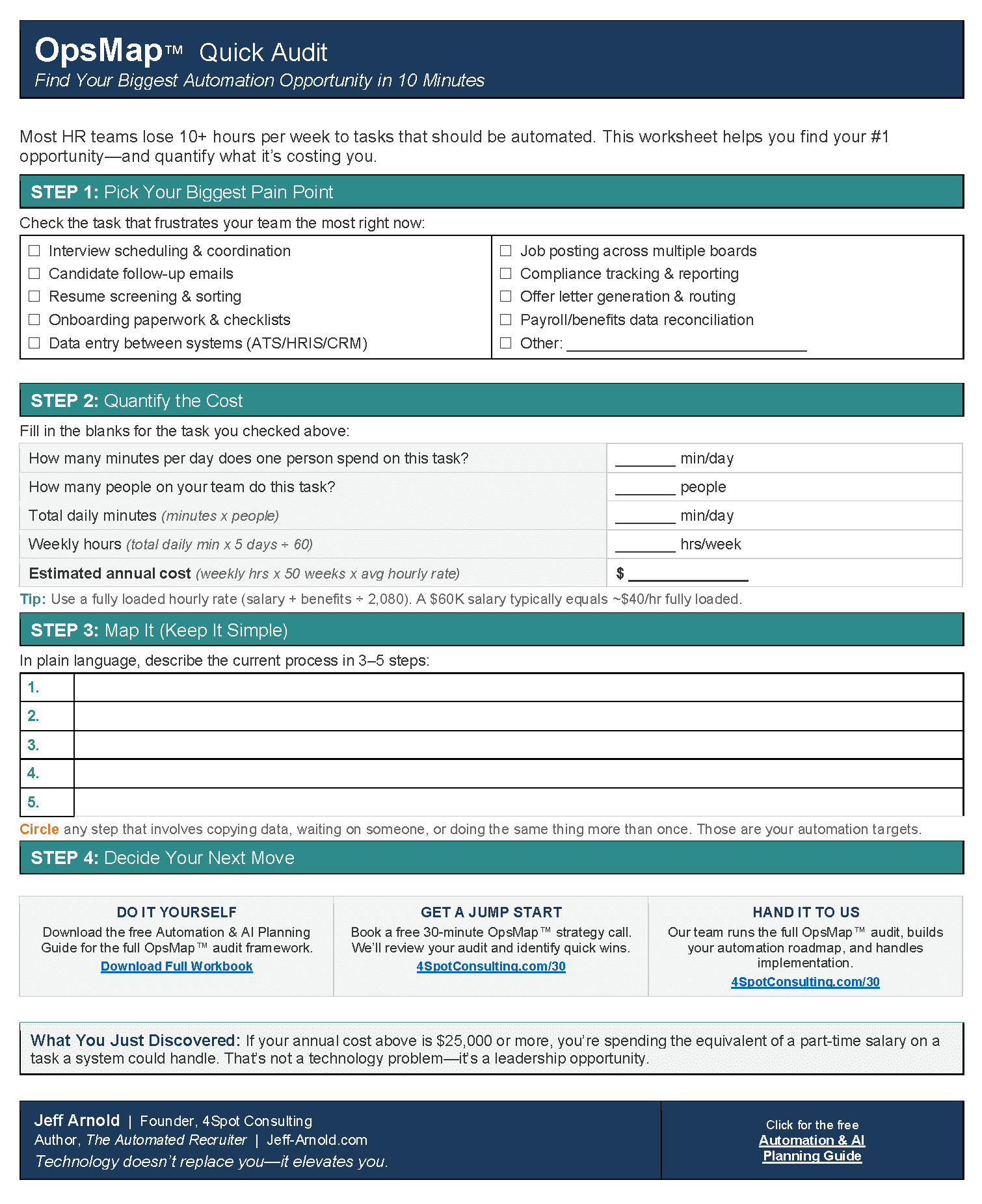
Many businesses recognize the need for automation but struggle with implementation. They might try point solutions or grapple with complex integrations that fail to deliver cohesive results. Our OpsMesh framework is designed to overcome these challenges by providing a holistic, strategic roadmap. We begin with an OpsMap, a diagnostic audit that uncovers specific inefficiencies and identifies the most impactful automation opportunities within your unique operational landscape. This ensures that every automation built during our OpsBuild phase is purposeful, integrated, and directly contributes to your strategic objectives.
We operate from a position of deep experience, understanding that true business transformation comes from a thoughtful integration of process, people, and technology. We don’t just build systems; we architect solutions that eliminate human error, reduce operational costs, and build the foundation for scalable growth. Our commitment extends beyond implementation, with OpsCare providing ongoing support and optimization, ensuring your automation infrastructure evolves with your business needs.
The time for allowing high-value employees to be burdened by low-value tasks is over. The competitive edge belongs to those who strategically leverage automation to empower their teams and unlock their full potential. It’s about saving you 25% of your day, not just for a single employee, but across your entire organization.
If you would like to read more, we recommend this article: The Strategic Imperative: Why Automation is No Longer Optional for Business Growth