Post: **AI for HR: Revolutionizing Candidate Screening & Onboarding**
The AI Advantage: Transforming Candidate Screening and Onboarding for Modern HR
In today’s competitive talent landscape, the stakes for efficient and effective HR operations have never been higher. Business leaders are constantly seeking ways to not just fill roles, but to attract, assess, and integrate top-tier talent with unprecedented speed and accuracy. The traditional methods, often mired in manual data entry, subjective reviews, and fragmented communication, are simply not built for the demands of high-growth B2B companies. This is where artificial intelligence, integrated strategically into the HR lifecycle, isn’t just an advantage—it’s a necessity.
Beyond Keywords: The Evolution of Candidate Screening
For decades, candidate screening has been a tedious, often biased, bottleneck in the recruitment process. Recruiters spend countless hours sifting through mountains of resumes, searching for specific keywords or qualifications that may or may not truly reflect a candidate’s potential. This approach frequently leads to missed opportunities with exceptional candidates whose profiles don’t perfectly match a rigid template, or conversely, wastes time on candidates who look good on paper but lack essential soft skills or cultural fit.
AI transforms this fundamental step. Instead of simple keyword matching, advanced AI models can analyze resumes, cover letters, and even public professional profiles to identify patterns, evaluate experience alignment, and predict job performance with greater nuance. These systems can go beyond explicit skills to infer capabilities, learning agility, and problem-solving approaches by analyzing textual context and past success indicators. This dramatically reduces the initial screening time, allowing human recruiters to focus on deeper engagement with a more qualified, pre-vetted pool of candidates.
Furthermore, AI-powered tools can standardize the initial assessment process, minimizing unconscious bias that can creep in during manual reviews. By focusing on objective data points and performance predictors, organizations can foster a more equitable and diverse hiring environment. It’s not about replacing the human element but augmenting it, ensuring that every candidate receives a fair and thorough initial evaluation, and every recruiter’s time is maximized for strategic interaction rather than administrative burden.
Streamlining Onboarding: From Paperwork to Productivity
The journey from candidate to productive employee is fraught with administrative hurdles. New hires often face a deluge of paperwork, mandatory training modules, and an overwhelming amount of information to absorb, all before they can even begin contributing meaningfully. This disjointed experience can lead to early disengagement, reduced productivity, and even higher attrition rates within the critical first few months.
AI and automation fundamentally reshape the onboarding experience, transforming it from a bureaucratic obstacle course into a smooth, engaging pathway to productivity. Imagine a scenario where, upon accepting an offer, a new hire immediately receives personalized access to a portal that intelligently guides them through necessary documentation, connects them with their team, and provides tailored learning paths based on their role and prior experience. This isn’t science fiction; it’s the reality enabled by AI-driven automation.
Systems can automatically trigger HRIS updates, payroll setup, IT provisioning, and even allocate necessary software licenses or equipment. AI-powered chatbots can answer common new hire questions 24/7, freeing up HR staff to handle more complex, human-centric issues. Moreover, these systems can monitor a new hire’s progress through their onboarding journey, flagging potential issues or offering timely support, ensuring a consistent and supportive experience for everyone.
The Strategic Imperative: Integrating AI for Tangible ROI
For organizations operating at scale, where every minute and every dollar counts, the strategic integration of AI into HR operations isn’t merely about technological adoption—it’s about achieving measurable ROI. Eliminating manual errors in data entry, drastically reducing time-to-hire, and improving new hire retention directly impact the bottom line. Our OpsMesh™ framework at 4Spot Consulting provides a holistic approach to understanding where these automation and AI opportunities lie within your business, especially in critical areas like HR and recruiting.
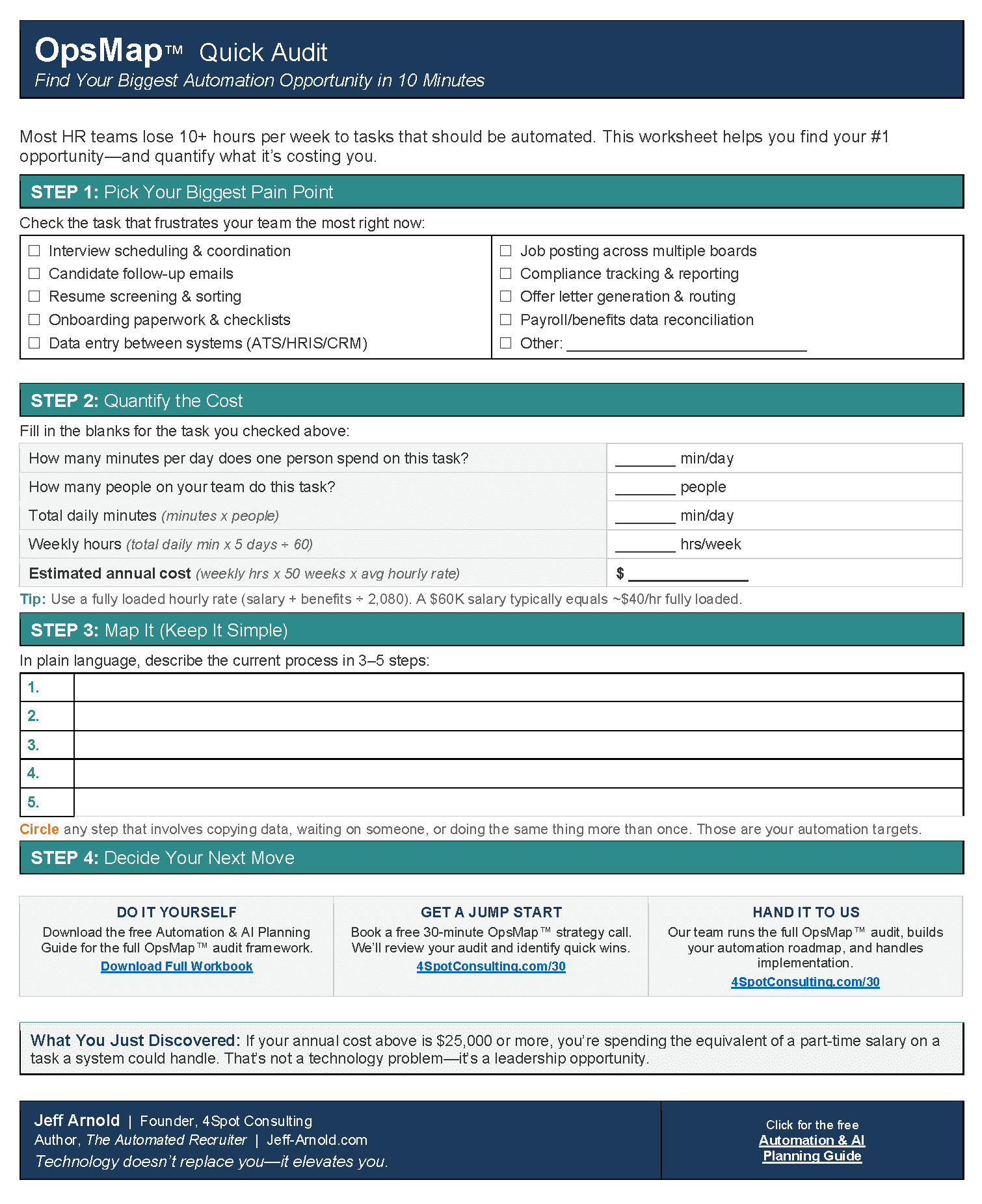
Through our OpsMap™ strategic audit, we pinpoint inefficiencies and map out a bespoke strategy for implementing AI and automation solutions. This isn’t just about deploying a new tool; it’s about re-engineering processes to create a single source of truth for talent data, reduce low-value work for high-value employees, and ensure your HR systems are not just reactive but predictive and proactive. We’ve seen firsthand how an HR tech client saved over 150 hours per month by automating their resume intake and parsing process using Make.com and AI enrichment, syncing crucial data directly into Keap CRM. This is the power of strategic automation: moving from drowning in manual work to having a system that just works.
The AI advantage in candidate screening and onboarding is clear: faster talent acquisition, reduced operational costs, enhanced candidate experience, and ultimately, a more scalable and resilient workforce. It allows business leaders to focus on strategic growth, knowing that their core operational systems are optimized and humming.
If you would like to read more, we recommend this article: The Future of Recruitment Automation: Beyond Basic ATS
RELATED POST