Post: Manual HR’s Silent Drain: The Automation Imperative for B2B Growth
The Unseen Costs of Manual HR: Why Automation Isn’t Just for Tech Giants
In the bustling world of high-growth B2B companies, the focus often gravitates towards sales figures, marketing reach, and product innovation. Yet, lurking beneath the surface of seemingly efficient operations, especially within Human Resources and recruiting, are unseen costs that silently erode profitability and stifle scalability. Many business leaders, particularly those outside the tech sector, mistakenly believe that sophisticated automation is a luxury reserved for Silicon Valley behemoths. This perspective, however, overlooks a critical truth: the very manual processes intended to keep things running often become the most significant drain on resources, regardless of company size.
At 4Spot Consulting, we speak directly to leaders who value time and outcomes. We’ve witnessed firsthand how even a seemingly minor manual task, when multiplied across a growing workforce or an active recruitment pipeline, can balloon into hundreds of lost hours, significant financial leakage, and a bottleneck that chokes potential. The real cost isn’t just the salary of the person performing the task; it’s the opportunity cost of what that high-value employee isn’t doing, the errors introduced, and the delay in critical business functions.
Beyond Payroll: The True Burden of Manual Processes
Consider the typical HR department or recruiting function. From initial candidate screening and interview scheduling to onboarding paperwork, benefits administration, and ongoing employee data management, the sheer volume of repetitive, often mundane, tasks is staggering. Each piece of information entered by hand, every email sent to coordinate schedules, and every document manually filed presents an opportunity for human error and a direct expenditure of valuable time.
This isn’t just about administrative overhead. These manual processes create a ripple effect. A delayed offer letter can mean losing a top candidate to a competitor. An incorrectly entered detail in an HR system can lead to compliance issues or payroll discrepancies. Over time, these inefficiencies don’t just slow things down; they actively diminish your company’s capacity to grow, innovate, and adapt. Your most talented people, hired for their strategic thinking and problem-solving abilities, find themselves bogged down in low-value, high-volume administrative chores.
The Ripple Effect on Productivity and Morale
When high-value employees are consistently engaged in low-value work, several critical business aspects suffer. Firstly, productivity plummets. Instead of focusing on strategic initiatives like talent development, employee engagement, or workforce planning, HR teams are perpetually playing catch-up with administrative tasks. Secondly, employee morale takes a hit. Repetitive tasks are demotivating and can lead to burnout, increasing turnover rates within HR and recruiting departments themselves. This creates a vicious cycle where a depleted, overworked team struggles even more with manual loads.
Furthermore, manual data handling often results in fragmented information across disparate systems—spreadsheets, emails, standalone HR platforms. This lack of a “single source of truth” means critical business decisions are made on incomplete or outdated data, impacting everything from headcount planning to performance reviews and compliance reporting. The hidden cost here is a reduction in agility and an increase in risk.
From Reactive to Strategic: Reclaiming HR’s Core Purpose
The solution isn’t to simply hire more administrative staff. That merely throws more money at the symptom, not the root cause. The real solution lies in strategic automation, transforming HR and recruiting from reactive, administrative functions into proactive, strategic partners in business growth. By automating the repetitive, rule-based tasks, organizations can free up their human capital to focus on what truly requires human intellect and empathy: relationship building, strategic planning, complex problem-solving, and fostering a thriving company culture.
Identifying Automation Opportunities in HR & Recruiting
Where do you begin? Opportunities for automation are abundant:
- **Candidate Screening & Communication:** Automate initial resume parsing, send automated interview invitations, and manage candidate follow-ups.
- **Onboarding Workflows:** Digitally streamline new hire paperwork, IT provisioning requests, and welcome communications.
- **Employee Lifecycle Management:** Automate reminders for performance reviews, benefits enrollment, and policy acknowledgements.
- **Data Synchronization:** Connect your Applicant Tracking System (ATS) with your HRIS and CRM to ensure seamless data flow and eliminate manual re-entry.
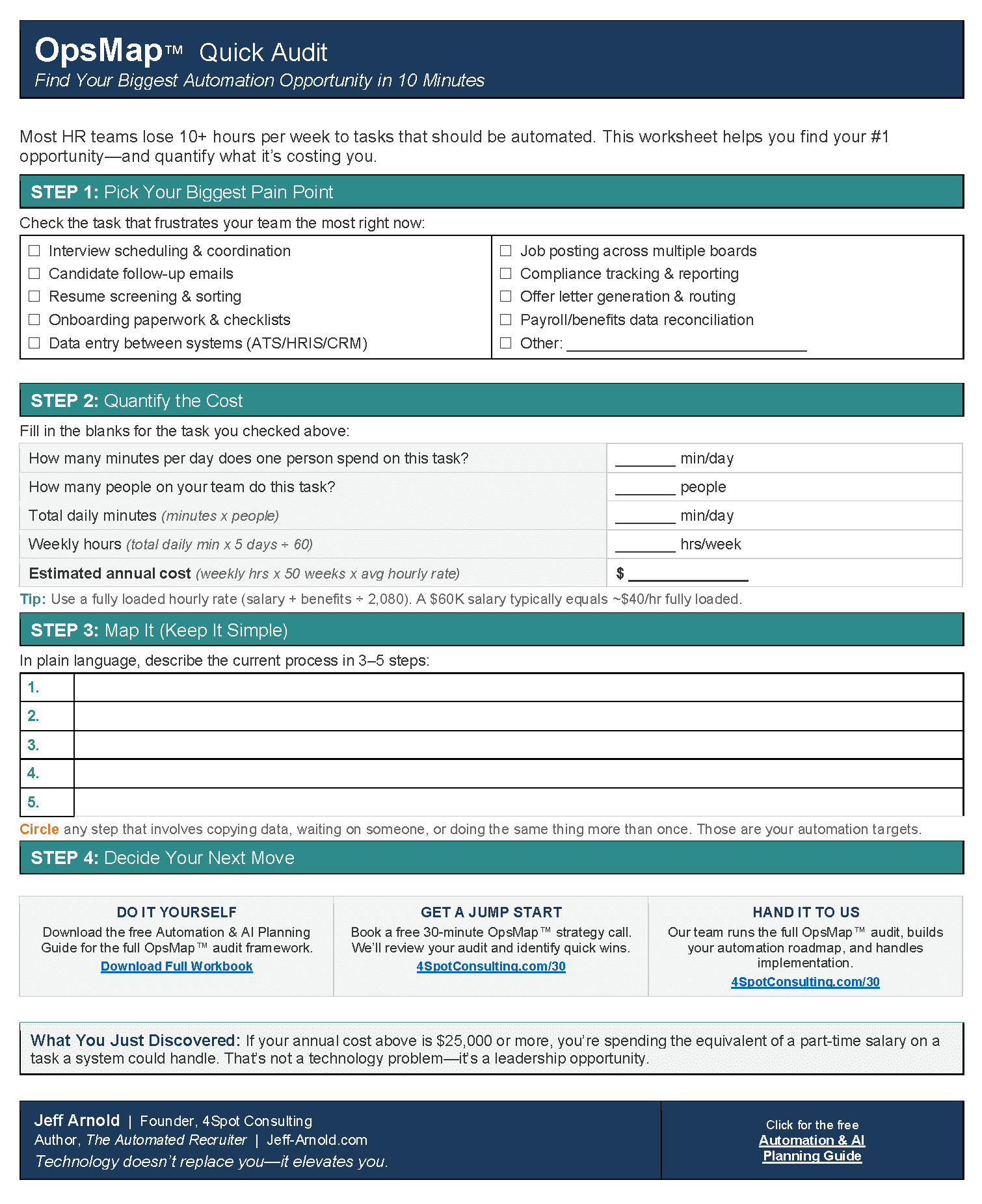
This is precisely where our OpsMap™ diagnostic comes into play. It’s a strategic audit designed to uncover these inefficiencies, surface tangible automation opportunities, and roadmap profitable automations specific to your business context.
4Spot Consulting’s Approach: Strategic Automation for Real-World Impact
At 4Spot Consulting, we don’t just build automations; we engineer solutions that drive measurable business outcomes. Our OpsMesh framework ensures that all your systems are integrated, creating a robust, scalable infrastructure where data flows effortlessly, and human error is minimized. We are experts in connecting dozens of SaaS systems, transforming fragmented operations into a cohesive, automated ecosystem.
We’ve seen clients, like an HR tech firm, save over 150 hours per month by automating their resume intake and parsing process using Make.com and AI enrichment, then syncing this critical data directly into their Keap CRM. This wasn’t about cutting corners; it was about empowering their team to focus on candidate engagement and strategic talent acquisition, rather than being bogged down in manual data entry. The quote from their leadership sums it up perfectly: “We went from drowning in manual work to having a system that just works.”
Building a Future-Proof HR Operation
Implementing automation is not a one-time fix; it’s an ongoing journey of optimization and iteration. Our OpsCare service provides the continuous support and refinement needed to ensure your automation infrastructure remains robust, adaptable, and aligned with your evolving business needs. We eliminate the low-value work from your high-value employees, allowing them to truly contribute to the bottom line.
By investing in intelligent automation, businesses can transcend the limitations of manual HR, not only eliminating unseen costs but also building an operation that is more agile, accurate, and ultimately, more scalable. This isn’t just about efficiency; it’s about unlocking your company’s full potential.
Ready to uncover automation opportunities that could save you 25% of your day? Book your OpsMap™ call today.
If you would like to read more, we recommend this article: Mastering HR & Recruiting Automation for Modern Business Growth