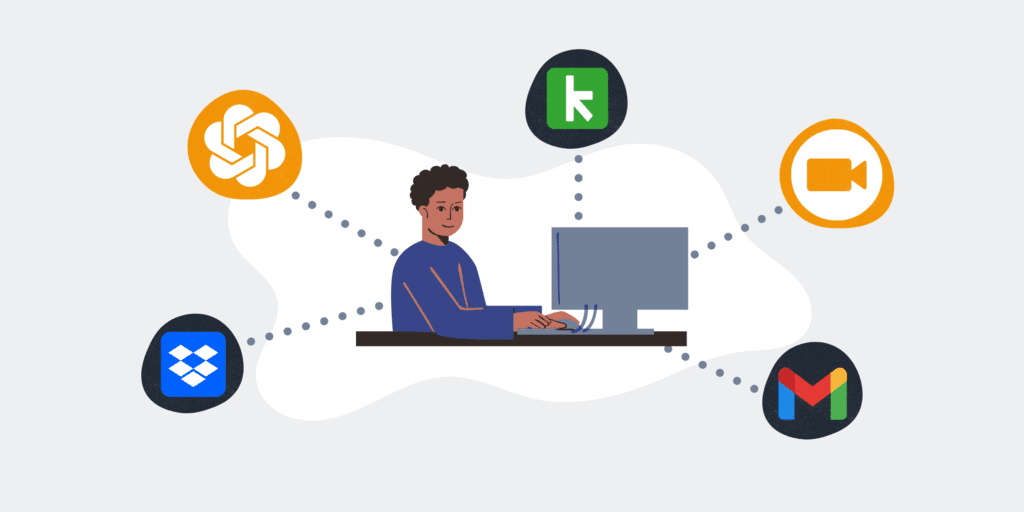
Post: The Hidden Tax on AI: Why System Integration is Non-Negotiable
The Hidden Tax of Disconnected Systems: Unlocking AI’s Potential Through Integration
In today’s hyper-connected business landscape, the promise of Artificial Intelligence is undeniable. From automating repetitive tasks to surfacing critical insights, AI holds the key to unprecedented efficiency and competitive advantage. Yet, for many high-growth B2B companies, truly harnessing this power remains an elusive goal. The culprit? A sprawling ecosystem of disconnected systems, each operating in its own silo, quietly levying a “hidden tax” on productivity and progress. This isn’t just about manual data entry; it’s about a foundational barrier that prevents your AI investments from ever reaching their full potential.
The Invisible Drain: How Siloed Systems Hinder Growth and AI Adoption
Consider the typical B2B operation: your CRM manages sales leads, your HRIS handles employee data, your project management tool tracks tasks, and your accounting software keeps the books. Each system is designed to perform a specific function well, but rarely are they designed to communicate seamlessly with each other. The result is a fragmented data landscape where critical information gets stuck, duplicated, or simply lost in translation.
This fragmentation isn’t just an inconvenience; it’s a direct impedance to growth and a significant drain on resources. High-value employees – your HR leaders, COOs, and recruitment directors – spend countless hours on mundane reconciliation, cross-referencing data, and fixing errors that arise from manual transfers. This isn’t the innovative, strategic work they were hired to do; it’s low-value work that directly impacts your bottom line and stunts your ability to scale effectively. When your systems don’t talk to each other, your team is forced to become the human middleware, an inefficient and error-prone solution.
The Cost Beyond Time: Missed Opportunities and Inaccurate Insights
Beyond the immediate time sink, the hidden tax manifests in several critical ways. Decision-making suffers when data is inconsistent or incomplete. Strategic initiatives are delayed as teams struggle to gather a holistic view of operations, customer interactions, or employee performance. More critically, the true power of AI — its ability to analyze vast datasets, identify patterns, and predict future outcomes — is severely curtailed. If your AI is only fed partial or stale data from individual systems, its insights will be, at best, limited, and at worst, misleading. You might be investing in cutting-edge AI tools, but if the underlying data infrastructure is a patchwork of disconnected islands, you’re essentially putting a Ferrari engine into a rickety cart.
For example, how can an AI-powered recruitment tool accurately predict candidate success if it doesn’t have real-time access to performance data from your HRIS, or if it can’t cross-reference a candidate’s journey from application through onboarding to current role? The answer is it can’t, or at least not optimally. The promise of predictive analytics turns into mere guesswork, undermining the very reason you invested in AI in the first place.
Integration as the Foundation for Intelligent Operations
The solution isn’t to buy more software, but to make your existing software work together. This is where strategic integration comes into play. By building robust bridges between your disparate systems, you create a unified data environment — a “single source of truth.” This foundational shift allows information to flow freely and accurately across your organization, eliminating redundant efforts and fostering real-time insights.
At 4Spot Consulting, we approach this challenge not just as a technical task, but as a strategic imperative. Our OpsMesh™ framework is designed precisely to address these integration gaps, transforming your operational chaos into a symphony of interconnected processes. We leverage powerful low-code automation platforms like Make.com to orchestrate complex workflows, ensuring that every piece of data moves efficiently and intelligently, becoming immediately available to the systems that need it, including your AI solutions.
From Manual Overload to Automated Advantage: A Real-World Impact
Consider the case of an HR tech client grappling with overwhelming manual resume intake. Before our intervention, their team spent over 150 hours per month manually parsing resumes, extracting information, and attempting to sync it across various platforms. This was a classic example of human employees performing low-value, repetitive tasks that were ripe for automation. More importantly, this manual bottleneck prevented them from leveraging AI to pre-screen candidates or personalize outreach effectively.
Using Make.com and AI enrichment tools, we implemented an automated system that streamlined the entire resume intake and parsing process. Now, when a resume arrives, it’s automatically processed, key data points are extracted by AI, and then synced directly into their Keap CRM. This eliminated over 150 hours of manual work monthly, freeing up their high-value recruiters to focus on strategic engagement and candidate experience. As our client put it, “We went from drowning in manual work to having a system that just works.” This automation not only saved time and money but also created a clean, centralized data stream, making their future AI investments far more effective.
Building Your Integrated Future with 4Spot Consulting
The era of operating with disconnected systems is drawing to a close. To truly embrace the power of AI, reduce human error, and achieve scalable growth, integration is no longer optional; it’s essential. Our OpsMap™ diagnostic is the first step in this journey—a strategic audit designed to uncover your specific inefficiencies, surface critical automation opportunities, and roadmap a future where your systems work in harmony, powering your AI and saving you 25% of your day.
Stop paying the hidden tax of disconnected systems. Start building an integrated foundation that propels your business forward. We’ve done this for countless high-growth B2B companies, and we can do it for yours.
If you would like to read more, we recommend this article: Mastering Operational Efficiency with AI: Your Blueprint for Business Transformation



RELATED POST