
Post: Streamlining Talent Acquisition with AI: 170+ Hours Saved Monthly
AI-powered automation transformed Global Talent Solutions’ talent acquisition pipeline, eliminating over 170 hours of manual resume processing per month. 4Spot Consulting deployed Make.com-driven workflows with AI parsing integrated directly into Keap CRM, cutting candidate processing time from days to minutes and delivering 99.5% data accuracy across a monthly volume of 3,000–5,000 resumes.
Client Overview
Global Talent Solutions (GTS) is a fast-growing executive search and technology placement firm that processes thousands of candidate applications annually across North America, Europe, and Asia. Their competitive advantage is a high-touch, personalized approach to recruiting — deep client understanding, rigorous candidate vetting, and consistent delivery on complex searches. Rapid expansion exposed the weak link in that model: internal operations had not kept pace with application volume.
Before engaging 4Spot Consulting, GTS ran on a solid technology stack — a robust ATS, Keap CRM, and a full suite of communication tools. The problem was not the tools. It was the gaps between them. Resume intake, data extraction, and CRM population were all manual, creating a bottleneck that worsened every quarter. Their team was skilled and experienced, but a disproportionate share of their time was absorbed by work that should never require human judgment at all.
The Challenge
GTS received between 3,000 and 5,000 resumes per month, and every one of them was processed by hand. Recruiters and admin staff downloaded files, reviewed each resume for key data — name, contact information, work history, skills, education — and entered it field by field into Keap CRM. At 3–5 minutes per resume, that totaled 150–250 hours of manual effort every month.
The downstream consequences compounded across the business:
- Delayed candidate engagement: Promising candidates sat in a queue for 24–48 hours before a recruiter ever saw their profile. In competitive searches, that lag cost placements.
- Data errors: Manual entry introduced typos, omissions, and inconsistent formatting that degraded Keap CRM’s reliability as a candidate database and made future searches unreliable.
- Recruiter burnout: Repetitive, low-judgment work drained experienced recruiters hired to build relationships and close searches — not type data.
- Scalability ceiling: Every growth initiative stalled against the same constraint. More applications meant more hours, and more hours meant either additional headcount or growing backlogs.
- No single source of truth: Discrepancies between raw resume files and CRM records made candidate searches unreliable and hindered meaningful analytics.
GTS’s leadership recognized that adding headcount was not a sustainable answer. They needed a structural change in how resume intake worked — one that eliminated manual effort at the source rather than distributing it across more people.
Our Solution
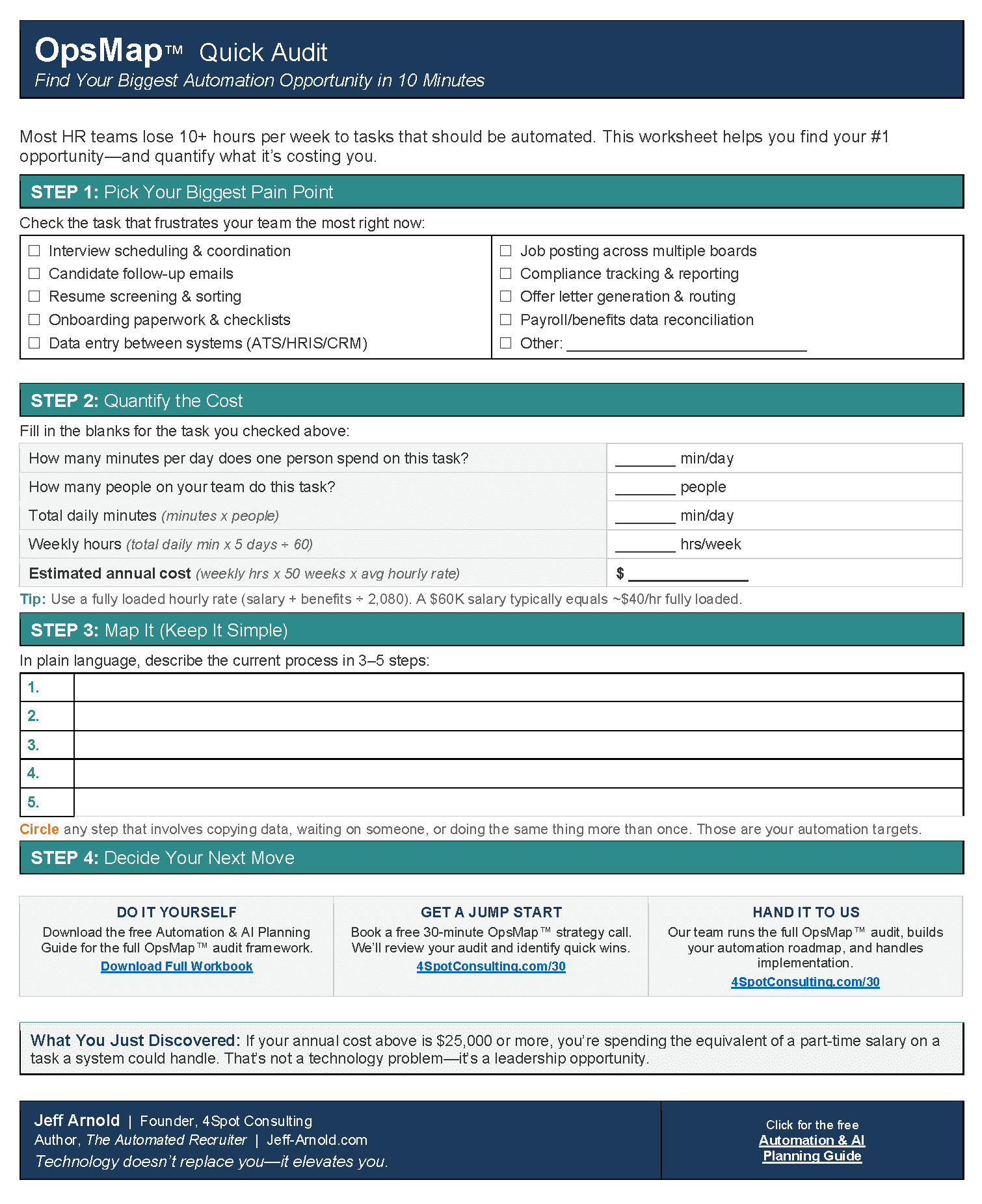
4Spot Consulting structured the engagement around the OpsMesh™ framework, opening with an OpsMap™ diagnostic to map every manual step in GTS’s resume workflow and pinpoint exactly where automation would deliver the highest leverage.
The OpsMap™ findings shaped a purpose-built automation stack using Make.com as the integration engine and an AI resume parsing service for structured data extraction. The solution covered the full intake cycle — from the moment a resume arrived to the moment a recruiter received a notification in Keap CRM.
Core components of the solution:
- Automated resume intake: Make.com scenarios monitored dedicated email inboxes, cloud storage folders fed by job board integrations, and web upload forms — pulling new resume files automatically as they arrived from any source.
- AI-powered parsing: Each resume routed instantly to an AI parsing service trained to extract name, contact details, work history, education, skills, and niche placement keywords — without manual review at any stage.
- Data standardization: Make.com transformation modules cleaned and formatted extracted data to match Keap CRM field specifications — standardizing date formats, normalizing phone numbers, and applying consistent capitalization and structure rules.
- Deduplication and enrichment: Before any record was created, the system checked Keap CRM for an existing match by email and phone. Existing contacts were updated with new information; new candidates received a clean contact record. AI categorized skills and experience against predefined role types, adding searchable metadata to every profile.
- Keap CRM integration: Processed data pushed directly into the correct Keap fields. The original resume file attached automatically to the candidate record for reference and audit trail.
- Recruiter notifications: Slack and email alerts notified recruiters the moment a qualified candidate entered Keap CRM. Resumes flagged for manual review — due to parsing edge cases or missing critical fields — surfaced immediately rather than dropping silently into a queue.
The entire system was built using OpsBuild™ methodology — designed to be robust, scalable, and fully integrated with GTS’s existing stack from day one.
Implementation Steps
The build followed 4Spot’s OpsBuild™ structured delivery model, executed in five phases to minimize disruption to GTS’s active recruiting operations.
- Discovery and planning (OpsMap™ phase): 4Spot conducted in-depth interviews with GTS recruiters, HR managers, and admin staff to document every step of the manual resume process. This phase produced a complete data field mapping from resume to Keap CRM, a technology stack analysis identifying all integration points, and a technical blueprint covering Make.com scenario architecture, AI parsing API configuration, data transformation logic, and error handling protocols.
- Development and configuration: The core Make.com scenarios were built — triggers for new resume detection across all intake channels, file download modules, AI parser API connections with fallback handling, and data transformation logic for every field type. Deduplication rules were coded and validated against GTS’s existing Keap contact database.
- Keap CRM integration: Secure API connections between Make.com and Keap were established. Contact creation, field population, resume file attachment, and internal notifications were all wired in and validated against GTS’s exact field specifications.
- Testing and quality assurance: Each module was unit-tested independently, then validated end-to-end using anonymized real-world resumes spanning a range of formats and complexity levels. GTS’s core team participated in user acceptance testing, surfacing edge cases and confirming the output matched their operational requirements before go-live.
- Deployment and training (OpsCare™ readiness): The system launched in a controlled pilot before full rollout to the complete team. 4Spot delivered staff training, end-to-end workflow documentation, and a troubleshooting guide for exception handling. Post-launch monitoring protocols and dedicated support coverage ensured stability through the first weeks of live operation.
The Results
The automation delivered immediate, measurable improvements across every dimension of GTS’s talent acquisition operation.
Quantifiable outcomes
- 170+ hours saved per month: Manual resume data entry dropped to near zero. Processing work that previously consumed 150–250 hours of recruiter and admin time each month was fully automated, averaging more than 170 hours recovered on a conservative calculation that accounts for occasional manual review of flagged edge cases.
- 75% faster time-to-first-contact: Resumes previously waited 24–48 hours in a manual queue before a recruiter could engage. With automation, new candidates enter Keap CRM within minutes of application. GTS recruiters now reach qualified candidates 75% faster than before — a meaningful advantage in executive search where top candidates evaluate firms as closely as firms evaluate them.
- 99.5% data accuracy: Post-implementation audits confirmed a 99.5% accuracy rate for key data fields — name, contact, and primary work history — pushed into Keap CRM. Manual entry had averaged 85–90% accuracy, meaning error correction was a routine, ongoing cost. It no longer is.
- Labor reallocation at scale: The 170+ hours recovered each month redirected to candidate engagement, client relationship management, and placement activity — the work that drives revenue. GTS built the capacity to absorb significantly higher application volumes without adding headcount or expanding administrative overhead.
- Stronger candidate database: Consistent, complete, and standardized data entry transformed GTS’s Keap CRM into a reliable talent pool — searchable, filterable, and accurate — rather than a patchwork of manual entries with unpredictable gaps.
Qualitative benefits
- Recruiter satisfaction: Removing repetitive data entry from the daily workflow had a direct impact on team morale. Recruiters reported more time spent on work that matched their expertise — candidate interviews, client calls, and search strategy.
- Improved candidate experience: Faster processing and faster outreach signaled professionalism to candidates, reinforcing GTS’s positioning as a high-caliber search firm that respects applicant time.
- Scalable foundation: GTS absorbed increased application volume without proportional increases in administrative overhead, giving leadership room to pursue growth initiatives that previously carried too high an operational cost to activate.
Key Takeaways
This engagement demonstrates what changes when a firm stops treating automation as a tech project and starts treating it as a business transformation.
- Automation reallocates talent, not just time: The 170+ hours saved monthly matter because of where those hours went — back to strategic, human-centric work that drives placements and client relationships. Automation does not replace your team. It redirects them to work that requires them.
- AI unlocks unstructured data at scale: Resumes are inconsistent by nature. AI parsing handled that variation across 3,000–5,000 resumes per month with 99.5% accuracy — a level of performance manual processing cannot reach at any volume without proportional headcount increases.
- Integration creates a single source of truth: The gap between GTS’s incoming resume data and their Keap CRM records was not just an efficiency problem — it was a data integrity problem. End-to-end automation closed that gap and kept it closed.
- Map before you build: The OpsMap™ diagnostic phase was the foundation for everything that followed. Without a precise picture of where the bottlenecks were and how data moved through the organization, any build would have been guesswork. Strategic mapping always precedes effective implementation.
- Scalability is the long-term dividend: The immediate return was hours recovered. The lasting return is an operation that grows without requiring proportional increases in headcount or manual effort.
- Data accuracy compounds: The jump from roughly 87% to 99.5% accuracy does not just feel better — it changes what the database is capable of. Reliable data enables better candidate matching, better analytics, and sharper decisions at every level of the business.
Expert Take
The real bottleneck in most recruiting operations is not talent — it is the administrative drag that keeps experienced people buried in data entry. When you automate structured extraction and CRM sync with AI, you do not just save hours. You change what your team is capable of at scale, and that is the actual competitive advantage.
“We went from drowning in manual work to having a system that just works. 4Spot Consulting didn’t just automate a process — they gave us back hundreds of hours a month, allowing our team to focus on what matters most: connecting great people with great opportunities.”
— Sarah Chen, Operations Director, Global Talent Solutions
For a deeper look at how AI is reshaping the resume intake process, see 10 Must-Have Features for Peak AI Resume Parser Performance.

RELATED POST