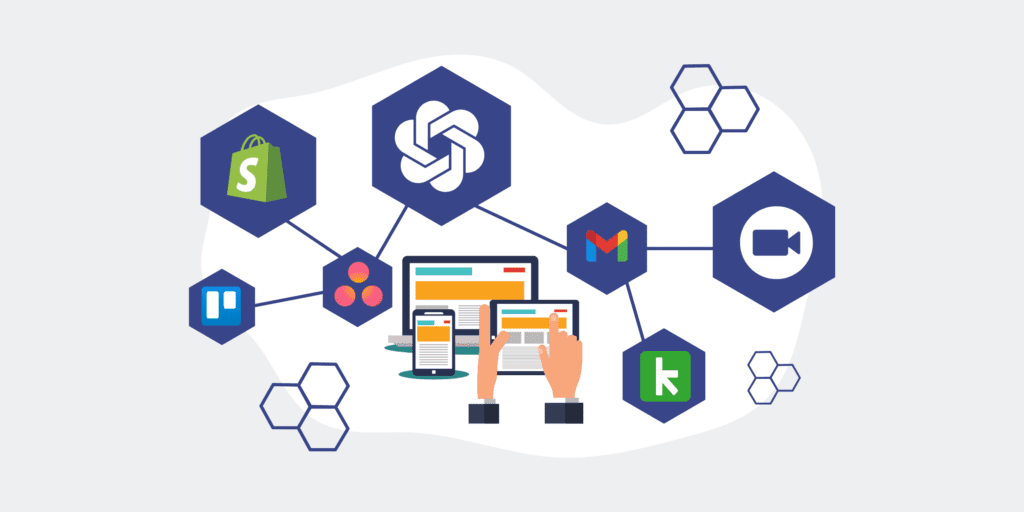
Post: AI Transforms HR: Global Talent Solutions Saves 150+ Hours Monthly
4Spot Consulting built an AI-powered resume automation pipeline for Global Talent Solutions that eliminated over 150 hours of manual data entry per month, slashed data-entry errors by 25%, and increased candidate processing throughput by 207%—all integrated natively into their Keap CRM through Make.com. The result: recruiters now spend their time on relationships, not spreadsheets.
Client Overview
Global Talent Solutions (GTS) is a multi-national HR technology firm that sources, vets, and places highly skilled professionals across IT, engineering, and healthcare. With an expanding portfolio of enterprise clients and aggressive growth targets, GTS processes hundreds of inbound applications daily across website forms, job boards, and direct referrals. As volumes climbed, their internal operations struggled to keep pace—not because of a lack of talent on their team, but because the infrastructure underneath them was built for a smaller era.
GTS had invested in Keap as their CRM backbone and relied on manual recruiter workflows to bridge the gap between inbound resumes and usable candidate data. That gap was widening. Leadership recognized that sustaining their competitive reputation for speed and precision required a fundamentally different operational model—one where automation handled the data and their people handled the relationships.
The Challenge
Manual resume processing at GTS had become a structural bottleneck that threatened both quality and growth capacity. Each inbound application triggered a chain of labor-intensive steps that consumed recruiter bandwidth and introduced compounding errors into the CRM.
- Manual Data Entry: Recruiters and admin staff hand-keyed contact details, work history, skills, and education from each resume into Keap. The process was slow, inconsistent, and prone to duplicate records and missed fields.
- Inefficient Parsing and Categorization: Without automated parsing, categorizing candidates by skill set, industry, and seniority level required individual recruiter judgment—creating an uneven, non-searchable database.
- Lack of Standardization: Different team members used different tagging conventions and job-title formats, making bulk searches and reporting unreliable.
- Missed Opportunities: A growing backlog of unprocessed resumes meant qualified candidates were invisible to recruiters, directly extending time-to-fill and costing GTS client trust.
- High Operational Costs: Senior recruiters were consumed by administrative tasks instead of strategic sourcing and candidate engagement—a costly misallocation of skilled labor.
- Scalability Constraints: Every new client engagement meant more resumes, which meant more manual hours. The only path to growth under the old model was adding headcount for data entry—an unsustainable equation.
GTS needed a partner who could architect a solution that handled high-volume intake with precision, integrated cleanly with Keap, and freed their recruiters to operate at a strategic level. That is exactly what 4Spot Consulting delivered.
Our Solution
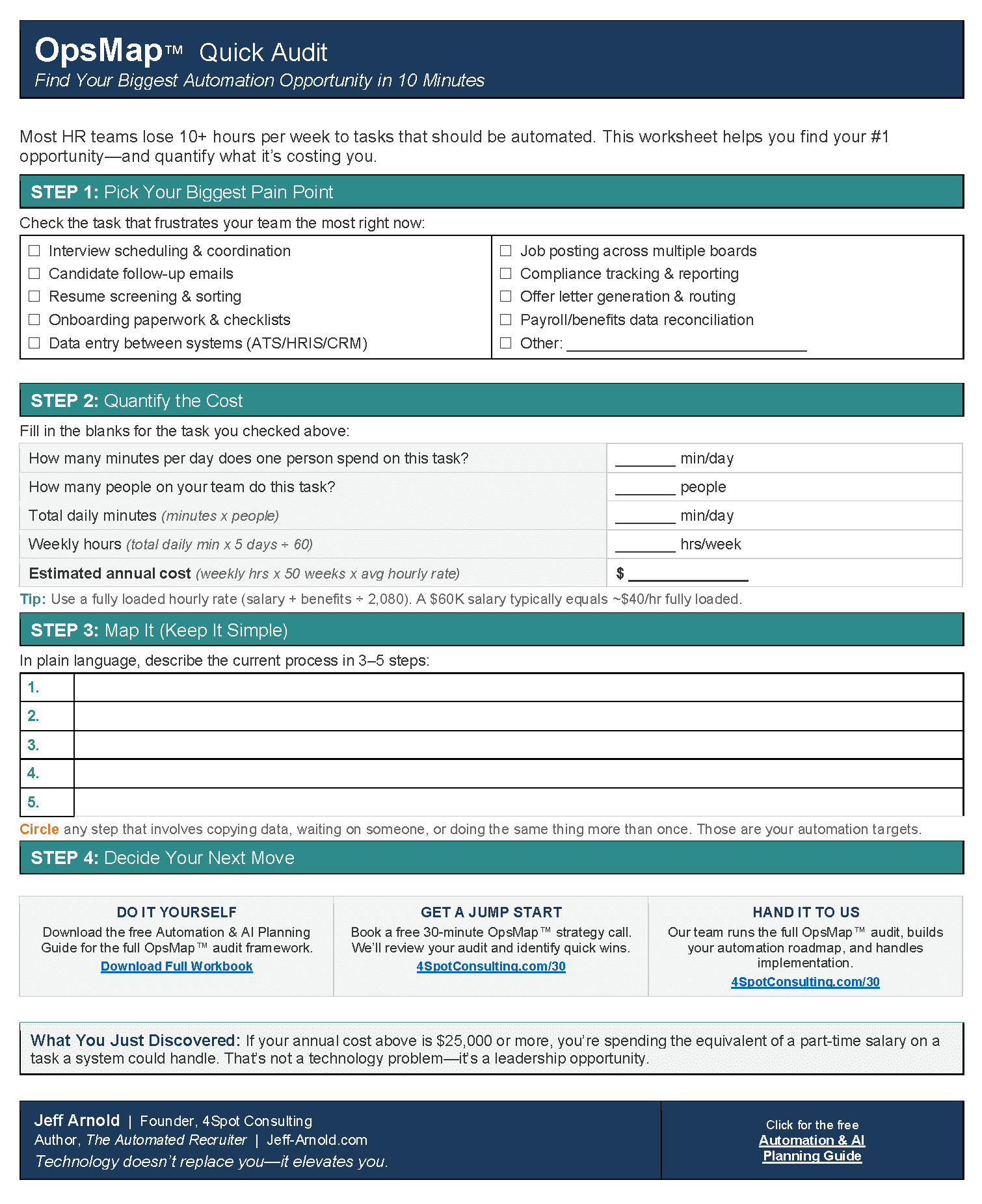
4Spot Consulting applied our OpsMap™ diagnostic framework first, conducting a deep-dive audit of every touchpoint in the GTS resume workflow before a single line of automation was written. The OpsMap™ phase surfaced the full scope of the bottleneck and defined the precise data architecture needed inside Keap to support the new pipeline.
The solution centered on a multi-stage automation engine built in Make.com, augmented by AI parsing and enrichment layers, and fully integrated with Keap CRM. Core components included:
- Centralized Ingestion: A single intake layer captured resumes from all sources—website forms, email attachments, and job board exports—ensuring every application entered the same automated pipeline.
- AI-Powered Resume Parsing: Best-in-class AI parsing extracted names, contact details, work history, skills, education, certifications, and location preferences from unstructured documents. The AI understood context, not just keywords, producing far more accurate field-level data than rule-based parsers.
- Data Normalization: Parsed output was standardized—job titles, skill nomenclature, and date formats were normalized before writing to Keap, ensuring every record entered the CRM in a consistent, searchable format.
- Automated Keap CRM Integration: Make.com scenarios created new contact records or updated existing ones, populated custom fields, applied skill and qualification tags, and linked candidates to active job requisitions—automatically.
- Deduplication and Conflict Resolution: Logic within the pipeline identified duplicate entries and either merged records or flagged them for human review, protecting the integrity of the talent database.
- Candidate Categorization and Scoring (Tier 2 AI): A second AI layer assessed each candidate profile against predefined criteria and client-specific job descriptions, applying automated seniority classifications and preliminary fit scores to accelerate shortlisting.
- Workflow Triggers and Notifications: Upon successful processing, the system fired subsequent actions—automated candidate acknowledgment emails, recruiter alerts for high-priority profiles, and initial screening sequences inside Keap.
- Error Handling and Reporting: Robust error-handling logic within Make.com caught parsing failures and integration exceptions, routing alerts to the GTS team for prompt intervention and generating regular accuracy and throughput reports.
This architecture was built and delivered under our OpsBuild™ framework, ensuring every component was documented, tested, and handed off with full operational runbooks. For ongoing performance assurance, GTS enrolled in our OpsCare™ monitoring program post-launch.
Expert Take
The compounding cost of manual data entry in high-volume recruiting environments is almost always underestimated. Organizations calculate the direct labor hours but rarely account for the downstream cost of dirty data—bad matches, failed searches, and duplicated outreach that erodes candidate trust. An automation architecture that solves intake and normalization simultaneously delivers exponentially more value than one that addresses either problem in isolation.
Implementation Process
Execution followed a structured six-phase methodology under the OpsBuild™ framework, designed to minimize operational disruption while maximizing outcome certainty.
- Discovery and OpsMap™ Audit: Workshops with GTS leadership, HR directors, and recruiting staff mapped the as-is workflow in full detail—every intake channel, manual decision point, Keap field, and error mode. Requirements for the to-be system were locked before any build work began.
- Solution Design and Architecture: Make.com was confirmed as the orchestration platform. The AI parsing engine was selected based on format versatility and extraction accuracy benchmarks against GTS resume samples. Keap’s custom field schema and tagging taxonomy were redesigned to accommodate automated data flows.
- Development and Configuration: 4Spot engineers built the full Make.com scenario set—connecting email parsing modules, document upload handlers, AI parsing APIs, and Keap CRM API calls. Internal notification routing to recruiters via email and Slack was configured for high-priority candidate flags and exception alerts.
- Testing and Quality Assurance: Unit testing validated each module individually. End-to-end testing processed large batches of representative GTS resumes across varied formats, languages, and edge cases. User Acceptance Testing (UAT) with the core recruiting team produced final adjustments before go-live approval.
- Deployment and Training: The system went live in a controlled cutover. GTS staff received hands-on training covering monitoring dashboards, exception handling procedures, and reporting interpretation. Full system documentation was delivered alongside the go-live.
- OpsCare™ Monitoring and Optimization: Post-launch, 4Spot’s OpsCare™ program provided active monitoring, performance reviews, and continuous improvement identification as GTS volumes scaled and new use cases emerged.
Results
The AI automation pipeline delivered measurable, immediate impact across every dimension of GTS’s talent acquisition operations.
- 150+ Hours Saved Per Month: Automating resume intake, parsing, and CRM entry freed between 150 and 180 recruiter hours monthly that had been consumed by repetitive administrative work. Those hours were reallocated to candidate engagement, client strategy, and talent mapping.
- 25% Reduction in Data Entry Errors: AI parsing combined with normalization logic eliminated the inconsistency and human error that previously degraded the Keap database. Accuracy rates for key data points—contact information, skill tags, experience dates—reached levels that made the talent pool reliably searchable for the first time.
- 207% Increase in Processing Speed: Resume processing dropped from minutes per record to seconds. The automated pipeline handled hundreds of applications in the time a single recruiter previously processed a handful, giving GTS a decisive speed advantage in reaching top candidates before competitors.
- Enhanced Candidate Experience: Automated acknowledgment emails went out within seconds of application receipt. Candidates experienced a faster, more professional response cycle—a direct improvement to GTS’s employer brand perception.
- Improved Talent Matching: Standardized, AI-enriched Keap data enabled precise, multi-criteria candidate searches that previously took hours of manual filtering. Recruiters identified qualified candidates in seconds, improving match quality and reducing time-to-fill.
- Unlocked Scalability: The automated pipeline removed the headcount-to-volume dependency. GTS absorbed significant application volume growth without adding administrative staff, enabling confident pursuit of new enterprise clients.
- Empowered Recruiting Team: Freed from data entry, recruiters focused on the relationship-driven, judgment-intensive work that drives placements. Team satisfaction improved and strategic output increased measurably.
“We went from drowning in manual work to having a system that just works. 4Spot Consulting didn’t just give us a tool; they gave us back our time and enabled us to focus on the human side of HR, which is invaluable.”
— Head of Talent Acquisition, Global Talent Solutions
Key Takeaways
The GTS engagement reinforces principles that apply to any HR or recruiting organization evaluating automation investment.
- Strategic Automation Is Non-Negotiable: Manual processes for high-volume, repetitive tasks drain resources, cap growth, and erode data quality. Automation is a competitive requirement, not a luxury.
- AI Amplifies Human Potential: AI does not replace recruiters—it clears the path for them to do work that requires human judgment, relationship intelligence, and strategic thinking.
- Data Integrity Drives Every Downstream Decision: Automation built on normalization and deduplication creates a single source of truth. The quality of a CRM is the quality of every search, report, and campaign that depends on it.
- Integration Multiplies Value: Standalone AI tools deliver limited returns. The compounding value emerges when AI parsing, workflow orchestration, and CRM are connected into a single end-to-end pipeline.
- Diagnostic Work Before Build Work: The OpsMap™ audit phase is not overhead—it is the foundation. Skipping it produces automation that solves the wrong problem or creates new ones.
- Define ROI Before You Build: GTS entered this engagement with clear targets: hours saved, error reduction, processing speed. Measurable objectives drove every design decision and made the outcome undeniable.
For a deeper look at how 4Spot Consulting has scaled these results across the full GTS operation, read $1.2 Million Saved: 4Spot Consulting’s AI Automation Transformation for Global Talent Solutions. To explore the broader AI applications driving results in HR and recruiting, see 10 AI Applications Empowering HR & Recruiting for Strategic ROI.
Frequently Asked Questions
How long did implementation take from OpsMap™ audit to go-live?
The full implementation—from the initial OpsMap™ diagnostic through UAT and production deployment—ran approximately six to eight weeks, depending on the complexity of Keap schema redesign and AI model calibration against GTS-specific resume formats.
Does the automation work with resumes submitted through multiple channels?
Yes. The centralized ingestion layer captures resumes from website forms, email attachments, and job board exports through a unified intake point, so every application enters the same automated pipeline regardless of source.
What happens when the AI parser encounters an unusual resume format?
The error-handling logic in Make.com catches parsing exceptions and routes them to a dedicated review queue with an automated recruiter notification. No application is silently dropped—every exception is visible and actionable.
Can the system be expanded to handle additional HR workflows beyond resume intake?
Absolutely. The Make.com and Keap architecture built for GTS serves as a scalable foundation. Additional workflows—onboarding automation, candidate re-engagement sequences, interview scheduling—connect to the same infrastructure without rebuilding from scratch.
What ongoing support does OpsCare™ provide after go-live?
OpsCare™ delivers active performance monitoring, error-rate reviews, scenario optimization as volumes scale, and proactive identification of new automation opportunities—ensuring the system evolves with the business rather than becoming obsolete.
RELATED POST