Post: How Sarah Compressed a 45-Minute Onboarding Process to Under 4 Minutes
Sarah is an HR Director at a regional healthcare organization. Her team was drowning in manual onboarding work — the kind that looks manageable on paper until you multiply it across every new hire, every week, every quarter. The process took 45 minutes per person. That time was not spent on strategy, culture, or the things HR directors are actually hired to do. It was spent filling out fields, sending the same emails, and chasing down the same signatures.
We had been tracking patterns like this in our field research on AI-assisted automation builds — specifically, what happens when you pair Make.com with an MCP-connected Claude setup and give it a well-described operational problem. Sarah’s onboarding workflow became one of our clearest examples of what that combination can do in a real HR environment.
Here is what happened, how we built it, and what it means for HR teams still running onboarding on effort and repetition.
Results at a Glance
| Metric | Before | After |
|---|---|---|
| Time to complete onboarding workflow per hire | 45 minutes | Under 4 minutes |
| IT involvement required | Yes — multiple touchpoints | Zero |
| Weekly hours reclaimed across HR | — | 12 hours |
| Time to hire (end to end) | — | Cut 60% |
What Was the Onboarding Problem, Exactly?
Sarah’s team was not broken. They were just absorbing a disproportionate share of process load that had no business requiring human attention.
Every new hire triggered the same chain of manual steps: pulling the new hire record from the ATS, entering data into the HRIS, generating the offer and onboarding documents, routing them for signature, then sending a sequence of welcome and first-day communications. Each step was done by hand. Each step was done every time.
Forty-five minutes per hire. For a team hiring at any real volume, that math compounds fast. And none of those 45 minutes involved a conversation, a decision, or anything that required Sarah’s experience or judgment. It was data movement and document generation — exactly the category of work automation was built to handle.
The secondary problem: IT was in the loop for any system-touching change. That created latency. It also created a bottleneck Sarah had no control over.
How Did We Approach the Build?
We started where we always start — with a clear picture of the current process before we touched a single tool. That means documenting every step, every handoff, every system involved, and every decision point that requires human judgment versus every step that is just execution of a rule.
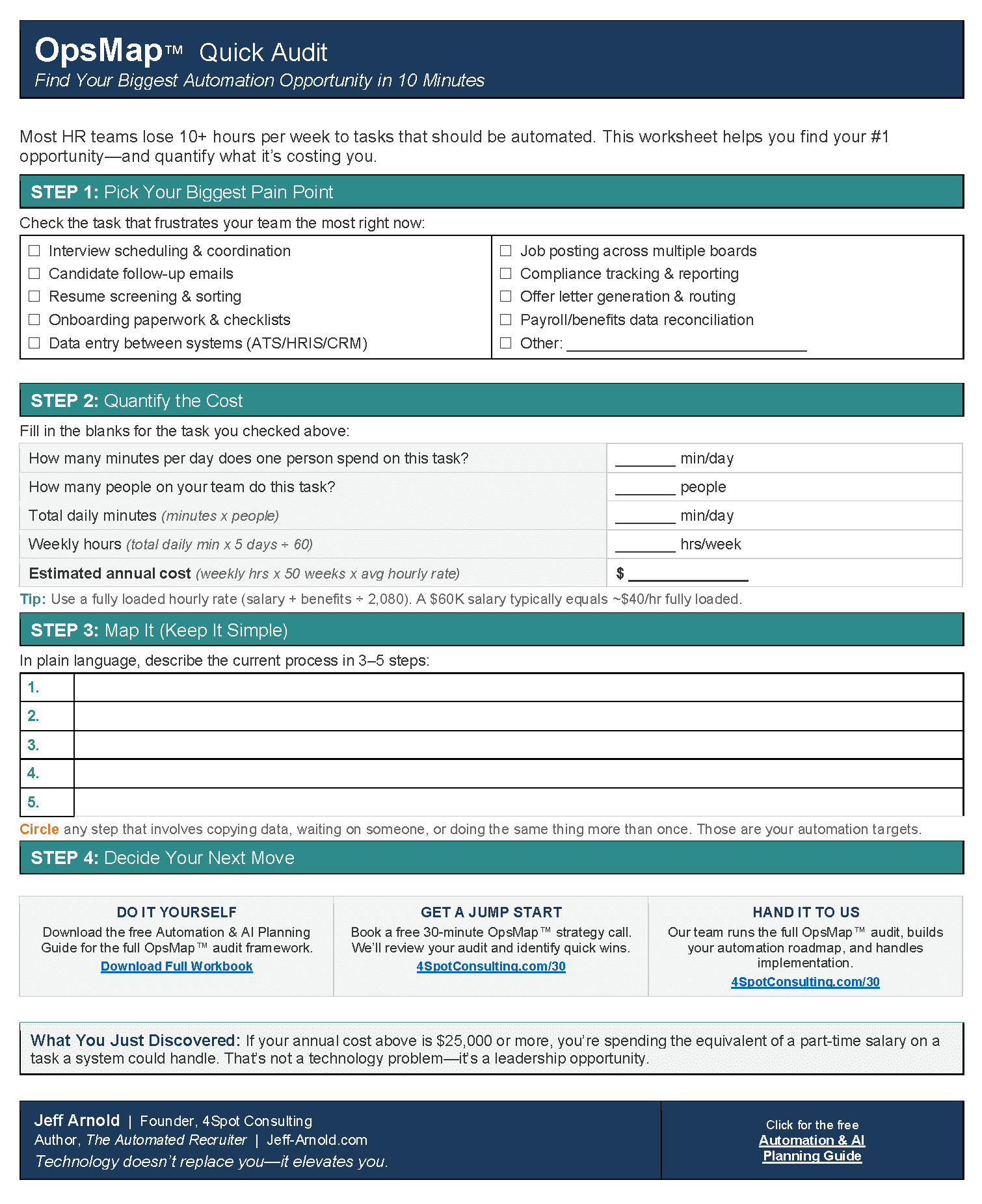
The OpsMap™ audit is how we do that. For Sarah’s team, the onboarding workflow mapped cleanly: trigger (hire confirmed in ATS) → data extraction → HRIS entry → document generation → signature routing → welcome sequence. No ambiguous decision points in the core path. That made it a strong automation candidate.
We also ran the workflow through the pre-automation checklist to confirm the process was stable enough to build on. It was. The steps were consistent, the inputs were predictable, and the outputs were rule-based. Green across the board.
From there, we scoped the build as part of the OpsBuild™ phase — identifying which tools needed to connect, what data needed to flow where, and how error handling should work when something upstream broke or was missing a field.
What Did the Implementation Look Like?
The build ran on Make.com. That was not a default choice — it was the right choice for this situation. Make’s visual canvas made the multi-step workflow easy to trace and audit. Its native modules covered most of the integrations Sarah’s team was already using. And for the one system that did not have a native Make module, we used a generic HTTP module and fed it the API documentation directly.
The scenario structure followed the process map exactly:
- A webhook trigger fired when a hire was marked confirmed in the ATS
- The scenario extracted the new hire record and mapped the relevant fields
- Data was posted to the HRIS — no manual entry, no copy-paste, no transcription risk
- Onboarding documents were generated automatically using the mapped data
- Signature requests were routed to the right parties without HR touching the queue
- A welcome sequence launched on a time-based schedule from the hire confirmation date
This is also where our MCP-assisted build approach made a real difference. We have written in detail about how Make MCP changes the build process for HR teams — but the short version is this: when you describe what you need precisely, the MCP builds the scenario structure correctly the first time. It handles the JSON formatting inside HTTP modules, infers missing context, and asks clarifying questions rather than guessing. That compressed the build timeline significantly.
Error handling was routed specifically — not a generic catch-all. If a field was missing from the ATS record, the scenario flagged the specific record and notified Sarah’s team with context, not just a failure alert. That distinction matters in production. A vague error tells you something broke. A routed error tells you what broke and where to look.
Zero IT involvement across the entire build and deployment. Sarah’s team owned it.
What Were the Results?
The onboarding workflow that took 45 minutes per hire now runs in under 4 minutes. Most of that remaining time is document generation and signature routing — systems doing work, not people.
Sarah’s team reclaimed 12 hours per week. That is not 12 hours of idle time. That is 12 hours redirected toward candidate experience, manager enablement, and the strategic work that HR leadership is actually accountable for.
Hiring time, end to end, dropped 60%. That is a downstream effect of removing the manual lag at each handoff. When the process runs automatically on confirmation, there is no queue, no wait, no follow-up email asking if the documents went out. It happened. The system logged it. Move on.
The IT dependency is gone. That is not a small thing. Every hour Sarah’s team spent waiting on IT for a system change was an hour the business was paying for delay. That friction is eliminated.
What Are the Lessons for HR Teams Considering This?
A few things stood out from this build that apply broadly.
The audit is not optional. We only got to a clean build because the process was mapped before we built anything. Automating a messy process makes the mess faster. The OpsMap audit is what separates a workflow that scales from one that breaks at volume.
Description quality determines build quality. When we used MCP-assisted build tools, the output was only as good as our process description. Vague inputs produce vague scenarios. Specific inputs — with field names, system names, trigger conditions, and error expectations spelled out — produce scenarios that work in production.
Error handling is a first-class requirement, not an afterthought. Healthcare environments have compliance exposure. A scenario that silently fails is worse than no automation at all. Routed, specific error handling — with human notification and enough context to act — is non-negotiable.
Zero IT involvement is achievable, but it requires a good platform. Make.com handled everything Sarah’s team needed without escalation. That is a function of platform capability and build quality working together. Neither alone is sufficient.
The gains compound. Twelve hours a week is the immediate number. But hiring time dropping 60% means faster time-to-start, which means faster time-to-productive. The value does not stop at the HR team.
Is This Repeatable for Other HR Teams?
Yes — with the right conditions in place. Sarah’s result was not an accident, and it was not unique to healthcare. The pattern applies anywhere onboarding follows a consistent, rule-based path: confirmed hire triggers a predictable sequence of data movement and document generation.
The variables that determine whether your team gets a similar result are process stability (is your onboarding consistent enough to automate?), system accessibility (do your tools have APIs or native integrations?), and description clarity (can you articulate the process precisely enough to build from?). If all three are yes, the build is viable.
If you are not sure, the right starting point is the OpsMap audit — not a build. You need to know what you are automating before you commit resources to building it.
Information in this article is deemed to be accurate at time of publishing. 4Spot Consulting reviews and updates content periodically as best practices evolve.