Post: 8 Traps to Avoid When Scaling Automation for Lasting ROI
Eight traps derail automation scaling programs: absent strategy, dirty data, automating broken processes, missing governance, people resistance, no error handling, zero observability, and premature scaling. Each trap compounds the others. Avoid all eight and your automation stack builds compounding ROI. Hit any one and your program stalls.
What “Scaling Automation” Actually Means
Scaling automation is the discipline of expanding a working single-process automation into an interconnected, governed, organization-wide system that produces compounding efficiency gains over time. It is not the same as deploying more automations.
A business with fifty broken automations has zero scale. A business with eight well-governed, integrated automations sharing a clean data layer is scaling. The skills required to build automation number one are almost entirely different from the skills required to build automation number twenty without creating fragility and integration debt.
The majority of automation value comes not from individual task automation but from end-to-end process integration, the kind that only becomes possible when automations share an architectural spine rather than being assembled independently.
Trap 1: No Strategy, No Defined Goals
Automation without a SMART goal framework produces tool sprawl, not ROI. When organizations automate in response to immediate pain rather than strategic priority, the result is a collection of disconnected point solutions that solve yesterday’s most visible problem while ignoring this quarter’s highest-value bottleneck.
A strategy for scaling automation answers four questions before any build begins: Which processes produce the most business value if automated? What does success look like in measurable terms? Who owns each automation and its outputs? How does this automation connect to the ones that already exist?
A working automation strategy requires:
- A prioritization matrix ranking processes by annual time cost, error rate, and integration complexity
- SMART success metrics defined before build, not after launch
- A designated automation owner for every workflow in production
- A roadmap that sequences builds by dependency, not departmental politics
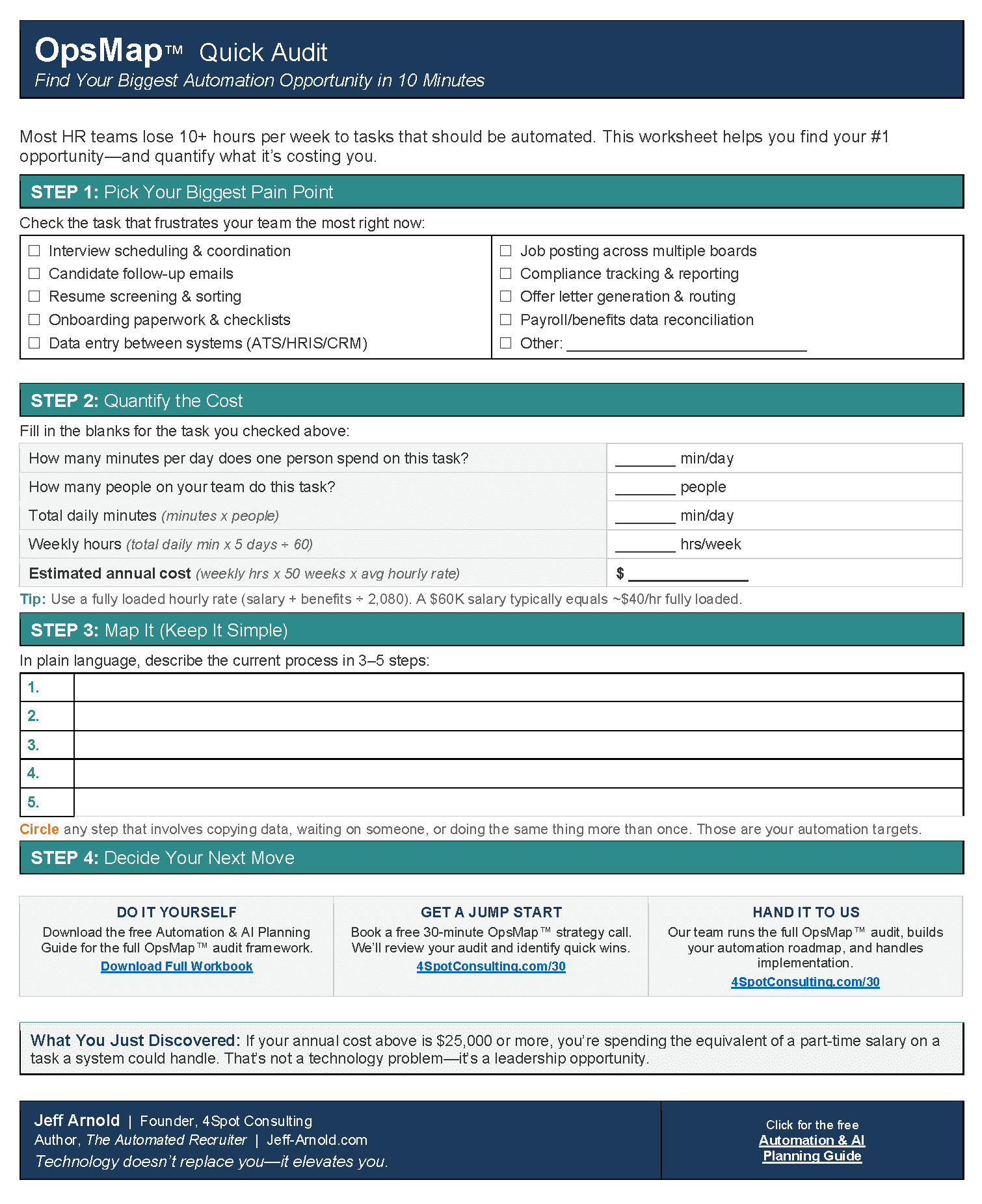
The OpsMap™ checklist is the starting framework for that prioritization exercise. Run it before the first Make.com scenario gets built.
Trap 2: Underestimating Data Quality
Automation amplifies whatever data it receives, including bad data. The MarTech 1-10-100 rule quantifies the compounding cost: preventing a data error costs one unit of effort; correcting it after the fact costs ten; failing to correct it costs one hundred in downstream business impact.
At machine speed, a field-mapping mismatch that produces a 5% manual error rate produces that same 5% error rate across every automated run, instantly, silently, at full volume. A data audit is not optional infrastructure for automation programs. It is the prerequisite.
Data quality gates to establish before scaling:
- Canonical field-mapping document across all connected systems
- Required-field validation at every data entry point
- Duplicate detection rules in your CRM before automation reads from it
- A named data steward accountable for ongoing quality
Trap 3: Automating a Broken Process
Automation does not fix process problems. It accelerates them. A hiring process that loses candidates because of three unnecessary approval layers does not improve when Make.com automates it. It loses candidates faster, at higher volume, with zero human intervention to catch the error.
The OpsMap™ discovery framework exists for exactly this reason: map the process first, fix the breakage points, then automate the repaired workflow. Every hour spent on process design before automation saves ten hours of rework after deployment. Run the audit before building any scenario that touches a customer-facing or revenue-critical process.
Trap 4: No Governance and No Documentation
Ungoverned automation accumulates debt faster than ungoverned code. When no one owns a workflow, no one patches it when an upstream API changes, no one notices when it fails silently at 2 AM, and no one knows what it was supposed to do when the person who built it leaves.
The OpsMesh™ governance layer addresses this directly: every automation in production gets a named owner, a documentation record, a version history, and a monitoring cadence. Without that structure, every new automation is a liability as much as an asset.
Minimum governance requirements for any automation in production:
- Named owner with a defined escalation path
- Plain-language description of what it does and what systems it connects
- Last-tested date recorded and tracked
- Alert destination for all failure events
Trap 5: Skipping Change Management
Automation removes tasks from people’s days, and people notice. Without deliberate change management, automation programs generate resistance, workarounds, and shadow systems that undercut efficiency gains before they show up in any metric.
The teams that scale automation successfully treat people adoption as a build step, not a communications footnote. That means involving process owners in workflow design, communicating what automation handles versus what it does not, and creating clear escalation paths for edge cases the automation does not cover.
Expert Take
The most common failure mode in scaling automation programs is not technical. It is a workflow that runs perfectly in Make.com and gets manually bypassed by the team it was built to help, because no one explained it, trained on it, or gave people a reason to trust it. Adoption is not a soft skill. It is a deployment requirement.
Trap 6: Building Without Error Handling
A Make.com scenario without error handling is not a finished automation. It is a process that runs perfectly in testing and fails silently in production. Silent failures are worse than no automation: the work appears done, no one follows up, and the error surfaces weeks later when downstream impact is already compounding.
Every external API call, every CRM write, and every file operation needs an onerror handler, at minimum a Break with retry logic and an alert route. The 4Spot standard is three retry attempts at 60-second intervals, with a Slack or email alert on final failure routed to a named owner.
Trap 7: No Monitoring or Observability
A scenario that ran successfully last Tuesday is not guaranteed to run successfully today. API endpoints change. Rate limits get hit. Upstream data formats drift. Without monitoring, none of these failures surface until a business process breaks and someone starts tracing backwards.
Observability for automation programs means three things: execution logs that are retained and searchable, failure alerts that route to a human who can act, and periodic health checks that verify integrations are still live. Make.com’s execution history gives you the first. The other two require deliberate build decisions.
Observability checklist for any production automation:
- Execution history retention enabled in Make.com
- Failure alerts routed to a named Slack channel or email address
- Monthly health check cadence on high-stakes scenarios
- A report or dashboard tracking run volume and error rate trends
Trap 8: Premature Scaling Without Validation
The pressure to scale fast after early automation wins is real, and it is where most programs accumulate the technical debt that eventually stalls them. A scenario that handles 50 records cleanly does not automatically handle 5,000 records cleanly. A workflow that works with one CRM integration does not automatically hold when three more are added.
Validate at each scale threshold before expanding. Test with production-volume data. Stress-test API rate limits. Confirm error handling holds under load. One ops team that followed this validation protocol at every layer recovered more than 100,000 annual labor hours without a single rollback event.
The alternative is a fragile stack that requires a full rebuild the moment it gets real load, and that rebuild costs more than building it right the first time.
The Right Sequence for Scaling Automation
The eight traps above share a root cause: they are all skipped steps. The solution is not more platform features. It is a reliable build sequence that holds regardless of timeline pressure.
The sequence is: map before you automate with OpsMap™, fix before you automate, govern before you scale with OpsMesh™, validate before you expand, and monitor everything in production. Businesses that follow this sequence build automation programs that compound, where each new workflow makes the existing stack more valuable rather than more fragile. That is what scaling automation actually looks like.


RELATED POST